Archive | February, 2025

Everything humans see is a simplification.

24 Feb

Everything humans see is a simplification.

A human sees the world in 3 dimensions. That is a simplification. Humans are fundamentally limited, generalizing creatures living on autopilot. Categorization is the brain’s tool to organize nearly everything we encounter in our daily lives. Grouping information into categories simplifies our complex world and helps us to react quickly and effectively to new experiences. Categorization and classification allow humans to organize things, objects, and ideas that exist around them and simplify their understanding of the world. Categorization is like your brain’s very own personal assistant, grouping similar things together so you can find what you need, when you need it.

Our brain categorizes continuously: not only chairs during childhood, but any information at any given age. What advantage does that give us? Pieter Goltstein says: “Our brain is trying to find a way to simplify and organize our world. Without categorization, we would not be able to interact with our environment as efficiently as we do.” In other words: We would have to learn for every new chair we encounter that we can sit on it. Categorizing sensory input is therefore essential for us, but the underlying processes in the brain are largely unknown.

Social categorization is a fundamental human cognitive process because it allows for the quick simplification of complex social information. Scientists at the Max Planck Institute of Neurobiology have now shown that also mice categorize surprisingly well. The researchers identified neurons encoding learned categories and thereby demonstrated how abstract information is represented at the neuronal level.

While categorization is a natural and necessary mechanism to cope with the complexity of our world, it perilously inhibits our ability to address the most pressing and tangible problems of our time. The psychological force at play here is a need to categorize — to fit things into neatly defined, clearly labeled boxes. In times of increasing complexity, such categorization can be extremely useful, creating order in a world that is fundamentally messy and establishing structures so that we can better organize, analyze, and manage it. Yet also, extremely limiting in understanding the natural deeper complexity of life.

Image

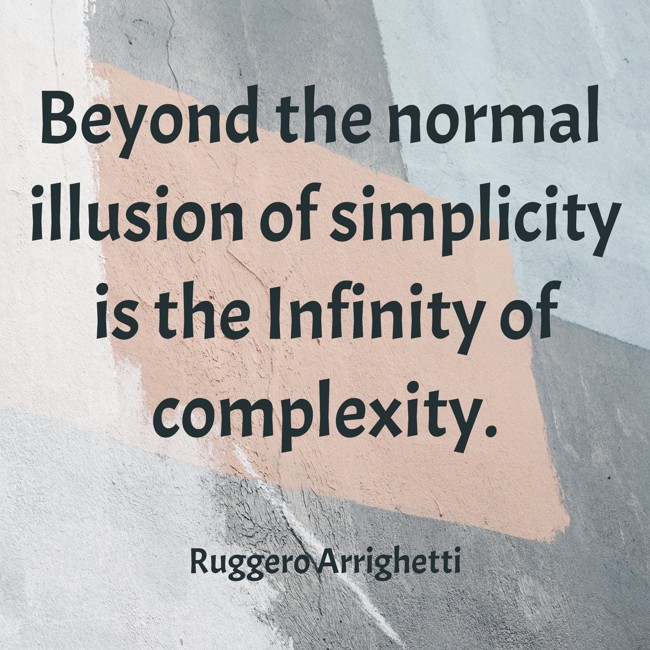
Infinity of Complexity

24 Feb

Astronomer says We Are All Made of Stardust

23 Feb

All humans, plants, animals and the Earth itself are built from the ashes left behind after the death of stars. We are fashioned from the nuclear waste that remains after massive stellar explosions. You Are Made of Stardust
“Every atom we are made of has an origin that can be traced back to before the solar system was formed,” Prof Sir Martin Rees said to a full house at the Royal Irish Academy in Dublin. “We are literally the ashes of dead stars or the nuclear waste left behind.”
 “The thing we learn from astronomy is we shouldn’t think of a culmination,” he said. “The universe may have an infinite life ahead of it.”

Though the billions of people on Earth may come from different areas, we share a common heritage: we are all made of stardust! From the carbon in our DNA to the calcium in our bones, nearly all of the elements in our bodies were forged in the fiery hearts and death throes of stars. The building blocks for humans, and even our planet, wouldn’t exist if it weren’t for stars. If we could rewind the universe back almost to the very beginning, we would just see a sea of hydrogen, helium, and a tiny bit of lithium.

Prof Sir Martin Rees also suggested that, although very small compared to the rest of the universe, the Earth may be very important in cosmological terms as the place where sentient life originated before being dispersed to other planets.

Image

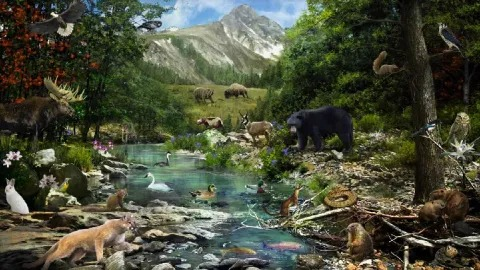
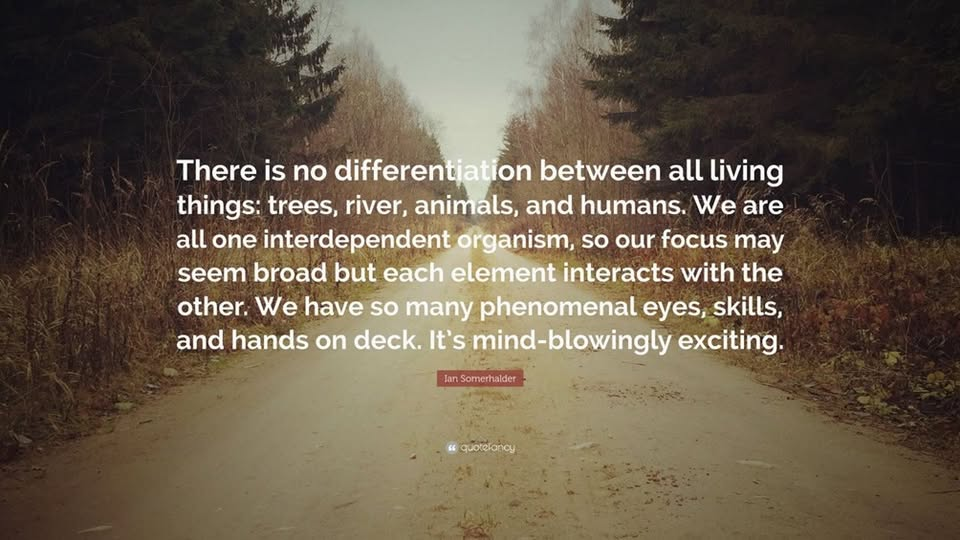
All Living Things: One Interdependent Organism

23 Feb

The Age of the universe

23 Feb

The Age of the universe is estimated at 26.7 billion years. According to the study’s author, Rajendra Gupta, a physics professor at the University of Ottawa, their newly-devised model indicates that the universe is 26.7 billion years old, older than the previous estimate of 13.7 billion years.

And yet, In a few billion years, our sun will become a red giant so large that it will engulf our planet. But the Earth will become uninhabitable much sooner than that. After about a billion years the sun will become hot enough to boil our oceans.

The sun is currently classified as a “main sequence” star. This means that it is in the most stable part of its life, converting the hydrogen present in its core into helium. For a star the size of ours, this phase lasts a little over 8 billion years. Our solar system is just over 4.5 billion years old, so the sun is slightly more than halfway through its stable lifetime.

And life on earth has of course a much briefer existence…It is standard for every organism to burn out. The lifespan of a living organism is considered the period between its birth and death. While a few die just under 24 hours, some can outlive many generations. The biological ageing of animals involves the decline of a diverse range of bodily functions. Lifespan is marked by several conditions – one of the most prominent ones being heredity. While the upper age limit of an animal can be affected by its environmental conditions, species cannot age beyond a specific age, even under the most permissible conditions.

For example,

  • There are almost 8 billion (8*109) people with an average lifespan of 70 years.
  • There are about 130 billion (130*109) mammals in the world, with average lifespans from ~5 days (rodents) to ~200 years (whales).
  • There’s about 3 trillion (3*1012) trees in the world with lifespans from 50 years to several thousand years.
  • There are an estimated 10 quintillion (10*1018) insects in the world, with most lifespans shorter than a year.
  • There are an estimated five million trillion trillion (5*1030) bacteria in the world, with an average lifespan of less than a day.

We can look at these numbers based on their orders of magnitude alone, since the numbers are so large. Since there are overwhelmingly more bacteria on the planet than any other type of organism, the global lifespan average will get skewed towards the average lifespan of a bacteria, which is short.

So two things should be borne in mind. First, that all the cycles of creation since the beginning of time exhibit the same recurring pattern, so that it can make no difference whether you watch the identical spectacle for a hundred years, or for two hundred, or forever. Secondly, when the longest-and the shortest-lived of us come to die, their loss is precisely equal. For the sole thing of which any man can be deprived is the present; since this is all he owns, and nobody can lose what is not his. Marcus Aurelius

Carl Sagan: Science is not only compatible with spirituality; it is a profound source of spirituality

23 Feb

Science is not only compatible with spirituality; it is a profound source of spirituality. When we recognize our place in an immensity of light?years and in the passage of ages, when we grasp the intricacy, beauty, and subtlety of life, then that soaring feeling, that sense of elation and humility combined, is surely spiritual. So are our emotions in the presence of great art or music or literature, or acts of exemplary selfless courage such as those of Mohandas Gandhi or Martin Luther King, Jr. The notion that science and spirituality are somehow mutually exclusive does a disservice to both.–

Carl Sagan, The Demon-Haunted World: Science as a Candle in the Dark

Preface and Chapter 1 Introduction, Of the Book, God is No-thing. The Apophatic Assertion, TheSalvation for Humankind – revised 2022

10 Feb

Preface and Chapter 1 Introduction, Of the Book, God is No-thing. The Apophatic Assertion, The
Salvation for Humankind – revised -. Copyright Rodger Ricketts Psy.D.,2022. All rights reserved.
Protected by international copyright conventions. No part of this chapter may be reproduced in any
manner whatsoever, or stored in a retrieval system or transmitted, without express permission of the
Author publisher, except in case of brief quotations with due acknowledgement. Publisher
CreateSpace Independent Publishing Platform

Preface
After 40 years of active study and practice on the Buddha’s teachings and
having written four books on what I call ‘Buddha-inspired psychology,’ I
recently found a very insightful perspective that expanded what I had
learned before. The perspective is that the Buddha’s teachings are a form of
Apophatic Theology, thereby; they inherently undercut any easy attempts at
codification. The revelation of Emptiness or Sunyata with the Divine is
experienced rather than defined and categorized through limited language
descriptions. With such an emphasis on first-hand, personal experience, the
insight of intrinsic nature through Awakening runs contrary to the abstract,
‘positive’ Cataphatic theology. This book is a unique and cogent perspective
that investigates and promotes the Buddha’s teachings as a ‘negative’,
Apophatic theology.
While there are scholarly books and research articles on the topic of
Apophatic theology, very few incorporate the Buddha’s teachings and
scientific thought. In this book, I aspire to show that indeed the Buddha’s
and science’s teachings and insights can be succinctly integrated into the
Apophatic spiritual tradition that spans cultures and time. Within the larger
scope of the canons of ‘via negativa’, the Buddha’s teachings of
Nothingness or Emptiness or Sunyata and recent scientific insights are
clearly a part of the Apophatic spiritual tradition.
This revised book goes beyond what was in the first edition and instructs the
reader even more deeply about the topic. From a broad, modern perspective,
my aim is to make accessible for those who are on their own spiritual path
of personal discovery the universal teachings of the Buddha.
I have always appreciated that the Buddha taught universal truths that are
applicable everywhere and throughout time. The integration of these truths
with other teachers of Apophatic theology has affirmed my belief in this
universality. Even with my forty years of research studies, attendance of
temple retreats with monks and lay lectures and meditation practice, I have
only now found this instructive link between the Buddha’s teachings with
other teachers of the Apophatic tradition. I want to share these insights with
my fellow spiritual path voyagers. I believe they too will find it as
interesting and illuminating as I have.
Chapter One
Introduction
In the past 40 years as a clinical psychologist and student of the Buddha, I
became aware of the many similarities between the two studies. This
awareness led me to successfully integrate both in my own life and clinical
practice the benefits of combining the perspectives. As a result, I have
written four books explaining my perspective on the Buddha’s psychological
benefits for wellness and happiness.
In the past year, I learned Apophatic theology or Apophaticism. This
research introduced me to Western and other Apophatic writers resulting in
my defining the Buddha’s teachings as an example of a mystical or
Apophatic perspective.
There are clear similarities between the Buddha’s writing and Angelus
Silesius and other Apophatic theology writers. While there is some
scholarship about this similarity, unfortunately, it is rarely discussed in
either mainstream Buddhist or Christian literature. This lack of discussion
prompted me to integrate relevant aspects of my previous writings on the
Buddha’s teachings with the Apophatic perspectives and highlight what I
believe are important correspondences.
In the past, I had read some works of Christian Mystics like Meister Eckhart
and the book of the Cloud of Unknowing, but I never was specifically
introduced to the Apophatic tradition. This past year as I began to read the
Apophatic works of Angelus Silesius and Anicius Manlius Severinus
Boethius, I realized that the Buddha’s teachings could be rightly considered
Apophatic. This realization opened a new dimension of comprehension and
relevance for me about what I had written in my previous books and essays
on the Buddha’s teachings.
Apophaticism wonders how to speak about the indescribable or immanent
Existence or Absolute, instead of the common use of the pronoun or noun,
like ‘God’ or an equivalent – with its language/meaning associations or
exaggerations attached to it. The Apophatic writers prefer to use the
reference of Mysterious or No-thing. Philosopher Mulla Rajab affirmed
“…an unqualifiable and attribute-less nature of ‘God’.”
Also, philosopher Maimonides explained that ‘God’ must be free of
properties and is thus unlike anything else and indescribable. At times in my
chapters, I have used the designation of (X) instead of ‘God,’ etc., to avoid
this quandary. As the reader goes through the chapters in this book, they will
soon understand further this dilemma of designation, which is a useful
lesson in Apophatic theology.
In the following chapters, the reader will notice that I have placed emphasis
on the Buddha’s teachings throughout because I have found his ancient
teachings have the most in-depth and complete analysis of an Apophatic
training and perspective. These chapters about the Buddha’s teachings and
Apophatic writings, while not encyclopedic, are not only for intellectual
curiosity but as a living testament of truth with positive consequences not
only for the wellness and well-being of the individual but for society and the
whole Gaia. When understood and incorporated into one’s life, this is
enlightening. Clearly, in this book I inform and advocate.
To conclude, with this book’s analysis of the Apophatic, the Buddha’s
teaching and modern scientific insights, one develops a cogent scientific and
modern understanding of the inherent restrictions to fully comprehend the
mysterious nature of existence or Being. The middle way is an alternative
term for the Eightfold Path, and we do not hold extreme positions in any
way. When all words collapse into silence, we resist labeling that Wonder
with another name; therefore, we realize that we can only say ‘it is what it
is.’
Everything is impermanent and interacting with all. It is all like a flame
feeding from the original source but soon to extinguish. All form is brief and
a manifestation of the great mysterious source. Rodger R Ricketts
The student asked the teacher, ‘What is the meaning of life?’ The teacher
replied, ‘Life is the meaning. Nurture the gift of life in yourself and other
sentient beings. Support the inherent will to survive and thrive within the
natural residence of the ecosystems of existence. Be kind and wise.’ Rodger
R Ricketts

Image

Interdependent and Interconnected

6 Feb
Image

Forms Change but Essence Remains…

6 Feb
Image

TAO…

6 Feb