The Lakota phrase Mitákuye Oyás’iŋ describes Reality by addressing it as “All My Relations.” All humans, all animals, all plants, all the waters, the soil, the stones, the mountains, the grasslands, the winds, the clouds and storms, the sun and moon, stars and planets are our relations and are relations to one another. We are connected to each other in multiple and vital ways. When one is in pain, all are harmed. When there is justice for one, there is more justice for all.
It is time for the dominant culture to finally learn that its people cannot harm those it deems lesser than themselves simply because it wants to and can. This is, simply, wrong. It violates the fundamental nature of reality. Actions that violate the fundamental nature of reality build tension into the system that eventually causes a loss of balance and a rebound of consequence to those who broke natural law. This is true whether the ones being unjustly persecuted and abused are human beings whose color or religious beliefs are not those of the dominant culture, or parts of the natural world that those of the dominant culture judge as insentient or even not-living. In all these cases, the dominant culture judges these “others” as unacceptable or lesser than themselves, and therefore undeserving of respect and reciprocity.
Being “woke” is not simply a matter of learning what words to speak. Truly right words can only come from a heart that is open to the living world’s grief, that is willing to be broken by the pain of this grief. Such a heart experiences the pain that all the rest of creation has suffered for generations upon generations, and in doing this it helps to share and bear that burden. Only then, once the true heart has shattered from this pain, can Real Knowledge flow into it. It enters through the spaces between the shattered fragments. This is the pathway to true healing, for that heart and the heart of creation itself.
===Notes about the translation and meaning of Mitákuye Oyás’iŋ:
Although “All Our Relations” is the most common translation of Mitákuye Oyás’iŋ — even Vine Deloria, Jr. defines it as such in his books — the phrase actually bears within it rich layers of additional meaning that cannot be easily translated into English. It’s important to point this out because words and ideas, stories and rituals, are bound together into a single reality that must be respected, not misappropriate. In the video, the late Sicungu Lakota Elder Albert White Hat, a friend who was on Tapestry’s board for many years, explains this matter of language and concept being inextricably interwoven.
The Native relationship to nature is revealed in Native hunting and food-growing practices. It is believed that the animals we hunt, whom we view as our relatives, offer themselves to us as an act of Metta. In return, the hunter must do something for the animal, for instance a deer dance or buffalo dance, to thank the animal and pray for regeneration of the animal’s family. When it comes to the food that we grow, we have dances and seasonal fertility rituals, which are ceremonies that bring us into direct relationship with the spirit of plants and Earth consciousness.
I see the whole Native way as realizing our relationship with everything and ourselves as an integral part of all things, which in turn causes us to treat the Earth and other forms of life with respect, as part of our family. Western civilization is finally recognizing that relationship. Suddenly people are saying that the Earth is alive and talking about Gaia and holistic worldviews and systems theory. Native people are basically saying, “Yes, welcome home.”
The Indian elders say, “We must remember also the four-footed, those who swim and those who fly, those who crawl and those who move very slowly like the stone people, and all the green and growing things.” Within this sacred circle we are one. What we do affects everyone, everything. These great teachings remind us of our responsibility to care for all life. In our pursuit of progress and comfort we have separated ourselves from our place in this great circle. Earth traditions bring us back into harmony and balance within the circle.The Lakota end all prayers with “O Mitakuye Oyasin,” meaning “I do this for all my relations (or all sentient beings).” Dualism happens when egocentricity develops, creating a split with nature, each other and all life. When I was departing for a yearlong retreat in the Tibetan Buddhist tradition, I told the medicine woman Bertha Grove, “I’ll be alone for a long time.” She replied, “You’re not going to be alone. When you go outside and look around, you won’t feel alone at all. You’ll be completely accompanied by the trees, the plants, the birds and the animals.” For many years, I had learned about nonduality and the teachings of integration, but Grove’s way of saying it was like a direct transmission.
Animism flows from the belief that everything is part of an interconnected web of life. It is deeply embedded in many indigenous worldviews and as well as nondual meditation traditions from Tibet, India, China and Egypt. Both animism and nonduality share some profound philosophical and experiential similarities.
While not explicitly labeled as apophatic, many indigenous religions share core principles with apophatic theology, particularly in their emphasis on the mystery of the divine, the limitations of human language, and the importance of direct experience. The apophatic lens can offer a valuable framework for understanding and appreciating the diverse spiritual expressions found in indigenous cultures. The concept of the “Unknown God” in ancient Egyptian religion, and the debate among scholars about whether it was monotheistic, henotheistic, or polytheistic, can be seen as related to apophatic ideas, as it acknowledges a divine reality beyond human comprehension. How it Relates to Indigenous Religions:
While apophatic theology is primarily associated with specific theological traditions like Christian mysticism and negative theology within Hinduism and Islam, its core principles resonate with some aspects of indigenous religions.
- Emphasis on Mystery:
- Many indigenous traditions emphasize the sacredness and mystery of the natural world and the divine, often employing symbolic language and ritual practices that point to something beyond literal explanation.
- Reverence for Nature:
- Indigenous religions often have a deep connection with the natural world, viewing it as imbued with spiritual power and interconnectedness, which can be seen as an expression of the divine in a way that transcends human concepts.
- Oral Traditions:
Many indigenous traditions rely on oral traditions and stories, which often utilize metaphors and symbolism to convey spiritual truths, rather than relying on propositional statements.
- Focus on Experience:
Indigenous spiritual practices often prioritize direct experience and personal connection with the spiritual realm, rather than relying solely on abstract theological doctrines.
Both challenge the rigid subject-object dualism and reductionist materialism that dominate modern thought and instead present an interconnected, holistic and kinship-based worldview and an embodied experience of existence.
I believe our ecological crisis of climate change and biodiversity collapse is ultimately a crisis of consciousness. Our disconnection from nature fuels both ecological collapse and a mental health epidemic. Reclaiming the felt sense of interconnectedness found in animism and nonduality is a powerful antidote to our alienation.
I have found that practicing nondual awareness and spending more time outdoors exploring with mindful awareness practices can dramatically reduce self-reflective overthinking, help to get to the root of today’s existential anxiety epidemic and heal our alienation from nature. Through nondual awareness practices, we can start to feel a deeply rooted sense of aliveness and kinship with all other living beings. In animistic cosmology, we are not separate from nature and we exist within a kinship worldview where we feel fundamentally at home in this world. In animism, there is no strict division between self and nature; rather, existence is participatory. The forest is not just a backdrop for people but a dynamic, intelligent presence.
Posted in Tapestry on June 12, 2020 by Dawn

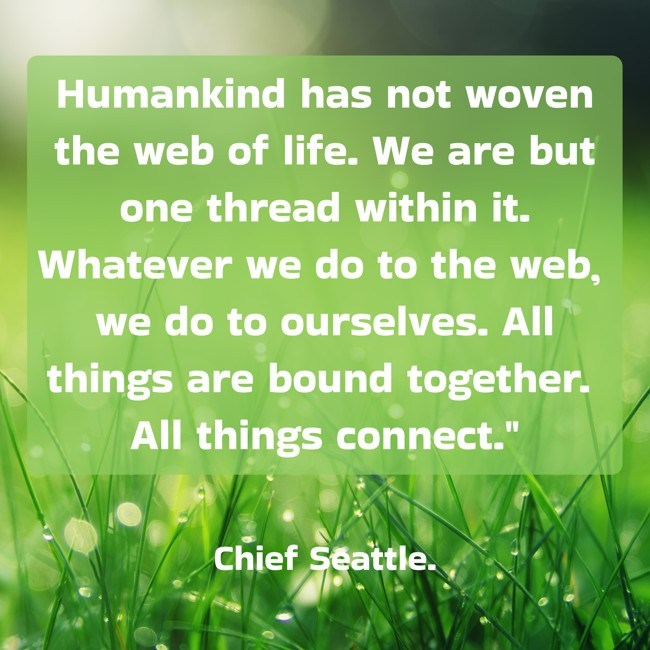
 We are all Interconnected even with the Universe