Archive | Unknowable RSS feed for this section

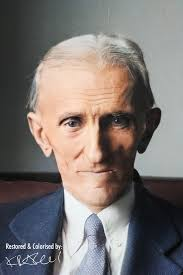
‘If you want to find the secrets of the universe, think in terms of energy, frequency and vibration’. A few examples of engineer and mathematician Nicola Tesla’s Reflections on the Mind.

16 Jun

Here are some examples of Tesla’s viewpoint. In a speech, Nicola Tesla said, ‘The sources of energy capable of transforming humanity have long been near us in nature itself, in human emotions, in the sound of music, in the breath of the earth.’ He said that mankind had searched for power outside itself for too long forgetting that it is found within. ‘I believe that the energy that feeds the universe is not just a physical resource. It is something greater. We call it ether. Some call it the divine spark or the essence, they are all the same. All living things are nourished by this force. It is hidden in the depths of the planet, in the structures of light, in the harmony of sounds and in thoughts.’ He claimed that one day this energy would become the foundation of new technologies capable of feeding the hungry, healing the sick, and eliminating the need for destructive sources of energy.

 Tesla noted with sorrow that in his time, society was not ready to accept such ideas. There were too much politics, greed and fear of the unknown in the world.In his view no religion can claim to be the absolute truth. He asserted that all of them are reflections of the same human desire to understand the source of life and one’s purpose. Religions and philosophies are attempts to explain the infinite with finite words. They may be useful, but they have no significance on the scale of the universe. ‘God, as I understand him, is an infinite force. It is the energy from which everything originated. But it does not judge. It does not punish. It simply exists.’ said Tesla.

During an interview that Tesla granted to a journalist in the year 1930, he said:’We are just waves in time and space, changing continuously, and the illusion of individuality is produced through the concatenation of the rapidly succeeding phases of existence’; ‘My brain is only a receiver, in the Universe there is a core from which we obtain knowledge, strength and inspiration. I have not penetrated in the secrets of this core, but I know that it exists’; ‘We are all one. Only egos, beliefs, and fears separate us’; He added ’None of those who ever lived have truly died because energy is eternal and life is a form of energy. The body departs but the essence itself, the vibration itself does not disappear.’

These ideas, of course, resonate with spiritual teachings, but Tesla emphasized he arrived at them not through faith but through science. And at the same time, he did not deny the divine. God is light, it is the primary energy from which everything began. This light has no form. It requires no worship. It simply exists. It is in everything, in us, in the air, in the stars. People assign human traits to God to make it easier to understand. But the true power of God lies in his impersonality and infinity.

Then the interview returned to the topic of death. Tesla said he was not afraid of it because death is not the end but a return. He compared it to how a wave returns to the ocean. You will not die because you were never born. You have always existed in one form or another. We are only temporarily in these bodies, in this world. When everything ends we will simply move to another state. Everything is energy and it never disappears.

Sense Perception and Reality

7 Jun

Rochelle Forrester Copyright © 2015 Rochelle Forrester
All Rights Reserved

A more formally logical way of presenting the above argument,with”a world”being defined
as that which can be perceived by a conscious being through its senses, is as follows:

1)There is no way in which we can know the world,other thant hrough our senses.Theonly
reality we can know is phenomena.
2) Our senses give us only some information about the world.
3)The things we can perceive can beconsidered to be in our world, the things we cannot
perceive can be considered to be in other or different worlds.
Therefore
4) As there are many things we cannot perceive there are many worlds other than our own.
5)There is no reason to consider that any world is more real,more true or more valid than any
other world.
6)If there is no reason to believe anyone world is truer or more real than any other,theyc an
only be treated as equally true or real.
Therefore
7) Any one world is as valid and real and true as any other.
8) There is a wide variety of senses and each sense has thresholds which limit perception.
Therefore
9) There must be a wide variety of worlds.
10) As the senses of different people and species overlap some of the worlds overlap.
11)As any being may hav esenses which are quite unlike those of anyother being manyof
these worlds will not over lap.Such beings will live in totally separate worlds from those o fother
beings.
12)There seems to be no reason to believe there is a finite limit on the range of potential
sense organs.
Therefore
13) There is no finite limit on the number of potential worlds that may exist.

Reality appears to consist of a vast number,possibly an infinite number,of sensory worlds.
Each person has their own individual world.This is the world they perceive which is always different
from the world perceived by others.Variations exist from person to person due to each person
occupying different points in time and space and due to the qualityof the individual person’s sense
organs.Each species has its own world due to the tendency fo rmembers of each species to have the
same sense organs which will tend to function in a similar way within each member of the species.
There seems to be no good reason for favoring any one of these sensory worlds over any other of
them. It seems impossible to claim that the human view of the world has any special claim to validity
when an alteration of our senses will give us different sense perceptions.How can you say what you
perceive is,when the samething can be perceived with different sense organs and it can be something
quite different? If the human view was to b epreferred it would be no more than a case of a human
centric view of the world that is not capable of any real justification
.

Biodance – the endless exchange of the elements of living things

31 May

Biodance – the endless exchange of the elements of living things with the earth itself – proceeds silently, giving us no hint that it is happening. It is a dervish dance, animated and purposeful and disciplined; and it is a dance in which every living organism participates. These observations simply defy any definition of a static and fixed body. Even our genes, our claim to biologic individuality, constantly dissolve and are renewed. We are in a persistent equilibrium with the earth. Yet the boundary of our body has to be extended even farther than the earth itself. We know that certain elements in our body, such as the phosphorus in our bones, were formed at an earlier stage in the evolution of our galaxy. Like many elements in the earth’s crust, it was cycled through the lifetime of several stars before appearing terrestrially, eventually finding its way into our body. A strictly bounded body does not exist. The concept of a physical I that is fixed in space and that endures in time is at odds with our knowledge that living structures are richly connected with the world around them. Our roots go deep; we are anchored in the stars.’

“Each body structure has its own rate of reformation: the lining of the stomach renews itself in a week; the skin is entirely replaced in a month; the liver is regenerated in six weeks. Some tissue is relatively resistant to the constant turnover, such as the supporting tissue called collagen and the iron in the blood’s hemoglobin molecules. But even though these rates of replacement differ, after five years one can presume that the entire body is renewed even to the very last atom.”

Dr. Larry Dossey

Fascinating and Mysterious Existence

16 Mar

In the year 2015 I wrote the first paragraphs here as a blog. Later in researching and writing my latest book; The Garden of Eden- In this Life ( September, 2025) I included Rochelle Forrester’s writings supporting my proposals in my original blog.

Fascinating and Mysterious Life

“Behind anything that can be experienced there is something that the mind cannot grasp and whose beauty and sublimity reaches us only indirectly and as a feeble reflection.”

~ Albert Einstein ~

This short essay takes serious the advice of Albert Einstein and will satisfactorily clarify the title in a couple of paragraphs. One of the topics that I discussed in my books, The Teachings of the Buddha: Seeing Without Illusion and The Buddha’s Radical Psychology: An Exploration is that we and all living beings are confronted with the fact that because of our evolutionary biological constitution we are like the men of the well-known ‘Blind Men and Elephant’ parable. The story goes that a long time ago a raja gather together all the men of a town who were congenitally blind. He presented to each man different parts of the elephant: to one the head of the elephant, to another its ears, to another a tusk, to another the trunk, the foot, back, tail, and tuft of the tail, saying to each one that that was the elephant. Then he asked each to describe the elephant. The men who were presented with the head answered, ‘Sire, an elephant is like a pot.’ And the men who had inspected the ear replied, ‘An elephant is like a winnowing basket.’ Those who had been presented with a tusk said it was a plowshare. Those who knew only the trunk said it was a plough; others said the body was a granary; the foot, a pillar; the back, a mortar; the tail, a pestle, etc. Then they began to quarrel, shouting, ‘Yes it is!’ ‘No, it is not!’ ‘An elephant is not that!’ ‘Yes, it’s like that!’ and so on, till they came to blows over the matter.

Now this parable has two lessons: one is that of the nature of dogmatic points of view and more for this essay the nature of knowledge. For if the elephant represents existence in the sense of the external environment, human beings are like the blind men of the story when it comes to comprehending the nature of existence. We can’t understand yet we keep thinking we can. Also for some this has the consequence of dogmatic thinking.

The reason we can’t know the veiled nature of existence is really quite obvious and depends on only two factors. The first and primary factor is that we are physical beings and as physical beings, we interact and input the sense data from the external environment through a highly selective physical apparatus – our body. We, and by the nature of it, all physical beings, have by necessity certain senses which have adapted over our evolutionary history to be sensitive to only a very restricted range of available sense data. It is through this highly limited input of the overall possible data that we then construct with our cognitive apparatus our ‘world’ or our personal idiosyncratic significance and meaning of the external world. In fact, this construction is an illusion of the veiled reality of existence and is dependent on our particular species nervous system and brain structure.

Therefore, we see that existence which is our ‘grounding’ is inscrutable and unknowable. Just to give a few examples of our very limited range of the known frequencies in the universe – we might not be aware of many other existent manifestations – what we call visible light is just one ten-billionth of the electromagnetic radiation spectrum. So, we’re only seeing a very tiny sliver of that, because we have biological receptors that are tuned into that little part of the spectrum. Radio signals, mobile phone signals, television signals, and many other signals are going right through our body without our awareness because we do not have biological receptors for that part of the spectrum. Also, while the human ear is capable of hearing many sounds produced in nature, certainly not all. The normal range of hearing for a healthy young person is 20 to 20,000 Hz so a heartbeat of 1 or 2 Hz cannot be heard and neither can we detect frequencies as high as 100,000 Hz as most bats can.

Then after receiving the various available sense inputs, our brain processes these inputs and then constructs an interpretation of that information so we can make sense out of the raw data we receive. This construction becomes our ‘world’ or our sphere or scene of our inner life. While in an evolutionary way this process has been successful to allow survival and adaption; in the larger sense living creatures are embedded and encapsulated in their own worlds unable to fully comprehend the larger universe because it is impossible to input all that information and then create a model about it. In fact, even the type or form of thoughts we can think are constrained by our biology and even more surprising Space and Time is also manufactured by our brain. So we live in a veiled universe and us mere mortals will never totally be able to see beyond the veil.

This observation is confirmed by Rochelle Forrester, ‘However each species world is as valid as any other species world, so that there is no single objective reality but rather a great variety of subjective realities each as valid as the other.’ ‘A consequence of perceptual relativity and the observer dependent universe is that humanknowledge and awareness of the universe should be treated with considerable caution. All views ofthe universe, and what happens in it, should be held with a degree of scepticism. The basis forknowledge is the realisation that we know very little. As individuals we each know only a tiny bit ofour total species knowledge and our species as a whole knows very little of how the universe really is.Our sensory apparatus is designed by evolution to help us in our everyday lives, but it is not designedto help us understand the universe. Yet many people hold beliefs with a degree of certainty, which isnot justified, due to their ignorance of the world around them. None of us know any absolute truths,the best we can do is have rational beliefs based upon the currently available information. The factthat no human knows any absolute truths should lead to people accepting that uncertainty is a rationalresponse to human ignorance or lack of knowledge.’ Sense Perception and Reality: A Theory of Perceptual Relativity, Quantum Mechanics and the Observer Dependent Universe

Familiarity with nature never breeds contempt. The more one learns, the more one expects surprises, and the more one becomes aware of the inscrutable. Archibald Rutledge