Tag Archives: consciousness

‘If you want to find the secrets of the universe, think in terms of energy, frequency and vibration’. A few examples of engineer and mathematician Nicola Tesla’s Reflections on the Mind.

16 Jun

Here are some examples of Tesla’s viewpoint. In a speech, Nicola Tesla said, ‘The sources of energy capable of transforming humanity have long been near us in nature itself, in human emotions, in the sound of music, in the breath of the earth.’ He said that mankind had searched for power outside itself for too long forgetting that it is found within. ‘I believe that the energy that feeds the universe is not just a physical resource. It is something greater. We call it ether. Some call it the divine spark or the essence, they are all the same. All living things are nourished by this force. It is hidden in the depths of the planet, in the structures of light, in the harmony of sounds and in thoughts.’ He claimed that one day this energy would become the foundation of new technologies capable of feeding the hungry, healing the sick, and eliminating the need for destructive sources of energy.

 Tesla noted with sorrow that in his time, society was not ready to accept such ideas. There were too much politics, greed and fear of the unknown in the world.In his view no religion can claim to be the absolute truth. He asserted that all of them are reflections of the same human desire to understand the source of life and one’s purpose. Religions and philosophies are attempts to explain the infinite with finite words. They may be useful, but they have no significance on the scale of the universe. ‘God, as I understand him, is an infinite force. It is the energy from which everything originated. But it does not judge. It does not punish. It simply exists.’ said Tesla.

During an interview that Tesla granted to a journalist in the year 1930, he said:’We are just waves in time and space, changing continuously, and the illusion of individuality is produced through the concatenation of the rapidly succeeding phases of existence’; ‘My brain is only a receiver, in the Universe there is a core from which we obtain knowledge, strength and inspiration. I have not penetrated in the secrets of this core, but I know that it exists’; ‘We are all one. Only egos, beliefs, and fears separate us’; He added ’None of those who ever lived have truly died because energy is eternal and life is a form of energy. The body departs but the essence itself, the vibration itself does not disappear.’

These ideas, of course, resonate with spiritual teachings, but Tesla emphasized he arrived at them not through faith but through science. And at the same time, he did not deny the divine. God is light, it is the primary energy from which everything began. This light has no form. It requires no worship. It simply exists. It is in everything, in us, in the air, in the stars. People assign human traits to God to make it easier to understand. But the true power of God lies in his impersonality and infinity.

Then the interview returned to the topic of death. Tesla said he was not afraid of it because death is not the end but a return. He compared it to how a wave returns to the ocean. You will not die because you were never born. You have always existed in one form or another. We are only temporarily in these bodies, in this world. When everything ends we will simply move to another state. Everything is energy and it never disappears.

Sense Perception and Reality

7 Jun

Rochelle Forrester Copyright © 2015 Rochelle Forrester
All Rights Reserved

A more formally logical way of presenting the above argument,with”a world”being defined
as that which can be perceived by a conscious being through its senses, is as follows:

1)There is no way in which we can know the world,other thant hrough our senses.Theonly
reality we can know is phenomena.
2) Our senses give us only some information about the world.
3)The things we can perceive can beconsidered to be in our world, the things we cannot
perceive can be considered to be in other or different worlds.
Therefore
4) As there are many things we cannot perceive there are many worlds other than our own.
5)There is no reason to consider that any world is more real,more true or more valid than any
other world.
6)If there is no reason to believe anyone world is truer or more real than any other,theyc an
only be treated as equally true or real.
Therefore
7) Any one world is as valid and real and true as any other.
8) There is a wide variety of senses and each sense has thresholds which limit perception.
Therefore
9) There must be a wide variety of worlds.
10) As the senses of different people and species overlap some of the worlds overlap.
11)As any being may hav esenses which are quite unlike those of anyother being manyof
these worlds will not over lap.Such beings will live in totally separate worlds from those o fother
beings.
12)There seems to be no reason to believe there is a finite limit on the range of potential
sense organs.
Therefore
13) There is no finite limit on the number of potential worlds that may exist.

Reality appears to consist of a vast number,possibly an infinite number,of sensory worlds.
Each person has their own individual world.This is the world they perceive which is always different
from the world perceived by others.Variations exist from person to person due to each person
occupying different points in time and space and due to the qualityof the individual person’s sense
organs.Each species has its own world due to the tendency fo rmembers of each species to have the
same sense organs which will tend to function in a similar way within each member of the species.
There seems to be no good reason for favoring any one of these sensory worlds over any other of
them. It seems impossible to claim that the human view of the world has any special claim to validity
when an alteration of our senses will give us different sense perceptions.How can you say what you
perceive is,when the samething can be perceived with different sense organs and it can be something
quite different? If the human view was to b epreferred it would be no more than a case of a human
centric view of the world that is not capable of any real justification
.

Social Consequences of the Dualist/Non-Dualist perspective.

17 May


Chapter Fifteen.Of the Book, God is No-thing. The Apophatic Assertion. Copyright Rodger Ricketts Psy.D.,2020. All rights reserved. Protected by international copyright conventions. No part of this chapter may be reproduced in any manner whatsoever, or stored in a retrieval system or transmitted, without express permission of the Author-publisher, except in case of brief quotations with due acknowledgement. Published through CreateSpace Independent Publishing Platform.

Social Consequences of the Dualist/Non-Dualist perspective.

Usually, the social, relationship and environmental consequences of the dualist, rationalist vs non-dualist, transcendental perspective have not been explored in depth. In fact, there is little exploration regarding the direct social consequences of the adoption of either perspective after a focus on language, cognitive modeling, spirituality, and Awakening. Therefore, I want to use the excellent detailed analysis of the modern Jewish philosopher and educator, Martin Buber to show that whichever of the two perspectives (Non-Dualist/Dualist) one uses, there are significant relational consequences. Here is a good place to remind the reader that the Dualist and non-dualist perspectives are not exclusive from one another.

Martin Buber’s (I and Thou) and (I and It)

Martin Buber is best known for his 1923 book, Ich und Du (I and Thou), which distinguishes between “I-Thou”, in which the du or thou, is intended to convey the most intimate and loving relation possible. Thou means the you in a subject-to-subject relationship, while “I-It” is a relationship of subject-to-object modes of existence. ‘I’ is not a solitary concept that stands alone unconnected; ‘I’ is always in relation to ‘It’ or ‘Thou.’ This relation indicates the two basic ways in which we relate to the world. In the I-It relationship, the subjects are independent, isolated, and separate from a world which consists of things. According to Buber, most human beings solely adopt the I-It dualistic perspective over the I-Thou. The ‘I-It’ relation is dominated by categories of dualism, like ‘friend’ and ‘enemy’, and focuses on universal definitions, while in the I- Thou relationship, human beings are aware of each other through a unity of Being.

When that happens, we understand and empathically feel that everything is inter-being, interconnected and all living Beings are a Family of the Universe or divine. The realm of pure experience is not an ontological category, but the ordinary world of phenomena experienced directly, with no intervening conceptualization.

For as the Buddha also taught and is now clear through scientific investigation, humans and the environment are deeply enmeshed and co-dependent on each other. This is one world and every action by all living and non-living forces interact with and alter the previous reality- some more than others. Therefore, once we are inspired and apply the truths that the Buddha and Buber and others discovered and now are explicated in more modern terminology and description, there is a real possibility for a heaven on earth without the distraction of seeking supernatural intervention. The heaven on Earth can briefly be described as a world of sentient beings thriving through wisdom and empathy and compassion.

Alienation

The I-It is a relationship of separateness, detachment and ultimately alienation created by the dualistic subject/object dichotomy. Identifications appear by comparing and setting themselves apart from others. So long as you “have” yourself as an object, your experience of self and others is as of a thing among things. Once a subject, in the subject/object dyad, is analyzed as an object, the subject becomes an object or an It. When both objects and people are analyzed (subject-object relation) and judged by their capacities, they become means to an end. The I is experienced as isolated from the It, resulting in “alienation”.

To view the world as an “objective reality” separated from my consciousness and universal Being is a form of alienation. The state or experience of being alienated includes isolation, estrangement, separation, and severance. Alienation is the state of being as an outsider or the feeling of being isolated, as from others or the original being. This experience is expressed poetically by Simon and Garfunkel; ‘I am a rock, I am an island, I’ve built walls, A fortress deep and mighty, that none may penetrate.’ Alienation is the process whereby people become foreign to Being of which they exist in. This is the dominant alienation in modern society. As Derrida wrote, “Face-to- face relationships, communities of direct caretaking, control, and ownership of one’s own labor power, all these are giving way more and more to relations mediated by cell phone, digicam, digital communications replacing the immediacy of speech.” He describes well the virtual world of I-It.

The principle of alienation is found in all the great religions namely, the idea that people in the past have known the non-dualistic Absolute and lived in serenity and harmony. But with the development and rise of the ‘I’ analytical linguistic world, there was a rupture which left people feeling like strangers to each other and in the world. Also, there has often been the vision that at some time in the future this alienation will be overcome, and humanity will again live in harmony with itself and Nature.

The I–It is the mode of experience in which we engage the world as a detached object. It is based upon the axioms of logical empiricism/positivism: objectivity, determinism, abstractive contemplation, and a utilitarian approach to the other. This is the method of the rational investigation of truths and principles of science and philosophy, through which we come to understand things abstractly and intellectually, eventually for our egocentric use. Buber claimed that modern Western culture believes that this dualistic mode is the fundamental way for human beings to participate with the world. Therefore, other perspectives, which are vital to our authentic and awakened spiritual existence, are dismissed and even vilified.

While I-It is relevant to everyday living, the obstacle is its overwhelming predominance in modern technocratic society, with its basis on the principles of logical empiricism/positivism: objectivity, determinism, abstractive contemplation. The It is a mechanistic model of the universe as a machine, and the rational and empirical is operational in all areas of study with the grand vision of Humans gaining mastery over everything. In the end however, it creates a state or experience of being alienated.

SOCIAL RELATIONSHPS

In social relationships the alienated I-It individual is primarily egotistic and selfish and finds it problematic to empathize and put oneself in another’s place. They find it wearisome to be accessible and receptive because they are eremitic and solitarily orientated. They fear experiencing disappointments and disapprove of acquiescing. Yet, every success cannot satisfy their craving for indisputable success. They rigidly think in or act in an egotistical manner of accepting only what pleases them and tenaciously maintain their likes and dislikes. Their personality stagnates by not maturing and from not expressing their own creative capacities. Therefore, encapsulated, they never come to know the opportunity and satisfaction of interconnections and empathy with the world. Rigidity of the ego ‘shell’ is one of the afflictions of the solitary ‘I’, and integration with the inner refuge of peace, serenity and nothingness is absent. The self therefore remains preoccupied with maintaining, by means of the organization of rigid structures or schemas, its secure position in the historical world. Through their filtering ‘glasses’, a person believes they perceive the world ‘the way it really is’, rationally and logically. If a success is created, the egotistical person attributes it only to their own efforts, which only strengthens and heightens the wall separating them from the realization of their interconnectedness with all. The imagined self, preoccupied in establishing and classifying facts, constantly acts to satisfy its worldly cravings. With these fixed points of view, the world is clearly divided into a dualism of self-world/otherworld, subject/object, etc. While a person needs to be skillful to manage the world well, the predominance of the self-centered perspective, with its claims of supremacy, distorts not only a person’s personal and social status but any possible spiritual connection with existence, in which there is an apperception of oneness and inter-being to be realized with experience, insight and practice.

The egotistic life constantly seeks to thrill itself in the available ways of the sensual materialistic life. The intensity of their cravings varies, but the feedback loop is continuous and based on the subject/object duality. This exaggerated ignorance based on dualism creates foolishness and unhappiness. At root of why many people seek relief in many ways is a clear example of spiritual sickness, and hence suffering, i.e., alienation from life. Egocentric ignorance creates suffering of self and others.

Modern Society

Buber believed that with modern technological society increasingly supporting the I-It dogma, the loving relationship between individuals and nature, between other sentient beings, understanding their identity and the divine in an apophatic sense has become increasing more obscure and incomprehensible. He wanted to revive the link between the individual with the deepest levels of existence. To do that, he considered it necessary to unveil the impediments that hamper a person’s capacity to see and understand the No- thingness. As a result of the modern trend, it continues to become more difficult to develop an appreciation of an immanent, universal being. The problem is rooted in the supposition of the primacy of the dualistic subject-object relation. Buber believed that there had been a dramatic shift from relation to separation, creating a growing crisis of existence in ‘modern’ society. He believed that the relationship between individuals and people and creation continues to become increasingly that of I-It.

ECOLOGY and the I -THOU Relationship

The book, I and Thou is recognized as providing an enlightened perspective on the study of identity and social relations. However, on a deeper level, it was based on his awakening to humanity’s place in the Universe with relation to the Divine and Life. Buber, as all Apophatic teachers, explains humanity’s interdependence and intrinsic reciprocal aspects embedded within all relationships. Buber’s conception of the world is one that is interconnected, dependently co-originated and holistically integrated. He challenges the Cataphatic conventional theological perspective that separates humanity and existence or the divine.

As we have seen, a key premise of Buber and other apotheotic teachers is that there are two basic ways we can understand ourselves in relation to others. First, using Buber’s word of I-It, an individual has a view of an “other,” be it object or person, as a different and quantifiable entity. Whether the subject in question is an inanimate or a living being, the perception has an implied objectification. It is also this that allows the mind to make convenient generalizations. These are necessary operations of our daily existence. Without it, our ability to perform routine functions would not be possible.


The alternative is Buber’s I-Thou or mystical perspective. From this perspective, one acknowledges the transcendence of the fundamental distinguishment between oneself and an “other” and it is replaced by a relational reality. One’s life as a person standing in relation and intricacy to existence, is acknowledged. Buber demonstrates the two ways of thinking: “I consider a tree. I can look on it as a picture: stiff column in a shock of light, or splash of green shot with the delicate blue and silver of the background. I can perceive it as movement: flowing veins on clinging, pressing pith, suck of the roots, breathing of the leaves, ceaseless commerce with earth and air—and the obscure growth itself. I can classify it in a species and study it as a type in its structure and mode of life. I can subdue its actual presence and form so sternly that I recognize it only as an expression of law… I can dissipate it and perpetuate it in number, in pure numerical relation. In all this the tree remains my object, occupies space and time, and has its nature and constitution. It can, however, also come about, if I have both will and grace, that in considering the tree I become bound up in relation to it. The tree is now no longer It… It is not necessary for me to give up any of the ways in which I consider the tree… Rather it is everything, picture and movement, species and type, law, and number, indivisibly united in the event.”

Buber shows that he can choose to see the tree as a measurable and discrete It, or relate to the tree as a Thou, thus acknowledging their boundless ability to affect one another. His awareness of their interconnected and shared immanent relationship confers this possibility. From within this, we can understand how each affects one another.

Another Apophatic teacher, The Buddha, gives primary importance to the spiritual framework of relational interdependence through the principle of dependent origination. This view of the universe and the human beings undergird an imperative for people who realize the interdependent nature of their existence and the interconnection among all things. They develop a strong sense of responsibility for their own behaviors, as well as appreciation and empathy for others. It is from this realization of the true interbeing nature of existence that non harming, compassionate, altruistic action arises. The reciprocation of one’s being with another is the birthplace of care and compassion. 

Within the I-It there is separation and alienation while in I-Thou we find relation, edification, and transcendence. Thus, our ability to love and show affection stems from our capacity to awaken. It is this facet of dependent origination that our treatment of the environment is dependent upon how we view ourselves within it. To willfully assume a relation of care, one’s views must be attuned. The Buddha attributes all our resulting harming behaviors and the suffering hence caused, to the human ignorance (avijja), that is, we cannot see the world as it is and see our self as such within that existence. We are ignorant to the cosmic reality that everything in the world is inter-related, interdependent. By not adopting the Buddha’s worldview, we think we are separate from others as an isolated and independent entity. This ignorance is what Buddhism identifies as the very root cause of violence, conflict, alienation, environmental destruction, and war, which prevents human beings to live a thriving and peaceful life.

If we accept the notion of humanity’s reciprocal relationship with the earth and that our relationship is shaped by our vision, then our attitudes towards the environment are made manifest in our treatment of it. As Buber’s account points out so well, a tree can be seen as a simple, inanimate object, bound by nature’s laws, or as a captivating and mysterious being whose experience of life is wholly unknown to our minds. Then we can ask, is a forest solely a resource for the meeting of our needs or is it a habitat in which to live?


We are at the point now to consider the term biocentrism or life-centered (biocentric) approach to nature that encompasses all environmental ethics which “extend the status of moral object from human beings to all living things in nature”. Biocentric ethics, like I-Thou and dependent origination, calls for a rethinking of the relationship between humans, nature and existence. It views that nature does not exist simply to be used or consumed by humans, but that humans are simply one species amongst many, and that because we are part of an ecosystem, any actions which negatively affect the living systems of which we are a part adversely affect us as well, whether or not we maintain a biocentric worldview. Biocentrists, viewing life from can be considered an I-Thou perspective, observe that all species have inherent value, and that humans are not “superior” to other species in a moral or ethical sense.

The four main pillars of a biocentric outlook are:

  1. Humans and all other species are members of Earth’s community.
  2. All species are part of a system of interdependence.
  3. All living organisms pursue their own “good” in their own ways.
  4. Human beings are not inherently superior to other living things.

Albert Schweitzer was another 20th-century thinker who understood that life itself is the decisive factor in determining moral value. Working in very remote areas, Schweitzer experienced a diversity, complexity, and multiplicity of plant and animal life-forms rarely seen within industrialized societies. Schweitzer used the phrase “reverence for life” to convey what he took to be the most appropriate attitude toward all living beings. Life itself, in all its mystery and wonderment, commands respect, reverence, and awe.

To quote Schweitzer, “Ethics are complete, profound, and alive only when addressed to all living beings. Only then we are in spiritual connection with the world … Profound love demands a deep conception and out of this develops reverence for the mystery of life. It brings us close to all beings. To the poorest and smallest, as well as all others. We reject the idea that man is ‘master of other creatures,’ ‘lord’ above all others. We bow to reality. We recognize that all existence is a mystery, like our own existence. The poor fly which we would like to kill with our hand has come into existence like ourselves. It knows anxiety, it knows hope for happiness, it knows the fear of not existing anymore. Has any man so far been able to create a fly? That is why our neighbor is not only man: my neighbor is a creature like myself, subject to the same joys, the same fears, and the idea of reverence for life gives us something more profound and mightier than the idea of humanism. It includes all living beings” (Quoted in The Schweitzer Album, edited by Erica Anderson, 1965, p. 174).

Biocentrism may best be viewed as an attitude with which to approach life and not a codified dogma. By approaching each living being with reverence and humility makes human life more meaningful. Also, biocentric morality and ethics develops virtues and behaviors with which humans interact with empathy and affinity with other living beings.

The Buddha also tells us that the key to a compassionate ethic of Life is once we see the dependent origination in existence, the infinite interconnectedness of all life. We understand that our desire to thrive is the same for all other sentient beings, thereby, recognizing that all beings tremble at violence, that all wish to live and do not want to die. It is this affinity with all who share the gift of life that one naturally empathizes and put themself in the place of all sentient beings. Recognizing this, one will be friendly, kind with others and enhance their ability to thrive.

Most importantly from an ecological Biocentric point of view one comprehends how the biosphere is also totally interconnected and supporting of all life forms. Contrary to the narcissistic assumption that humanity’s interests supersede that of other creatures, it denies human superiority and claims that all living things have inherent value. Biocentrism proposes that the highest moral standing is life itself. All living beings, simply by being alive, have moral standing and deserve moral and ethical consideration. Inherent in this reciprocal dynamic of interrelatedness, there is an awareness and ethic on humanity’s Right relation with itself and the natural world.

Or as Lama Anagarika Govinda expressed it: ‘He who wants to follow the Path of the Buddha must give up all thoughts of ‘I’ and ‘mine’. But this giving up does not make us poorer; it actually makes us richer, because what we renounce and destroy are the walls that keep us imprisoned; and what we gain is that supreme freedom, which is not to be understood simply as a merging into the whole or a feeling of identity with others, but as the experience of an infinite relationship, according to which every individual is essentially connected with all that exists, thus embracing all living beings in his own mind, taking part in their deepest experience, and sharing their sorrow and joy.’

Because of our ignorance of not Awakening to the non-dual nature of existence, humans are unable to properly view the world which has distorted our discernment of its inherent value. For much of humanity, instead of harmonizing our mindsets and hence lifestyles with an equitable and just nature, we create suffering through egotistical gratification of greed, anger and alienation.

Also, as Buber explains, “to step into pure relation is not to disregard everything but to see everything in the ‘Thou’, not to renounce the world but to establish it on its true basis.” Thus, we lift the veil of ignorance and the illusion of separateness and alienation and, instead, we come to see the world as it truly is.

A similar view was proposed by A. Einstein also…“A human being is a part of the whole, called by us the Universe, a part limited in time and space. He experiences himself, his thoughts and feelings as something separated from the rest- a kind of optical delusion of his consciousness. This delusion is a kind of prison for us, restricting us to our personal desires and to affection for a few persons nearest to us. Our task must be to free ourselves from this prison by widening our circles of compassion to embrace all living creatures and the whole of nature in its beauty. Nobody is able to achieve this completely, but the striving for such achievement is in itself a part of the liberation and of a foundation for inner security.” — Albert Einstein, N.Y. Post, November 28, 1972.


Bouma-Prediger, Steven. 2001. For the Beauty of the Earth. Grand Rapids, Michigan: Baker Academic.

Buber, Martin. 1970. I and Thou. Trans. Walter Kaufmann. New York: Charles Scribner’s Sons.
Kohanski, Alexander. 1982. Martin Buber’s Philosophy on Interhuman Relation. Rutherford, Madison, Teaneck: Fairleigh Dickinson University Press & London and Toronto: Associated University Press.
Wikipedia biocentrism ethics


Union Is in the Heart

8 May

Follow the advice of your heart, because no one will be more faithful to
you than him.
—Book of Sirach, 37.13

I think that the positive forces that will create our future will not be the
forces and the laws of matter, but those of conscious cooperation,
comprehension, and love for others that all beings in existence must sooner
or later manifest because these values are the essence of our deepest nature.

I also think that the most effective way to achieve union is through a
process of collective and cooperative creation of a just, empathic, and
loving society through right and courageous actions informed by the heart
and by the intuitive and rational mind. Then our experience and knowing
will grow in our hearts and they will guide our individual actions through
an ever-higher level of consciousness. Unfortunately, today there is the real
danger of letting ourselves be seduced by the spreading culture of digital
ontology and digital consumerism that replaces true and profound
relationships with virtual and superficial ones, thus halting, if not reversing,
our spiritual development.

Social networks designed to bombard people with suggestive messages,
often personalized to reinforce personal biases or based on false
information or on presumed conspiratorial theories, generate groups that
can become alienated from reality in self-isolating worlds. Nikola Tesla said
that “progress must serve to improve the human race; if not, it is only a
perversion.”
Technology must be used to help us discover our true nature, not to
further imprison us in meaningless virtual worlds designed to enrich the
richest. We have come to the point where we can truly unite as humans no
matter where we were born, or stay divided in warring factions with ever
increasing destructive technology on our side.
Only when we truly comprehend that we are responsible for our
experiences and that the choice is ours alone, can we begin to truly know
ourselves and the world.

To know ourselves more and more, we need a new empathic science
that can convert scientific knowledge into deep lived knowing and from it
generate new scientific knowledge. Similarly, we need a new rational
spirituality that can convert lived knowing into new scientific knowledge
and from it generate new lived knowing. These two disciplines can then
intertwine in endless and mutual crescendo.
This is the essence of the Creative Principle of One. Within this vision,
empathic science and rational spirituality, integrating and interweaving, will
evermore increase our loving, joyful, and fulfilling union with the Whole.

Federico Faggin: Irreducible – consciousness, Life, Computers, and Human Nature 1988 Essentia Publisher

Transcending Duality

3 Apr

It was not a state of thinking but a state of living and being. It was pure consciousness. What I call a magnificence state of oneness that transcends duality. Getting me in touch with the parts of me that are eternal, infinite, and encompasses the whole. This was awesome; no longer becoming entrenched in beliefs that lock us into a state of duality and puts us in a constant state of judgment. What we endorse is considered good or positive and what we don’t is not, which also puts us in a position of needing to defend our beliefs. When others don’t agree and when we invest too much of our energy in defense, we become reluctant to let go even when ideas no longer serve us. That’s when our beliefs start to own us instead of the other way around. Having pure awareness, on the other hand, just means realizing what exists and what’s possible without judgments. Awareness doesn’t need defending. It expands with growth and can be all-encompassing, bringing us closer to the state of oneness. This is where miracles take place. In contrast, beliefs only allow what we deem credible while keeping us out of everything else.

Non-duality is a state of pure awareness which has a state of complete suspension of all previous held doctrine and dogma. It was when I was willing to let go, I received what I wanted, truly what was mine. Strongly held ideologies actually work against a person. Needing to operate out of concrete beliefs limits my experience because it keeps me within the realm of only what I know and my knowledge is limited and if I restrict myself to only what I am able to conceive, I’m holding back my potential and what I allow into my life. However, if I can accept that my understanding is incomplete and I’m able to become comfortable with uncertainty, this opens me up to the realm of infinite possibilities. After the non-duality, I am able to know and let go. When I suspend my beliefs as well as disbeliefs, I leave myself open to all possibilities. It also means that when I’m able to experience the most internal clarity and synchronicities, my sense is that the very act of needing certainly is a hindrance to experiencing greater levels of awareness. In contrast the process of letting go and releasing all attachment to any belief or outcome is cathartic and healing.

Anita MoorjaniDying to be Me

Fascinating and Mysterious Existence

16 Mar

In the year 2015 I wrote the first paragraphs here as a blog. Later in researching and writing my latest book; The Garden of Eden- In this Life ( September, 2025) I included Rochelle Forrester’s writings supporting my proposals in my original blog.

Fascinating and Mysterious Life

“Behind anything that can be experienced there is something that the mind cannot grasp and whose beauty and sublimity reaches us only indirectly and as a feeble reflection.”

~ Albert Einstein ~

This short essay takes serious the advice of Albert Einstein and will satisfactorily clarify the title in a couple of paragraphs. One of the topics that I discussed in my books, The Teachings of the Buddha: Seeing Without Illusion and The Buddha’s Radical Psychology: An Exploration is that we and all living beings are confronted with the fact that because of our evolutionary biological constitution we are like the men of the well-known ‘Blind Men and Elephant’ parable. The story goes that a long time ago a raja gather together all the men of a town who were congenitally blind. He presented to each man different parts of the elephant: to one the head of the elephant, to another its ears, to another a tusk, to another the trunk, the foot, back, tail, and tuft of the tail, saying to each one that that was the elephant. Then he asked each to describe the elephant. The men who were presented with the head answered, ‘Sire, an elephant is like a pot.’ And the men who had inspected the ear replied, ‘An elephant is like a winnowing basket.’ Those who had been presented with a tusk said it was a plowshare. Those who knew only the trunk said it was a plough; others said the body was a granary; the foot, a pillar; the back, a mortar; the tail, a pestle, etc. Then they began to quarrel, shouting, ‘Yes it is!’ ‘No, it is not!’ ‘An elephant is not that!’ ‘Yes, it’s like that!’ and so on, till they came to blows over the matter.

Now this parable has two lessons: one is that of the nature of dogmatic points of view and more for this essay the nature of knowledge. For if the elephant represents existence in the sense of the external environment, human beings are like the blind men of the story when it comes to comprehending the nature of existence. We can’t understand yet we keep thinking we can. Also for some this has the consequence of dogmatic thinking.

The reason we can’t know the veiled nature of existence is really quite obvious and depends on only two factors. The first and primary factor is that we are physical beings and as physical beings, we interact and input the sense data from the external environment through a highly selective physical apparatus – our body. We, and by the nature of it, all physical beings, have by necessity certain senses which have adapted over our evolutionary history to be sensitive to only a very restricted range of available sense data. It is through this highly limited input of the overall possible data that we then construct with our cognitive apparatus our ‘world’ or our personal idiosyncratic significance and meaning of the external world. In fact, this construction is an illusion of the veiled reality of existence and is dependent on our particular species nervous system and brain structure.

Therefore, we see that existence which is our ‘grounding’ is inscrutable and unknowable. Just to give a few examples of our very limited range of the known frequencies in the universe – we might not be aware of many other existent manifestations – what we call visible light is just one ten-billionth of the electromagnetic radiation spectrum. So, we’re only seeing a very tiny sliver of that, because we have biological receptors that are tuned into that little part of the spectrum. Radio signals, mobile phone signals, television signals, and many other signals are going right through our body without our awareness because we do not have biological receptors for that part of the spectrum. Also, while the human ear is capable of hearing many sounds produced in nature, certainly not all. The normal range of hearing for a healthy young person is 20 to 20,000 Hz so a heartbeat of 1 or 2 Hz cannot be heard and neither can we detect frequencies as high as 100,000 Hz as most bats can.

Then after receiving the various available sense inputs, our brain processes these inputs and then constructs an interpretation of that information so we can make sense out of the raw data we receive. This construction becomes our ‘world’ or our sphere or scene of our inner life. While in an evolutionary way this process has been successful to allow survival and adaption; in the larger sense living creatures are embedded and encapsulated in their own worlds unable to fully comprehend the larger universe because it is impossible to input all that information and then create a model about it. In fact, even the type or form of thoughts we can think are constrained by our biology and even more surprising Space and Time is also manufactured by our brain. So we live in a veiled universe and us mere mortals will never totally be able to see beyond the veil.

This observation is confirmed by Rochelle Forrester, ‘However each species world is as valid as any other species world, so that there is no single objective reality but rather a great variety of subjective realities each as valid as the other.’ ‘A consequence of perceptual relativity and the observer dependent universe is that humanknowledge and awareness of the universe should be treated with considerable caution. All views ofthe universe, and what happens in it, should be held with a degree of scepticism. The basis forknowledge is the realisation that we know very little. As individuals we each know only a tiny bit ofour total species knowledge and our species as a whole knows very little of how the universe really is.Our sensory apparatus is designed by evolution to help us in our everyday lives, but it is not designedto help us understand the universe. Yet many people hold beliefs with a degree of certainty, which isnot justified, due to their ignorance of the world around them. None of us know any absolute truths,the best we can do is have rational beliefs based upon the currently available information. The factthat no human knows any absolute truths should lead to people accepting that uncertainty is a rationalresponse to human ignorance or lack of knowledge.’ Sense Perception and Reality: A Theory of Perceptual Relativity, Quantum Mechanics and the Observer Dependent Universe

Familiarity with nature never breeds contempt. The more one learns, the more one expects surprises, and the more one becomes aware of the inscrutable. Archibald Rutledge

Consciousness across scales and implications for sentient beings

7 Mar

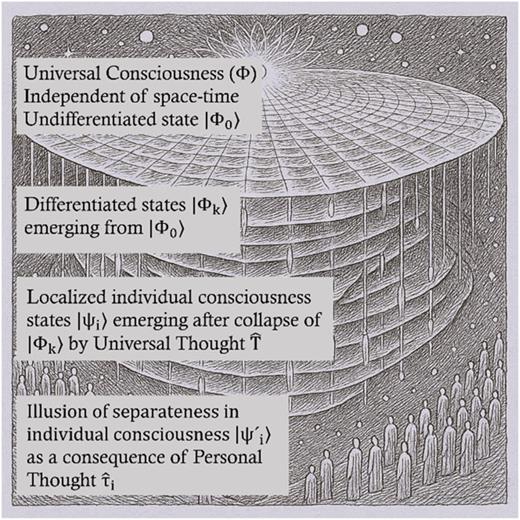
Illustration of the proposed framework and its implications for sentient beings. The universal consciousness field (Φ) exists beyond space–time in an undifferentiated state (⁠⁠. Through differentiation, it gives rise to localized excitations (⁠⁠), which manifest as physical structures or individual consciousness. Following the Big Bang, Φ evolves, generating complex systems capable of awareness—sentient beings with individual consciousness ψ⁠) localized in space–time. Once differentiated, personal thought (⁠τ⁠) shapes individual awareness and perception, producing evolving subjective interpretations of reality ψ over time. This process creates the illusion of separateness, even though all individual consciousness remains intrinsically connected within the universal consciousness field.

Universal consciousness as foundational field: A theoretical bridge between quantum physics and non-dual philosophy 

Maria Strømme Corresponding Author 

Death or Life Transition

23 Feb

Death or Life Transition

An age-old question for human beings is why do we die – sometimes in a senseless, violent manner? Why do good people die young? This is what self-conscious beings ask. After reflecting more on this from a perspective of the teaching of the Buddha and Quantum Information Panpsychism, I thought to put in words some of thoughts on death.

A year ago, I read a short but interesting blog by Joe Goldfarb on his ethical dilemma of killing plants. He wrote, “For one organism to live another must die. There is no escaping this. Having a tiered value status of life, i.e. a mammal has a higher status than a plant, based on assigned arbitrary values is a false perception of reality. I believe in a reality of equality, not inequality, regardless of the form and capabilities of the organism. A bear does not have more value than a flower, for both their names, and bodies are not real. The only thing that is real is their life, of which they both have of equal value. With that said, it is the gift of life, which I acknowledge and respect… Even killing less life, one is still taking life. This is why Veganism has good intentions but is inherently flawed. Because of this moral problem, I have been studying Native American belief systems in hopes of finding a resolution.”

Now, I don’t know if he has resolved this moral problem for himself, but his thoughts point out an important fact: in life, there is death. After hearing the News, there were more seemingly endless situations where the lives of people being at the wrong place, at the wrong time, are ended. It could be a natural disaster or a killing or some other calamity, but the result is the same: death. Their lives are quickly ended. If one removes the usual eulogy of Cataphatic priests, rabbis, ministers, or Imams that God has a purpose that we don’t understand and the person who has died will be in the hands of God (perhaps) – we must admit, we just don’t know exactly why. Death happens.

Thus, death is as natural as living. Under various conditions, life flourishes or perishes. We have seen that stars and planets extinguish only to be reborn, and our own sun and solar system will share a similar fate. Maybe even the universe endures cycles of death and renewal. All materialistic entities are transient and impermanent. As far as we know, there exists only energy/Consciousness.

Is this perspective depressing? Not at all. Embracing the fragility and brevity of life fosters a profound sensitivity and reverence for life, transforming our existence into a precious opportunity. Each fleeting moment propels us forward, creating ripples of effect that extend into the future making us more cautious about our actions being wholesome. When we comprehend that a permanent separate ‘self’ is illusory; an illusion, the prospect of losing it through death is alleviated.

Grief will express itself when one ponders they no longer experiencing life in the human materialistic existence. Yet, if one understands there is no substantial separate I or me, then the idea of losing it through death is not a problem. It is by not comprehending the ground of the fundamental Universal Consciousness, through the mistaken psychological separation caused by the ignorance of the identification in a dualism and a Self, that the fear and angst of death appears. Instead, when one realizes that we are an integral part of Panpsychism, the ALL of Consciousness, the grief of loss disappears.

As Mary Elizabeth Frye  expressed it poetically:

Do not stand at my grave and weepI am not there. I do not sleep.I am a thousand winds that blow.I am the diamond glints on snow.I am the sunlight on ripened grain. I am the gentle autumn rain. When you awaken in the morning’s hush I am the swift uplifting rush Of quiet birds in circled flight. I am the soft stars that shine at night. Do not stand at my grave and cry;I am not there. I did not die.

And my sentiments now about death…

When I die, bury me deep in a place where where my physical elements will support trees growing tall and flowers blossoming. My smile beneath will follow the colors spreading for joy. Mark not my place with statues or stones, find me where life can be found. My body will join the elements and energy of the universe and my consciousness will completely rejoin the Universal Consciousness from which I have always existed and continue on again for eternity in the cycle of life.   

‘Information Links All Things in the Universe’

20 Feb

Information and Inter-Communication

Science has traditionally held that matter and energy are the foundations of physical reality. But an emerging viewpoint posits that a more subtle, but equally fundamental, factor is also important: information. In Science and the Akashic Field, Ervin Laszlo stresses the importance of information for the interdependent functioning of the cosmos: “Information links all things in the universe, atoms as well as galaxies, organisms and minds. This discovery transforms the fragmented world-concept of the mainstream sciences into an integral, holistic worldview.”

In order to account for the presence of a significant number of particles in the universe, and for the ongoing evolution of the existing things, we need to recognize the presence of a factor that is neither matter nor energy. The importance of this factor is now acknowledged not only in the human and the social sciences, but also in the physical and the life sciences. It is information – information as a real and effective factor setting the parameters of the universe at its birth, and thereafter governing the evolution of its basic elements into complex systems. Information is an inherent aspect of both physical and biological nature . . . Information is not a human artefact, not something we produce by writing, calculating, speaking, and messaging. As ancient sages knew, and as scientists are now rediscovering, information is present in the world independent of human volition and action and is a decisive factor in the evolution of the things that furnish the real world. The basis for creating a genuine “theory of everything” is the recognition that “information” is a fundamental factor in nature. (18)

Laszlo provides a useful operational definition of information (or “in-formation”): “Information is the subtle, quasi-instant, non-evanescent and non-energetic connection between things at different locations in space and events at different points in time. Such connections are termed “nonlocal” in the natural sciences and “transpersonal” in consciousness research. In-formation links things (particles, atoms, molecules, organisms, ecologies, solar systems, entire galaxies, as well as the mind and consciousness associated with some of these things), regardless of how far they are from each other and how much time has passed since connections were created between them.”

A number of scientists have suggested that some of the quandaries of current cosmological theories can be resolved through the concept of information. “A common theme among researchers trying to look beyond general relativity and quantum theory to a more unified understanding of nature is that something else lies at the root of all things: information.”

The discoveries of quantum physicists in the early 20th century had tremendous implications for understanding the nature of reality. In The Field, Lynne McTaggart stresses the importance of their findings: “They realized that the very underpinnings of our universe is a heaving sea of energy – one vast quantum field. If this were true, everything would be connected to everything else like some invisible web.”

They also discovered that we were made of the same basic material. On our most fundamental level, living beings, including human beings, were packets of quantum energy constantly exchanging information with this inexhaustible energy sea. Information about all aspects of life, from cellular communication to the vast array of controls of DNA, was relayed through an information exchange on the quantum level. Even our minds operated according to quantum processes. Thinking, feeling – every higher cognitive function – had to do with quantum information pulsing simultaneously through our brain and body. Human perception occurred because of interaction between the subatomic particles of our brains and the quantum energy sea. We literally resonated with our world. In a stroke, they had challenged many of the most basic laws of biology and physics. What they may have uncovered was no less than the key to all information processing and exchange in our world, from the communication between cells to perception of the world at large. More fundamentally, they had provided evidence that all of us connect with each other and the world at the very undercoat of our being. (19)

One of the strangest features of quantum physics is the phenomenon of “nonlocality” or “entanglement.” Physicists discovered that some pairs of sub-atomic particles or atoms are entangled or correlated, and remain instantly connected over time: “Their nonlocality respects neither time nor space: it exists whether the distance that separates the particles and the atoms is measured in millimeters or in light-years, and whether the time that separates them consists of seconds or millions of years.”

As Niels Bohr, a Nobel prize-winning pioneer of quantum physics, discovered, once subatomic particles such as electrons or photons are in contact, they remain forever influenced by each other instantaneously and for no apparent reason, over any time or any distance. When particles are entangled, the actions of one will always influence the other in the same or the opposite direction, no matter how far they are separated. They act like a pair of star-crossed lovers who are forced to separate and live independently forever, but who continue not only to know each other’s moves but also to imitate the other’s every activity for the rest of their days. Albert Einstein had refused to accept nonlocality, disparaging the theory as “spooky action at a distance.” Einstein claimed this type of instantaneous connection couldn’t occur because it would require information traveling faster than the speed of light, which he considered the absolute outer boundary of how quickly one thing can affect something else. Even subatomic particles were not supposed to be able to affect other particles faster than the time it would take the first to travel to the second at the speed of light. (20)

In 1972, physicist John Bell proposed a possible test of the validity of nonlocality – taking measurements on a pair of quantum particles which were initially in contact but later separated. A decade later in Paris, physicist Alain Aspect and his team conducted an actual experiment which confirmed Bell’s theory. In The Holographic Universe, Michael Talbot describes the results: “Aspect’s real-life experiment showed that when two photons were fired off from a single atom, the measurement of one photon affected the position of the second photon. Whatever happened to one was identical to, or the very opposite of, what happened to the other. A comparison of the measurements showed that both were the same. Some invisible wire appeared to be connecting these two quantum particles across space, to make them follow each other forever.”

The phenomenon of nonlocality and the transmission of information across levels of the universe appears in fields as diverse as cosmology, evolutionary biology, ecology and consciousness research:

It is clear that nonlocal coherence has important implications. It signals that there is not only matter and energy in the universe, but also a more subtle yet real element: an element that connects, and which produces the observed quasi-instant forms of coherence. Identifying this connecting element could solve the puzzle at the forefront of scientific research and point the way toward a more fertile paradigm. We can take the first step toward this goal by affirming that information is present, and has a decisive role, in all principal domains of nature. Of course, this information that is present in nature is not the everyday form of information but a special kind: it is “in-formation” – the active, physically effective variety that “forms” the recipient, whether it is a quantum, a galaxy, or a human being. (21)

Although nonlocality or entanglement was first discovered at the quantum level, it is not limited to this domain, and also surfaces at macroscopic scales in the universe, such as electromagnetic and other fields. Ervin Laszlo proposes that the structures and processes of the manifest physical world are determined by interacting waves or patterns of energy and information embedded in the “Akashic field.”

A world where connection, coherence, and coevolution are fundamental features is not a fragmented and fragmentable world, but an integral one. In this world nonlocality is a fundamental factor: things that occur at one place and time also occur at other places and times – in some sense, they occur at all places and times . . . There is an urgent need for a paradigm in which nonlocality is a basic feature – the paradigm of a world that is intrinsically nonlocal. Such a paradigm is now emerging at the leading edge of scientific inquiry. It is based on a new understanding of how parts interact within wholes; ultimately how the parts we know as quanta and the macroscale entities built as coordinated sequences of quanta interact within the larger whole we call “cosmos.” The basic concept that can convey scientific meaning and legitimacy to this understanding is field. Fields are bona fide elements of the physical world, although they are not in themselves observable. They are like fishing nets so fine that their strands cannot be seen. The fields themselves are not visible, but they produce observable effects. Fields connect phenomena. Local fields connect things within a particular region of space and time, but there are also universal fields that connect things throughout space and time. Quanta, and the things constituted of quanta, interact through fields, and they interact universally. (22)

Scientists are becoming aware of the primary role of information in describing the laws and workings of physical reality. “Information really is physical and it literally in-forms our Universe, while at the same time transforming our view of what we actually mean by the term physical.”

The laws of motion and thermodynamics that define how matter and energy move and how they interact are basically laws of information. The concept of information content and flow is starting to be used powerfully to describe physical phenomena at deeper and more all-encompassing levels. The two twentieth century pillars of science, the quantum and relativity theories, are also being re-evaluated as informational theories, a development that is being seen as having the potential to finally bring together these as yet unreconciled perspectives of our Universe. This is just the first step to a much more encompassing perception, one that not only aims to understand the completeness of the physical world but also proposes a cosmology that encompasses all aspects of existence and experience and seeks answers to the deeper question of not only how reality is as it is but also why. (23)

Information exchange seems to occur at all levels of reality. For instance, an electron is much more than a simple structureless point. The active use of information by electrons, and indeed by all sub-atomic particles, indicates that the ability to respond to meaning is an innate characteristic not only of consciousness but of all matter. There is also evidence that at the smallest atomic scale, space-time is pixellated, suggesting that this is the foundational level for information and holographic reality.

The content and flow of information creates patterns and relationships between and within all scales of existence. The events and processes at each level of reality are not random or based on chance – rather, they are dependent on the information they embody. In The Cosmic Hologram, Jude Currivan writes: “Our Universe is fundamentally interconnected as a unified entity that is underpinned and permeated by information. The universal speed limit exhibited by light ensures that information is transferred at a constant and finite limit within space-time, maintaining causality and enabling our universe to experience and evolve.”

Information literally in-forms all that we call physical reality, and from the innate instructions, conditions, ingredients, recipe, and container, of the information that make up the cosmic hologram, enables the outcome of a universe that nurtures the evolution of complexity and ever more self-aware consciousness – makes a universe that is perfect for us. To understand the essential wholeness of reality requires that the principles and laws of physics be restated in informational terms. At every scale from the most minute up to its entirety, the reality of our Universe is indeed being restated in this way, revealing itself as being constituted of holographically expressed information, which is more fundamental than space-time and energy-matter . . . There’s no fundamental difference between quantum and macroscopic scales. They only appear different owing to the difficulty of informationally isolating larger entities from their surroundings. This shows that our Universe is innately coherent and nonlocally unified, where everything is fundamentally interconnected and informational in nature. (24)

The fundamental flow of information is integral to the ordering and evolution of the universe and the development of individual biological entities. Ervin Laszlo: “The network of information applies to all scales, from the genesis and evolution of the universe itself to the development and increase in complexity and ordering of matter – leading all the way to the emergence of the order defining biological organisms and systems expressing self-awareness, by which the universe is ultimately aware of itself.”

Information exchange is the key to understanding the evolution of the universe. The laws and processes of the flow of information provide a deeper understanding of the nature of physical reality as well as integrating quantum theory (which describes universally conserved energy-matter) and relativity theory (universally entropic space-time). “The origin of our universe, in an extraordinarily ordered state, embodied its minimum informational entropy that ever since has increased inexorably, causing the arrow of time to flow and the principle of causality within space-time to be inviolate.” In The Cosmic Hologram, Jude Currivan explores the significance of information in the evolution of the universe:

From its birth, [the universe] encoded the complete information and algorithmic instructions that ensured that all laws of physics pertaining to the behavior of energy-matter and that are described by quantum theory prevail universally and so enable it to exist as a unified entity. Such encoding and coherence also empowered the creation of elementary particles and the fundamental processes and interactions that progressively gave rise to stars, galaxies, and the evolution of ever-greater complexity and diversity. Information expressed as energy-matter, visible and dark, is both conserved and balances exactly to zero throughout its entire lifetime. Such conservation of information expressed as energy-matter on a universal basis is a statement of the first law of information. As such, the first law of information is essentially also the generalized expression of quantum theory . . . The continually increasing entropic flow of information within space-time, rising to a maximum at the end of the lifetime of our Universe, has enabled the development of ever-higher levels of consciousness and self-awareness to be expressed, embodied, and experienced. The nature of time itself can even be considered as being the accumulated flow of informational entropy, ever increasing from past to present to future. Indeed, just as the first law of information is an expression of quantum theory, so the second law of information is that for relativity theory. The first law of information enables our Universe to exist; the second law enables it to evolve. (25)

Rodger R Ricketts

  • Ervin Laszlo Science and the Akashic Field (Rochester, Vermont: Inner Traditions, 2007), p. 13.
  • Lynne McTaggart The Field (New York: Harper Perennial, 2003), pp. xvii-xviii.
  • Michael Talbot The Holographic Universe (New York: Harper Perennial, 2011), pp. xiii-xiv.
  • Ervin Laszlo Science and the Akashic Field (Rochester, Vermont: Inner Traditions, 2007), pp. 60-61.
  • Ervin Laszlo The Self-Actualizing Cosmos Rochester, Vermont: Inner Traditions, 2014), pp. 8-9.
  • Jude Currivan The Cosmic Hologram (Rochester, Vermont: Inner Traditions, 2017), pp. 2-3.
  • Jude Currivan The Cosmic Hologram (Rochester, Vermont: Inner Traditions, 2017), pp. 112-113.
  • Jude Currivan The Cosmic Hologram (Rochester, Vermont: Inner Traditions, 2017), pp. 113-115.

All Is Holistic and Integrative

20 Feb

Systems Theory

A useful approach to understanding the interrelationship of all things is the framework known as systems theory, sometimes called “general systems theory.” The systems view of life studies the world in terms of patterns and relationships. A system is defined as an integrated whole whose properties cannot be reduced to those of its parts. Psychologist Lawrence LeShan: “Primarily, objects and events are part of a pattern which itself is part of a larger pattern, and so on until all is included in the grand plan and pattern of the universe. Individual objects and events exist, but their individuality is distinctly secondary to their being part of the unity of the pattern.”

Fritjof Capra:

Natural systems are wholes whose specific structures arise from the interactions and interdependence of their parts. Systemic properties are destroyed when a system is dissected, either physically or theoretically, into isolated elements. Although we can discern individual parts in any system, the nature of the whole is always different from the mere sum of its parts. Systems are intrinsically dynamic. Their forms are not rigid structures but are flexible yet stable manifestations of underlying processes . . . Living systems tend to form multi-leveled structures of systems within systems. For example, the human body contains organ systems composed of several organs, each organ being made up of tissues, and each tissue made up of cells. All these are living organisms or living systems which consist of smaller parts and, at the same time, act as parts of larger wholes. Living systems, then, exhibit a stratified order, and there are interconnections and interdependencies between all systems levels, each level interacting and communicating with its total environment. (14)

The natural world offers many examples of the collective action of individual members of a species creating larger, more complex systems embodying a group mind or intelligence.

Patterns of such collective coordination can be seen in highly integrated insect communities: “Extreme examples are the social insects – bees, wasps, ants, termites, and others – that form colonies whose members are so interdependent and in such close contact that the whole system resembles a large multi-creatured organism. Bees and ants are unable to survive in isolation, but in great numbers they act almost like the cells of a complex organism with a collective intelligence and capabilities for adaptation far superior to those of its individual members.”

Examples of systems abound in nature. Every organism – from the smallest bacterium through the wide range of plants and animals to humans – is an integrated whole and thus a living system. Cells are living systems, and so are the various tissues and organs of the body, the human brain being the most complex example. But systems are not confined to individual organisms and their parts. The same aspects of wholeness are exhibited by social systems – such as an anthill, a beehive, or a human family – and by ecosystems that consist of a variety of organisms and inanimate matter in mutual interaction. What is preserved in a wilderness area is not individual trees or organisms but the complex web of relationships between them. (15)

Systems theorists have identified some of the principal laws of nature exhibited by systems:

  • Coherence: Complex systems are organized in such a way that each of its parts is linked with every other part. Coherence can exist both within the components of a given system (internal viability) and between other systems (external adaptation).
  • Interaction: New forms and functions emerge as diverse elements interact. Interaction creates interconnection, which produces coherence. “The hallmark of a system of such coherence is that its parts are correlated in such a way that what happens to one part also happens to the other parts – hence it happens to the system as a whole.”
  • Complementarity: Polarity is a basic characteristic of living systems. Opposites balance each other in a state of equilibrium (e.g., yin/yang).
  • Recursion: The parts and elements of the whole have similar patterns which repeat each other at successively deeper levels. “Coherent systems are inevitably complex. A higher form of organization in a complex system does not just repeat the structure on the lower levels, but adds novelty, while repeating key patterns that remain invariant.”
  • Instability: There are limits to the growth of a coherent system – beyond a critical point, systems become unstable and break down into their individual components.
  • Evolution: The evolution of natural systems is towards higher levels of coherence and complexity. “There is a progression from level to level of structure and complexity in nature: from the atomic to the molecular, from the molecular to the multimolecular, from the multimolecular to the cellular and multicellular, and from there to the ecological and bio-spherical.”

Through the action of the above, and other related laws, complexity emerges in the universe as evolution creates more and more complex and coherent atomic, molecular, biological and psychosocial structures and systems.

The self-organization of systems is a recurring feature at all levels of the universe: “The recursive system of self-organization, where every layer curves back on itself to monitor another layer, pervades physics and biology. Self-organization is embedded in the fabric of the cosmos, acting like an invisible, offstage choreographer to drive evolution.” In You Are the Universe, Deepak Chopra and Menas Kafatos discuss this important concept:

In a self-organizing system, each new layer of creation must regulate the prior layer. So, the generation of every layer in the universe, from particle to star to galaxy to black hole, cannot be considered random, given that it was created from a pre-existing layer that in turn was regulating the layer that produced it. The same holds true throughout nature, including the workings of the human body. Cells form tissues, which in turn form organs, the organs form systems, and finally, the entire body has been created.      Each layer emerges from the same DNA, but they stack up, as it were, until the pinnacle of achievement, the human brain, crowns it all . . . Whether we are speaking of genes and the brain or solar systems and galaxies, self-organization is present. Existence requires balance, which demands feedback. By monitoring itself, a system can correct imbalances automatically. Every new bit of the universe, however minuscule, must create a feedback loop with what gave rise to it. Otherwise it wouldn’t be connected to the whole. (16)

The building blocks of most systems are based on the principle of hierarchy, which determines the levels of organization and the nature and structure of the interconnections. Each living component possesses its own self-organization and a limited degree of autonomy within the larger system. These systems exist in a hierarchy in which higher levels subsume and regulate lower levels. “Every system does its job, being more or less responsible for its own survival and reproduction (within its niche in the whole organism), at the same time being controlled by one or more superordinate regulatory systems.” Many systems, both natural and manmade, are organized in a hierarchical structure:

Nature appears to be structured as levels of organization or complexity. Elementary particles give rise to atoms, atomic structures form molecules, which in turn form macromolecules such as proteins and DNA, which are the basis for living organelles and cells, which congregate and cooperate to form the profusion of living organisms populating the planet. Evolution, as a progressive complexification of matter and psycho-biotic systems, is ostensibly a dynamic process of ever-increasing levels of complexity and organization. In the sense of nested systems within systems, hierarchy is an accurate and appropriate description of nature . . . If we picture nature’s nested systems as circles within circles within circles, where the boundaries of all the circles are permeable, then hierarchy permits the flow of information and energy both up and down, and laterally, between systems at all levels. Hierarchy involves the communication of information and energy through “upward causation,” from lower-level (meaning less complex) systems to higher level (meaning more complex and organized) systems, and “downward causation,” from higher-level systems to their component parts; as well as horizontal causation (laterally between systems on the same level). In this systems view of hierarchy, power resides in the cooperative relationships between the various systems and their parts. (17)

In summary, the systems view of the universe is essentially holistic and integrative; it looks at the world in terms of interrelatedness and interdependency, linking all levels of existence in a unified whole. “Living systems are organized in such a way that they form multi-leveled structures, each level consisting of subsections which are wholes in regard to their parts, and parts with respect to the larger wholes. All entities – from molecules to human beings – can be regarded as wholes in the sense of being integrated structures, and also as parts of larger wholes at higher levels of complexity.”

Rodger R Ricketts

  • Fritjof Capra “The New Vision of Reality: Towards a Synthesis of Eastern Wisdom and Western Science” in Stanislav Grof, ed. Ancient Wisdom and Modern Science (Albany: State University of New York, 1984), pp. 139-140.
  • Fritjof Capra The Turning Point (New York: Simon and Schuster, 1982), pp. 266-267.
  • Deepak Chopra and Menas Kafatos You Are the Universe (New York: Harmony Books, 2017), pp. 71-72.
  • Ervin Laszlo Science and the Reenchantment of the Cosmos (Rochester, Vermont: Inner Traditions, 2006), pp. 118-119.