Archive | Wisdom RSS feed for this section

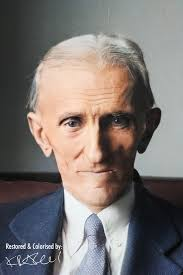
‘If you want to find the secrets of the universe, think in terms of energy, frequency and vibration’. A few examples of engineer and mathematician Nicola Tesla’s Reflections on the Mind.

16 Jun

Here are some examples of Tesla’s viewpoint. In a speech, Nicola Tesla said, ‘The sources of energy capable of transforming humanity have long been near us in nature itself, in human emotions, in the sound of music, in the breath of the earth.’ He said that mankind had searched for power outside itself for too long forgetting that it is found within. ‘I believe that the energy that feeds the universe is not just a physical resource. It is something greater. We call it ether. Some call it the divine spark or the essence, they are all the same. All living things are nourished by this force. It is hidden in the depths of the planet, in the structures of light, in the harmony of sounds and in thoughts.’ He claimed that one day this energy would become the foundation of new technologies capable of feeding the hungry, healing the sick, and eliminating the need for destructive sources of energy.

 Tesla noted with sorrow that in his time, society was not ready to accept such ideas. There were too much politics, greed and fear of the unknown in the world.In his view no religion can claim to be the absolute truth. He asserted that all of them are reflections of the same human desire to understand the source of life and one’s purpose. Religions and philosophies are attempts to explain the infinite with finite words. They may be useful, but they have no significance on the scale of the universe. ‘God, as I understand him, is an infinite force. It is the energy from which everything originated. But it does not judge. It does not punish. It simply exists.’ said Tesla.

During an interview that Tesla granted to a journalist in the year 1930, he said:’We are just waves in time and space, changing continuously, and the illusion of individuality is produced through the concatenation of the rapidly succeeding phases of existence’; ‘My brain is only a receiver, in the Universe there is a core from which we obtain knowledge, strength and inspiration. I have not penetrated in the secrets of this core, but I know that it exists’; ‘We are all one. Only egos, beliefs, and fears separate us’; He added ’None of those who ever lived have truly died because energy is eternal and life is a form of energy. The body departs but the essence itself, the vibration itself does not disappear.’

These ideas, of course, resonate with spiritual teachings, but Tesla emphasized he arrived at them not through faith but through science. And at the same time, he did not deny the divine. God is light, it is the primary energy from which everything began. This light has no form. It requires no worship. It simply exists. It is in everything, in us, in the air, in the stars. People assign human traits to God to make it easier to understand. But the true power of God lies in his impersonality and infinity.

Then the interview returned to the topic of death. Tesla said he was not afraid of it because death is not the end but a return. He compared it to how a wave returns to the ocean. You will not die because you were never born. You have always existed in one form or another. We are only temporarily in these bodies, in this world. When everything ends we will simply move to another state. Everything is energy and it never disappears.

Sense Perception and Reality

7 Jun

Rochelle Forrester Copyright © 2015 Rochelle Forrester
All Rights Reserved

A more formally logical way of presenting the above argument,with”a world”being defined
as that which can be perceived by a conscious being through its senses, is as follows:

1)There is no way in which we can know the world,other thant hrough our senses.Theonly
reality we can know is phenomena.
2) Our senses give us only some information about the world.
3)The things we can perceive can beconsidered to be in our world, the things we cannot
perceive can be considered to be in other or different worlds.
Therefore
4) As there are many things we cannot perceive there are many worlds other than our own.
5)There is no reason to consider that any world is more real,more true or more valid than any
other world.
6)If there is no reason to believe anyone world is truer or more real than any other,theyc an
only be treated as equally true or real.
Therefore
7) Any one world is as valid and real and true as any other.
8) There is a wide variety of senses and each sense has thresholds which limit perception.
Therefore
9) There must be a wide variety of worlds.
10) As the senses of different people and species overlap some of the worlds overlap.
11)As any being may hav esenses which are quite unlike those of anyother being manyof
these worlds will not over lap.Such beings will live in totally separate worlds from those o fother
beings.
12)There seems to be no reason to believe there is a finite limit on the range of potential
sense organs.
Therefore
13) There is no finite limit on the number of potential worlds that may exist.

Reality appears to consist of a vast number,possibly an infinite number,of sensory worlds.
Each person has their own individual world.This is the world they perceive which is always different
from the world perceived by others.Variations exist from person to person due to each person
occupying different points in time and space and due to the qualityof the individual person’s sense
organs.Each species has its own world due to the tendency fo rmembers of each species to have the
same sense organs which will tend to function in a similar way within each member of the species.
There seems to be no good reason for favoring any one of these sensory worlds over any other of
them. It seems impossible to claim that the human view of the world has any special claim to validity
when an alteration of our senses will give us different sense perceptions.How can you say what you
perceive is,when the samething can be perceived with different sense organs and it can be something
quite different? If the human view was to b epreferred it would be no more than a case of a human
centric view of the world that is not capable of any real justification
.

The Garden of Eden- In This Life

3 Jun

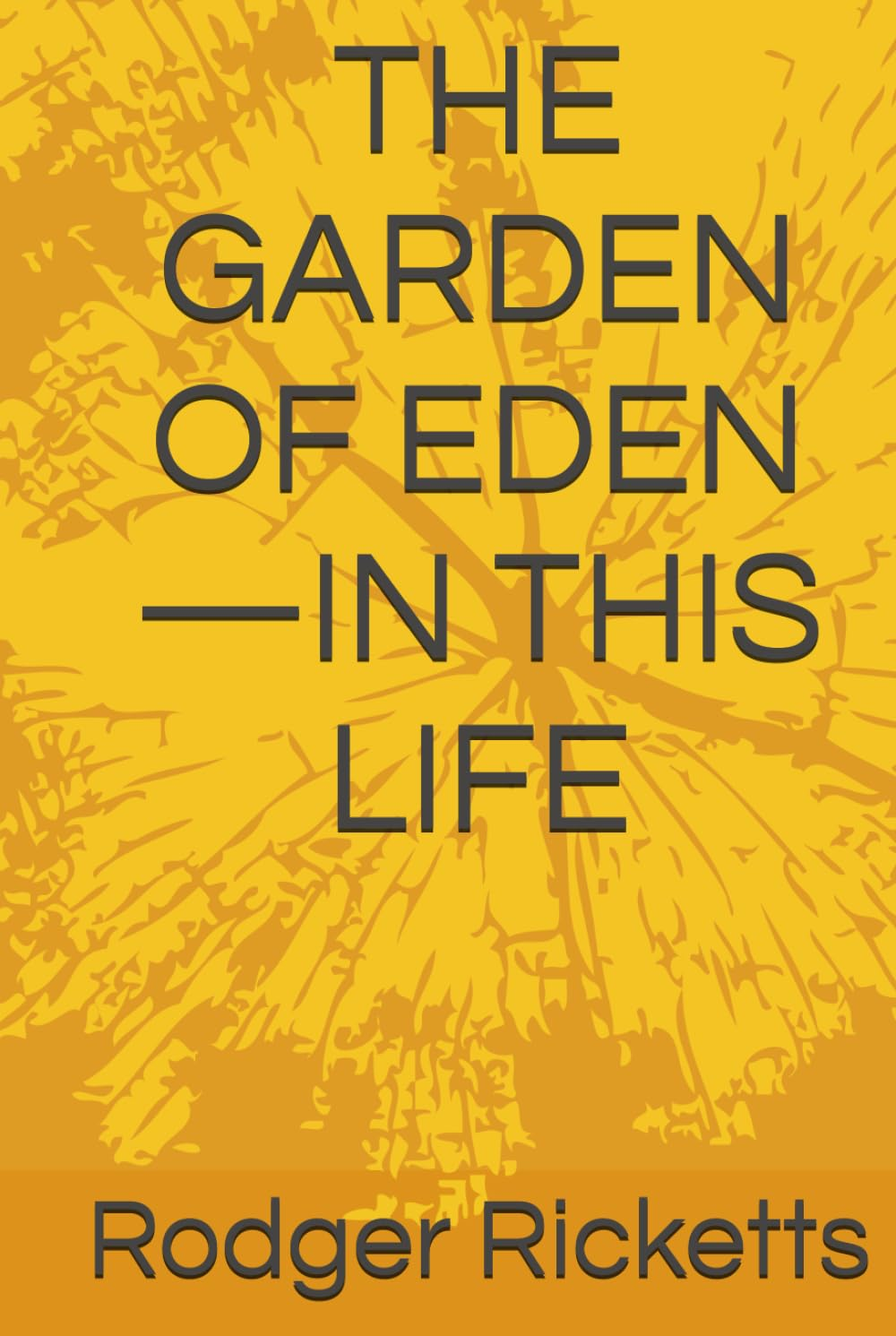
In The Garden of Eden in This Life, (2025) Dr. Rodger R. Ricketts—a clinical psychologist, mindfulness teacher, and lifelong student of the Buddha’s teachings—unveils a profound perspective linking ancient wisdom, modern psychology, and the apophatic (negative) spiritual tradition. Drawing from over forty years of study and practice, he explores how non-dualistic teachings from Buddhism, science, and multiple faith traditions reveal the limits of language, the illusions of separation, and the path back to an integrated state of being.You will journey through concepts like Sunyata (emptiness), the via negativa, and the psychology of transcendence—discovering how humanity’s separation from nature and spirit can be healed through direct experience, compassionate living, and expanded awareness. Open these pages and begin your journey back to the Garden… in this life.

Biodance – the endless exchange of the elements of living things

31 May

Biodance – the endless exchange of the elements of living things with the earth itself – proceeds silently, giving us no hint that it is happening. It is a dervish dance, animated and purposeful and disciplined; and it is a dance in which every living organism participates. These observations simply defy any definition of a static and fixed body. Even our genes, our claim to biologic individuality, constantly dissolve and are renewed. We are in a persistent equilibrium with the earth. Yet the boundary of our body has to be extended even farther than the earth itself. We know that certain elements in our body, such as the phosphorus in our bones, were formed at an earlier stage in the evolution of our galaxy. Like many elements in the earth’s crust, it was cycled through the lifetime of several stars before appearing terrestrially, eventually finding its way into our body. A strictly bounded body does not exist. The concept of a physical I that is fixed in space and that endures in time is at odds with our knowledge that living structures are richly connected with the world around them. Our roots go deep; we are anchored in the stars.’

“Each body structure has its own rate of reformation: the lining of the stomach renews itself in a week; the skin is entirely replaced in a month; the liver is regenerated in six weeks. Some tissue is relatively resistant to the constant turnover, such as the supporting tissue called collagen and the iron in the blood’s hemoglobin molecules. But even though these rates of replacement differ, after five years one can presume that the entire body is renewed even to the very last atom.”

Dr. Larry Dossey

Union Is in the Heart

8 May

Follow the advice of your heart, because no one will be more faithful to
you than him.
—Book of Sirach, 37.13

I think that the positive forces that will create our future will not be the
forces and the laws of matter, but those of conscious cooperation,
comprehension, and love for others that all beings in existence must sooner
or later manifest because these values are the essence of our deepest nature.

I also think that the most effective way to achieve union is through a
process of collective and cooperative creation of a just, empathic, and
loving society through right and courageous actions informed by the heart
and by the intuitive and rational mind. Then our experience and knowing
will grow in our hearts and they will guide our individual actions through
an ever-higher level of consciousness. Unfortunately, today there is the real
danger of letting ourselves be seduced by the spreading culture of digital
ontology and digital consumerism that replaces true and profound
relationships with virtual and superficial ones, thus halting, if not reversing,
our spiritual development.

Social networks designed to bombard people with suggestive messages,
often personalized to reinforce personal biases or based on false
information or on presumed conspiratorial theories, generate groups that
can become alienated from reality in self-isolating worlds. Nikola Tesla said
that “progress must serve to improve the human race; if not, it is only a
perversion.”
Technology must be used to help us discover our true nature, not to
further imprison us in meaningless virtual worlds designed to enrich the
richest. We have come to the point where we can truly unite as humans no
matter where we were born, or stay divided in warring factions with ever
increasing destructive technology on our side.
Only when we truly comprehend that we are responsible for our
experiences and that the choice is ours alone, can we begin to truly know
ourselves and the world.

To know ourselves more and more, we need a new empathic science
that can convert scientific knowledge into deep lived knowing and from it
generate new scientific knowledge. Similarly, we need a new rational
spirituality that can convert lived knowing into new scientific knowledge
and from it generate new lived knowing. These two disciplines can then
intertwine in endless and mutual crescendo.
This is the essence of the Creative Principle of One. Within this vision,
empathic science and rational spirituality, integrating and interweaving, will
evermore increase our loving, joyful, and fulfilling union with the Whole.

Federico Faggin: Irreducible – consciousness, Life, Computers, and Human Nature 1988 Essentia Publisher

Pure and Serene Mind (Part 2): The Path of Chi Restoration Through Qigong & Tai Chi

22 Apr

Written by Rodger R Ricketts

In the previous blog post, I explored how modern life gradually separates us from our original Chi through excessive mental activity, immersion in artificial systems, and disconnection from natural sensation. As symbolic thinking and external pressures dominate our awareness, the mind stretches beyond its natural limits, losing sensitivity to life energy. This disconnection weakens the true self and leads to imbalance, fragility, and inner suffering. Yet within each person remains the potential to restore purity, stillness, and authentic Chi by returning to original awareness, reconnecting with natural sensation, and aligning with timeless Daoist principles. Now, I examine how the ancient practices of Qigong and Tai Chi guide this restoration through stillness, movement, and the gradual purification of mind and life energy.

The cultivation and flow of energy through Qigong breathing techniques and Tai Chi movements reveal a path that is both clear and accessible. As individuals begin to recognize the false self that has often governed much of their existence, they should prepare for unexpected insights. Many people find themselves encumbered by multiple false identities. Rather than becoming discouraged, it is advisable to adopt a strategy of gradual progress—advancing step by step with unwavering faith—steadily uncovering one’s original life energy. This process unfolds layer by layer, requiring persistence and resilience. If one has been taught to believe that miracles occur externally, such a belief stems from a misconception rooted in a desire for effortless gain. It is imperative to cease heeding this false self and reject this erroneous notion immediately. Although the journey toward reclaiming one’s life energy may be challenging, it is ultimately profoundly rewarding.

If one maintains a pure heart and genuine sincerity in their efforts, it is possible to utilize the tools and guidance provided by a master to achieve the goal of discovering one’s true self. The experience of Chi can be regained through consistent practice. Several methods exist to restore the sensation of Chi, including motionless meditation, moving meditation, and receiving Chi energy from a master. According to the sacred teachings of an ancient lineage, a master capable of radiating life energy resembles a powerful iron magnet. Ideally, these practices should be undertaken concurrently. The primary purpose of these meditations is to create calmness and exclude the distractions of the artificial world, thereby enabling concentration and reconnection with internal sensations through stillness, typically in a seated posture, although some practices involve standing.

Despite the diversity in names and styles among various meditation techniques, all are designed to help practitioners eventually perceive their own energy. While many contemporary meditation systems emphasize sensing life energy, only one system currently extends beyond this initial stage by teaching how to direct the flow of Chi. This system contains essential knowledge that aids in purifying and strengthening true energy. It is the original Qigong meditation, deeply rooted in the principles of the Tao. Unlike other forms, the essence of Qigong meditation lies in cultivating the sensation of Chi within a clear mind. Qigong instructs practitioners to intensify this sensation and circulate it throughout the entire body, resulting in Chi that is fully present in every moment.

Through flowing movements, total Chi can be refined to become exceptionally pure and strong. This practice also forms the foundation of what is now known as Tai Chi. Tai Chi remains the only moving meditation practiced today that supports the development of Chi beyond the initial healing stages. Authentic Tai Chi enhances both the quantity and quality of life energy in a manner consistent with ancient Qigong meditation. Numerous styles of Tai Chi exist worldwide. For those whose lifestyle permits and who are resolute in their desire to attain true freedom from the artificial world, halt the depletion of life energy, and reclaim their true selves, it is possible to engage in all three stages of practice simultaneously, as was done in ancient times.

Among all training processes, the most critical step is learning to maintain the cleanliness and purity of one’s life energy. Purifying life energy is the ultimate goal, while maintaining its cleanliness is the means to that end. To keep life energy clean, one must keep the mind clean. If the mind remains unpolluted, unsullied, and undisturbed, it can purify life energy. The mind functions as a filter and must remain in its original, uncontaminated state, free from external influences. It must be brought to its most concentrated state: calm and comfortable, neither forced nor resistant, simply embodying one’s original self. The pursuit of this clean state of mind should not be forced, as the desire to attain it itself contaminates the mind. Ancient temple records recount stories of monks who failed to purify their minds due to excessive effort.

When the mind is free from contamination, distortion, and confusion, it naturally facilitates the purification of life energy. An apt analogy is to consider life energy as water and the mind as its filter. The mind must remain in its original, unaltered state—characterized by freedom, deep concentration, calmness, and comfort, without striving or resistance. Engaging in practices such as two-gong breathing and slow meditation with sincerity and honesty gradually calms and purifies the mind. With a purified mind, one can direct life energy to flow throughout the entire body, and over time, this energy will attain a purity comparable to that of a newborn. This represents a valuable aspiration: to harmonize one’s life energy with the original cosmic energy, known as the Dao.

Upon sensing and communicating with this pure life energy, one may progress further by reconnecting with its source through harmonious contact. This process entails transcending the layers of impurity and negative energy that obscure the original life energy, as well as the pollution of the artificial mind. In a polluted state, life energy cannot resonate at the same frequency as the Dao. It is not that the Dao refuses to communicate or assist; rather, communication is impeded while life energy remains contaminated and vibrates at a low frequency. Many individuals pray to external entities using words; however, such prayers often yield inconsistent outcomes because the original almighty force neither perceives nor communicates through low-level, artificially constructed symbols such as language. Instead, it communicates with those who turn inward and pray through the sensation of their pure life energy.

There exists no higher pursuit or more cherished goal than rediscovering and reclaiming one’s pure life energy. The most effective and singular method to cultivate life energy is through moving meditation that promotes the flow of Chi. Chi grows only when it flows, encompassing increases in strength, range, size, and volume. A greater volume of Chi better supports both body and mind. When the mind attains purity and Chi strengthens, it can be refined into higher forms of energy known as Jing Jing, which can be projected and transmitted beyond the body. Presently, no other meditation practice offers a comparable method to facilitate the flow of life energy as does the original Tai Chi flow meditation. Tai Chi simultaneously strengthens the mind and cultivates life energy, or Chi, and can be practiced anywhere and at any time. Practitioners are advised to wear comfortable clothing and flat, flexible shoes, breathe smoothly, quietly, and naturally, and may synchronize movements with breath without forcibly holding it. The mouth should remain closed with lips and teeth gently together, the tongue resting lightly against the roof of the mouth, and the head held upright as if suspended by a cord from above. Movements should be performed in a relaxed, comfortable manner with minimal muscular tension. With modest effort, the movements can be learned effectively.

At first glance, Tai Chi may appear to consist of slow, graceful movements designed primarily to improve physical balance and flexibility. However, beyond these physical benefits, Tai Chi represents a deeply meditative practice aimed at fostering clarity and inner stillness. The most profound aspects of significant Chi involve an empty mind and the clear release of mental tension. In Tai Chi, stillness does not imply the cessation of physical movement; rather, it entails cultivating a calm and focused mind. The practice promotes the release of distracting thoughts, worries, and mental chatter, thereby enabling full attention to be directed toward the present moment and the fluidity of one’s movements.

This state of stillness is known as Wuji, which translates as “emptiness” or “non-being” and represents the state of primordial, undifferentiated reality before the emergence of Yin and Yang. In Tai Chi, all movements and energy flow from Wuji. It is a state of pure potential wherein the mind is clear, the body relaxed, and awareness anchored in the present moment. By embracing stillness, Tai Chi practitioners access a powerful state of mental clarity that facilitates movement and fosters integration between body and mind.

Across these two blog posts, I traced the arc from loss to restoration: how modern existence subtly exhausts Chi and obscures true nature, and how ancient Taoist practice gently guides the return. Part One revealed how artificial systems, excessive thinking, and sensory overload separate us from original life energy, weakening intuition and inner peace. Part Two illuminated the path of return through sincerity, stillness, and movement, restoring Chi through meditation, Qigong, and Tai Chi. By purifying the mind, circulating life energy, and aligning with the Dao, one gradually reawakens the innate wholeness present in infancy—a pure and serene mind capable of sensing life energy naturally and resting effortlessly in truth. This journey requires patience and devotion, yet it ultimately leads to freedom, clarity, and harmony with the living universe.

We are divine

17 Apr

“We are divine, and we must live not by the
survival of the fittest, but in a way that supports everyone and everything on
this planet” Bruce H. Lipton

The time has come to use our powerful technologies for the good of all,
rather than for the delusional good of the self-proclaimed fittest. The idea of
separation, which finds its expression in the reductionism of classical
physics, must be replaced by the experience of union and inclusion already
evident in the holism of life. “There is not a single isolated fragment in all
of nature, each fragment is part of a harmonious and complete unity” (John
Muir). Only by recognizing this crucial interdependence can humanity go
beyond the repetition of the same dysfunctional patterns that have caused so
much unnecessary suffering to our species and to the ecosystem.
Many sages throughout history have suggested that we are beings of
light that will not die with the death of the body, because we are here to
learn and grow. I think we are here to learn to collectively create new
worlds in which to operate at a much higher level of cooperation, creativity,
and fulfillment than we now can at this early stage of our spiritual
evolution. The possibility of experiencing our true nature is already
supported by the enlightened personal experiences of millions of people
around the globe, and by countless “anecdotal” facts and events that science
hesitates to investigate. If we open ourselves to this potential that is
dormant in us and ask our greater self to show the way, we may soon be
able to experience an unsuspected unity in our lives, the early signs of
humanity’s awakening to its true power and purpose
.

Only when we truly comprehend that we are responsible for our
experiences and that the choice is ours alone, can we begin to truly know
ourselves and the world.
To know ourselves more and more, we need a new empathic science
that can convert scientific knowledge into deep lived knowing and from it
generate new scientific knowledge. Similarly, we need a new rational
spirituality that can convert lived knowing into new scientific knowledge
and from it generate new lived knowing. These two disciplines can then
intertwine in endless and mutual crescendo.
This is the essence of the Creative Principle of One. Within this vision,
empathic science and rational spirituality, integrating and interweaving, will
evermore increase our loving, joyful, and fulfilling union with the Whole.

I think that the positive forces that will create our future will not be the
forces and the laws of matter, but those of conscious cooperation,
comprehension, and love for others that all beings in existence must sooner
or later manifest because these values are the essence of our deepest nature.
I also think that the most effective way to achieve union is through a
process of collective and cooperative creation of a just, empathic, and
loving society through right and courageous actions informed by the heart
and by the intuitive and rational mind. Then our experience and knowing
will grow in our hearts and they will guide our individual actions through
an ever-higher level of consciousness.

copyright: Federico Faggin 2023 Irreducible: Consciousness, Life, Computers and Human Nature

The Unity of All -Non-Dualistic Apophatic Higher States of Consciousness

13 Apr

Non-Dualistic ApophaticHigher States of Consciousness

While Apophatic theology was often in the past regarded as heretical, blasphemy, and unorthodox, we have seen in the previous chapters that now the sciences including physics, cosmology, psychology, biology, ecology, linguistics, as well as meditation, all provide a secure platform for the non-dualistic Apophatic convictions and practice. Apophatic teachings and analysis clearly provide an alternative to the dominant Dualistic Cataphatic dogma. This acceptance and application of the non-dualist perspective is not just an academic survey but a way of living that has crucial truths that benefit the individual, interpersonal, biological, psychological, sociological, spiritual, societal, and ecological levels.

This book is meant to indicate the possibility and rationale that is encompassed in the title of Apophatic. To further explore in-depth the Buddha’s teaching of the Path to Awakening, the reader is referred to my previous books: The Buddha’s Teachings; Seeing Without Illusion, The Buddha’s Radical Psychology: Explorations and The Buddha’s Gift: A Life of Wellbeing and Wisdom.

Now we have the testimony of numerous modern articulate thinkers whose ability to describe their awakening perspectives leads a strong support to past spiritual leaders who, even in the threat of death, spoke their truths out of compassion for others. Remembering the insights of his personal mystical experience, Martin Buber, in his book, The Heart of Mysticism, described his higher states of consciousness: “Now from my own unforgettable experience I know well that there is a state in which the bonds of the personal nature of life seem to have fallen away from us and we experience an undivided unity.”

With this experience of Awakening, Buber understood the world without the alienating and separating dualistic subject/object dichotomy. Like the Buddha, out of compassion for humanity, Buber taught us how to experience and act in a non-alienated way. While Buber always emphasized that he understood relating to the world in an I-It manner, a ‘functional’ relationship between subject and object, is necessary, his primary concern was when a person was unable to respond from I-Thou, thus creating alienation and suffering. The relation between the person and Nothingness is a universal relationship that is found as the foundation for I-Thou, as authentic beings, without objectification. From an apophatic perspective, it is from the background of the I-Thou relation that I-It arises in the foreground.

Virtuous and Kind Behaviors

For this apophatic potential relational world to be realized, virtuous and kind behaviors are encouraged. This promotes sensitivity to the inner and outer world, more serenity, more authenticity, empathy and wisdom with less alienation, rumination, conflict, hatred, and bias.

The ‘I-Thou’ relation participates in the dynamic and living process of Being. That relationship simply Is. Through this relation, we interact with the world in its whole Being. It is not a means to an egocentric objective or goal of use and order but an authentic relationship involving respect and care for the whole being of each subject and existence.

Basic to the Apophatic relation, Lovingkindness or benevolence is a subject-to-subject relationship. Love cannot be an ego-based relation of subject to object but rather a relationship in which all members are subjects and share the immanent unity of Being. According to Buber, the I-Thou relationship is “the existential and ontological reality in which the self comes into being and through which it fulfills and authenticates itself.” This relation is characterized by mutuality and openness, directness, and being in the present.

I-Thou an expression of Inter-being relations

Using Buber’s ‘I-Thou’ as an apophatic example, communication is the fundamental expression of the uniqueness of relation within inter-being. These relational patterns of rapport and affinity are usually found when beings relate with lovingkindness, friendship, openness, and care. I meet you as you are, and you meet me as who I am. In this relationship, I am with you openly in my heart and mind. Living through relationships with this authenticity brings deep satisfaction, happiness and richness in life and opens a greater sense of the original relation with the Being. One easily expresses empathy and compassion, knowing that all are interconnected in unity. Such a perspective makes a different world, a world without violence. As Jesus said, ‘Thou shalt love thy neighbor as thyself.’ The Buddha said as well, “All beings tremble before violence. All fear death. All love life. See yourself in others. Then whom can you hurt? What harm can you do?”

As all Apophatic sages teach, by being ‘empty’ in the moment, here and now, we experience the wonder of existence. As we have seen in other chapters, the ultimate, even the very idea of the ultimate, cannot be known by discursive thinking. In the now, we live our life as it is. Also, through the practice of silent meditation, we focus on our life awareness. With this awareness, we experience our interconnectedness with all things and empathy and compassion for all sentient beings.

Knowing shatters illusions

Knowing begins with the release of illusions, with dis-illusion. Knowing means to penetrate through the fog, to arrive at reality; knowing means to ‘see’ the reality without illusion. Knowing is that the ‘ownership’ of truth is not possible. The Awakened relationship cannot be explained; it simply is. Through this ‘empty’ relation, we interact with the world in this whole Being. It is not a means to some object or goal but an authentic relationship involving respect for the whole being of each subject. Buber considers ‘I-Thou’ communication the fundamental expression of the uniqueness of relation within inter-being. These relational patterns of rapport and affinity are usually found when beings relate with lovingkindness, friendship, openness, and care.

In the I-Thou encounter, we relate to each other as authentic beings, without inquisition, prejudice, enmity, or predisposition. I meet you as you are, and you meet me as who I am. In this relationship, I am with you openly in my heart and mind. However, there are many people who never fully understand this deeper level of relation. This is tragic because living through relationships based on the non-dualistic perspective brings happiness, deep satisfaction and richness in life and opens a greater sense of the original relation with the Absolute.

When an I-Thou encounter occurs, I am meeting the other as thou with openness, directness, and presence by means of real mutual action, meaning and confirmation. As Buber wrote, “This person is other, essentially other than myself… I confirm it; I wish his otherness to exist, because I wish his particular being to exist.” We are interconnected, “not just with people, but animals too, and stones, clouds, trees” (Aitken 1984, p. 10). We are an integral part of everything.

Nothing exists by itself; nothing has a separate existence, an inherent separate self. As human beings we are Being, one with All. The truth is pure interbeing, beyond dualistic thinking of the alienated mind. Thus, one becomes aware of the impermanence and the Emptiness of the ‘IT’ world. Serenity comes with the acceptance of impermanence and interrelatedness. The insights of such Sages as the Buddha, the Hebrew prophets, Jesus, and Master Eckhart show that knowing begins with the awareness of the deceptiveness of our common-sense perceptions and cognitive constructions; our formulations of physical reality do not correspond to what is ‘really real.’ Therefore, most people are half-awake, half dreaming, and are unaware that most of what they hold to be true and self-evident is an ‘magician-like’ illusion produced by the influence of the dualistic alienated world in which they live.

Knowing, then, begins with the transformation of illusions, selfishness, and alienation. Knowing means to penetrate through the fog, to arrive at reality and to ‘see’ the reality without illusion. Knowing is not to own the truth, as possession is not possible, but to Be the truth. The Being mode of knowing allows us, as psychologist Erich Fromm (1992, pp.117-120) also observed, to go beyond ourselves, outside the ego. The Path’s result is kindness to oneself and another, to transcend the barriers that separate us from one another, and living life with recognition of interdependence and impermanence. When communicating at this level, we move beyond biased social roles, identifications, and objectification.

In I-Thou dialogues, we trust and can disclose deep, private aspects of ourselves that enable us to engage in deep and authentic relationships. The rigid, dualistic and egotistically dominated mind remains enmeshed in ignorance, greed, and anger that feeds on itself and, therefore, does not let go and rise above the suffering quagmire in which it remains. This ego rigidity needs an empathetic and compassionate approach to assist it in letting go and coming to know how it is possible to live in a world without the pain and distrust and suffering created through this dualistically based ignorance. And, in fact, the path can be clear and successfully traveled without much difficulty.

What is difficult is allowing oneself to give up the encased hatred, the anger, the greed, the biases of egoism and of selfishness. In the book, Lost Horizon, there is this passage: ‘Look at the world today. Is there anything more pitiful? What madness there is! What blindness! A scurrying mass of bewildered humanity crashing headlong against each other. The time must come when brutality and the lust for power will perish by their own sword. When that day comes, the world must begin to look for a new life.’

The new life away from that is and always has been pointed to by the apophatic teachers in the past and now. The whole movement is toward the development of maturity of perspective and, therefore, action with wisdom about the way we understand and think about existence. Therefore, incorrect ideas and beliefs must be renounced, which will change our human character and end further suffering.

For as the Buddha and other apophatic teachers have consistently taught, what is now clear through scientific investigation, that living beings, the environment and even the universe are deeply enmeshed and co-dependent on each other. This is one world and every action by all living and non-living forces interact with and alter the previous reality- some more than others. Therefore, once we become experienced, inspired, and apply the truths that the Buddha and others have discovered, and now are explicated in more modern terminology and description, there is a real possibility for a Heaven on Earth without the distraction of seeking supernatural intervention.

Heaven on Earth can briefly be described in a biocentric way as a world of humans acting through wisdom and empathy and compassion, The Buddha, one of the greatest Apophatic teachers, said in his last words to the monks, “It may be that after I am gone that some of you will think, ‘now we have no teacher.’ But that is not how you should see it. Let the Dharma and the discipline that I have taught you be your teacher. All individual things pass away. Strive on, untiringly.”

Now, as we have explored in this book the similar meditation instructions and doctrinal perspectives taught by the many Apophatic spiritual teachers, over time and different cultures, we know we can attain Awakening and know Emptiness and give up our suffering and the harmful consequences of dualistic alienation, for a life of wellbeing and happiness. Let us all assert the Apophatic Way and accomplish knowing the ‘unknowable’ – No-thing

Chapter 16 The Unity of All. Of the Book, God is No-thing. The Apophatic Assertion The
Salvation for Humankind – revised -. Copyright Rodger Ricketts Psy.D.,2022. All rights
reserved.

Black Elk Speaks…Indigenous Spirituality

8 Apr

Quotes of Black Elk who was a prominent Lakota Sioux visionary and healer, that taught about the connection with the sacredness and oneness of life, and the deep, loving, heart-opening spiritual knowledgethat we carry in our hearts, that is crucial for the coming together of all people as one family.

1.The first peace, which is the most important, is that which comes within the souls of people when they realize their relationship, their oneness with the universe and all its powers, and when they realize that at the center of the universe dwells the Wakan-Taka Great Spirit, and that this center is really everywhere, it is within each of us. This is the real peace, and the others are but reflections of this. The second peace is that which is made between two individuals, and the third is that which is made between two nations. But above all you should understand that there can never be peace between nations until there is known that true peace, which, as I have often said, is within the souls of men.

2. At the center of the universe dwells the Great Spirit. And that center is really everywhere. It is within each of us.

3. Peace will come to the hearts of men when they realize their oneness with the universe, It is everywhere.

4. Any man who is attached to things of this world is one who lives in ignorance and is being consumed by the snakes of his own passions.

5. As you walk upon the sacred earth, treat each step as a prayer.

6. What is Life? It is the flash of a firefly in the night. It is the breath of a buffalo in the wintertime. It is the little shadow which runs across the grass and loses itself in the sunset.

7. All things are our relatives; what we do to everything, we do to ourselves. All is really One.

8. The Great Spirit is everywhere; he hears whatever is in our minds and our hearts, and it is not necessary to speak to Him in a loud voice.

Black Elk Speaks: Being the Life Story of a Holy Man of the Oglala Sioux by John G. Neihardt

Transcending Duality

3 Apr

It was not a state of thinking but a state of living and being. It was pure consciousness. What I call a magnificence state of oneness that transcends duality. Getting me in touch with the parts of me that are eternal, infinite, and encompasses the whole. This was awesome; no longer becoming entrenched in beliefs that lock us into a state of duality and puts us in a constant state of judgment. What we endorse is considered good or positive and what we don’t is not, which also puts us in a position of needing to defend our beliefs. When others don’t agree and when we invest too much of our energy in defense, we become reluctant to let go even when ideas no longer serve us. That’s when our beliefs start to own us instead of the other way around. Having pure awareness, on the other hand, just means realizing what exists and what’s possible without judgments. Awareness doesn’t need defending. It expands with growth and can be all-encompassing, bringing us closer to the state of oneness. This is where miracles take place. In contrast, beliefs only allow what we deem credible while keeping us out of everything else.

Non-duality is a state of pure awareness which has a state of complete suspension of all previous held doctrine and dogma. It was when I was willing to let go, I received what I wanted, truly what was mine. Strongly held ideologies actually work against a person. Needing to operate out of concrete beliefs limits my experience because it keeps me within the realm of only what I know and my knowledge is limited and if I restrict myself to only what I am able to conceive, I’m holding back my potential and what I allow into my life. However, if I can accept that my understanding is incomplete and I’m able to become comfortable with uncertainty, this opens me up to the realm of infinite possibilities. After the non-duality, I am able to know and let go. When I suspend my beliefs as well as disbeliefs, I leave myself open to all possibilities. It also means that when I’m able to experience the most internal clarity and synchronicities, my sense is that the very act of needing certainly is a hindrance to experiencing greater levels of awareness. In contrast the process of letting go and releasing all attachment to any belief or outcome is cathartic and healing.

Anita MoorjaniDying to be Me