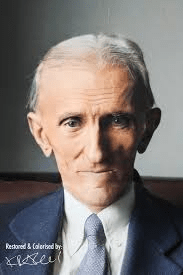
Here are some examples of Tesla’s viewpoint.In a speech, Nicola Tesla said, ‘The sources of energy capable of transforming humanity have long been near us in nature itself, in human emotions, in the sound of music, in the breath of the earth.’ He said that mankind had searched for power outside itself for too long forgetting that it is found within. ‘I believe that the energy that feeds the universe is not just a physical resource. It is something greater. We call it ether. Some call it the divine spark or the essence, they are all the same. All living things are nourished by this force. It is hidden in the depths of the planet, in the structures of light, in the harmony of sounds and in thoughts.’ He claimed that one day this energy would become the foundation of new technologies capable of feeding the hungry, healing the sick, and eliminating the need for destructive sources of energy.
Tesla noted with sorrow that in his time, society was not ready to accept such ideas. There were too much politics, greed and fear of the unknown in the world.In his view no religion can claim to be the absolute truth. He asserted that all of them are reflections of the same human desire to understand the source of life and one’s purpose. Religions and philosophies are attempts to explain the infinite with finite words. They may be useful, but they have no significance on the scale of the universe. ‘God, as I understand him, is an infinite force. It is the energy from which everything originated. But it does not judge. It does not punish. It simply exists.’ said Tesla.
During an interview that Tesla granted to a journalist in the year 1930, he said:’We are just waves in time and space, changing continuously, and the illusion of individuality is produced through the concatenation of the rapidly succeeding phases of existence’; ‘My brain is only a receiver, in the Universe there is a core from which we obtain knowledge, strength and inspiration. I have not penetrated in the secrets of this core, but I know that it exists’; ‘We are all one. Only egos, beliefs, and fears separate us’; He added ’None of those who ever lived have truly died because energy is eternal and life is a form of energy. The body departs but the essence itself, thevibration itself does not disappear.’
These ideas, of course, resonate with spiritual teachings, but Tesla emphasized he arrived at them not through faith but through science. And at the same time, he did not deny the divine.God is light, it is the primary energy from which everything began.This light has no form. It requires no worship. Itsimply exists. It is in everything, in us, in the air, in the stars. People assign human traits to Godto make it easier to understand. But the true power of God lies in his impersonality and infinity.
Then the interview returned to the topic of death. Tesla said he was notafraid of it because death is not theend but a return. He compared it to how awave returns to the ocean. You will notdie because you were never born. You havealways existed in one form or another. Weare only temporarily in these bodies, inthis world. When everything ends we willsimply move to another state. Everything is energy and it never disappears.
Yes. But to understand the overall situation, we have to imagine that everything is made of an undivided energy that has the desire and the capacity to experience and know itself. I call this unified field ‘One’. One exists ‘before’ the physical universe, though what physicists call the ‘physical universe’ is the informational aspect of reality. The semantic aspect of reality is the inner experience and knowing of One, which current physics does not recognise. Moreover, One exists in a vaster reality that contains the space–time reality we experience.
Out of One emerge conscious entities that, like One, have the desire and capacity to know themselves. Imagine each entity as a point of view or perspective that One has about itself. They are not separate from One, though their conscious experience is private. To know each other, these entities need to communicate, and to communicate they need symbols, like the words we use. Each entity is like a quantum field and the symbols are like the states of the quantum field, what we call physical particles.
If we are all part of a holistic One, how can we be separate from each other? If you experience yourself as the world that observes itself, you will directly know that you are me and I am you. So, it could never happen that I would not care about what happens to you because what happens to you also happens to me. But the only way to understand this is not intellectually. It can only occur through an experience of union, because until I had that experience of love, I could have said exactly what you just asked.
Oneness isn’t a mystical achievement or something you arrive at after years of effort; it’s simply what is already happening.
The effort usually comes from trying to feel connected, when in fact nothing was ever disconnected to begin with.
We are not in the universe like an object placed inside a container; we are something the universe is doing here and now just as a wave is something the ocean does.
Our thoughts, our breath, our body, and our relationships are not private events occurring in isolation, but expressions of the same ongoing process that moves clouds, grows trees, and turns seasons.
When this is seen, and not believed as an idea, but noticed as an experience, the sense of isolation softens.
Life stops feeling like a personal struggle to justify your place in the world and begins to feel more like participation in a larger movement, a dance you were never outside of, only momentarily imagining you were.
When we reflect on the idea of oneness, that we aren’t separate objects in a world of other objects but part of a single unfolding process, it can help us understand why events in one place ripple outward and affect people elsewhere.
The suffering and struggle communities face in any place around the world are not isolated ‘situations happening over there.’ They are part of a larger human system, shaped by shared histories, politics, economics, and our collective choices about how we govern, how we care for one another, and how we respond.
Seeing through the lens of interconnectedness, we notice that these aren’t isolated headlines: they are expressions of how we still grapple with systems that separate people into categories of ‘us’ versus ‘them.’
Oneness doesn’t mean ignoring real differences or injustices; it means recognizing that every human being’s pain and joy matters, and that the well-being of one community inevitably affects the well-being of others.
When one group is harmed or denied dignity, the reverberations are felt far beyond that community, shaping how all of us see justice, compassion, and our shared humanity.
We are not separate, what happens to one place touches the whole and indifference is not neutral.
To see our interconnectedness is to be quietly, insistently called into responsibility.
Connection is not a feeling we wait for; for it is something we practice through attention, through refusal, to care.
To resist, in this sense, is not only to oppose violence and injustice where we see it, but to interrupt the habits that allow harm to be normalized, distant, or forgotten. It is to listen, to speak, to show up, to protect one’s other dignity in ways small and structural,
Resistance rooted in oneness does not harden the heart, it sharpens it. It says: your suffering is not outside my concern; your freedom is bound up with mine. And so we act. Not because we are heroes or saviors but because separation was never real to begin with.
To connect us is to refuse the lie that some lies are disposable. To resist is to insist, again and again, on a world organized around love and care rather than domination, relationship rather than erasure.
This is not abstract philosophy it is lived practice. And it begins wherever we are.
If we take interconnectedness seriously, then awareness alone is not enough,
Seeing what is happening calls us into action. This means refusing silence when harm is justified or ignored. It means learning, naming what we see, and standing publicly against policies and systems that dehumanize, whether through state violence, displacement, occupation, or enforced poverty.
Action looks like showing up for communities under attack, amplifying voices that are being erased, demanding accountability from those in power, and materially supporting people on the front lines through mutual aid, organizing and sustained pressure.
To connect is to commit. To resist is to act in ways that make separation harder to maintain.
We choose where to spend our money, how we use our platforms, which stories we repeat, and which injustices we refuse to normalize.
We build networks of care, protect one another, and insist again and again that no one is disposable.
This is how oneness becomes practice, not theory: through collective action that interrupts harm and moves us toward a world organized around dignity, justice, and shared responsibility.
Wherever you are, whoever you are, all of us stand eye to eye, stand in love and solidarity with you.
Hello, my name is Rodger Ricketts, I’m Steph’s dad and she asked that I make a few remarks as an elder about marriage.
I begin with the magical word love. We are all here on this happy occasion because of love; these two love each other and our love for them.
Marriage is a living experience that needs to be constantly sustained and nurtured, otherwise, it can falter and vanish. Just like tending to a treasured garden, a happy marriage requires certain regular conscious actions to keep it beautiful and healthy.
Let me make a few points
Love, care and compassion create happiness. This union/ relationship is founded on love, concern, and kindness and these divine emotions are a basis for all positive actions. With each other, express your love directly through not only gentle words but also actions. Always be supportive, not aggressive.
Patience and respect for each other helps find the correct balance between achieving your wants as well as the other’s. Listen carefully to understand each other.
Marriage requires sometimes sacrifice, not out of resignation or duty, but love.
Finally, as a union together, you are stronger and wiser. As you support each other, always look for a win-win solution to problems and concerns. Laugh/cry together in your life and share happiness through and to each other.
Live and love your life, this mysterious thing called life, together.
May you and all here be happy, well and safe in your life.
“By religious feeling, what I mean altogether independently of anydogma, credo, organization of the Church, Holy Scripture, the hope of personal salvation, etc.—the simple and direct fact of a feeling of the‘eternal.’ This feeling is, in truth, subjective in nature. It is a contact.” Romain Rolland
“‘God’ must be free of properties and is thus unlike anything else, and indescribable.”Moses Maimonides
“an unqualifiable and attribute-less is the nature of ‘God.’”Mulla Rajab
“If you understand, it is not God.” St. Augustine or Augustine of Hippo
“The Tao [the absolute principle underlying the universe] that can be spoken is not the eternal Tao. The name that can be named is not the eternal name. The Nameless is the origin of Heaven and Earth.”Lao Tzu
“God has no form, no shape, no color, no differences, no race, no religion, no country, no place, no name, neither beginning nor end. God is the grace that lives within all lives.”Bawa Muhaiyaddeen
“You should love [God] as he is a non-God, a non-spirit, a non-person, a non-image, but as he is a pure, unmixed bright ‘One,’ separated from all dualities; and in that One we should eternally sink down, out of something into nothing.” Meister Eckhart
“The name Christ, an unknown significance, just as the title ‘God’ is not a name, but represents the idea, innate in human nature, of an inexpressible reality” Justin Martyr
Chapter 9- Transcendental Idealism: A Form of Enlightened Cognition The God is No-Thing An Apophatic Assertion: An Introduction for Humankind’s Transpersonal Actualization– revised -. Copyright Rodger Ricketts Psy.D.,2025. All rights reserved. Protected by international copyright conventions. No part of this chapter may be reproduced in any manner whatsoever, or stored in a retrieval system or transmitted, without express permission of the Authorpublisher, except in the case of brief quotations with due acknowledgement.
Apophatic theology highlights the transcendence of the divine orthe natural force that unites all things – that it is beyond the limits of human comprehension – in its ineffable nature. Apophatic theology —via negativa— acknowledges that human language and concepts are inadequate to fully describe the divine, so it focuses on what the divine is not. It acknowledges the vastness and mystery of the divine, ultimately allowing for a profound sense of unity with all of existence and a transcendence of ordinary dualistic perceptions of self and other.