Preface and Chapter 1 Introduction, Of the Book, God is No-thing. The Apophatic Assertion, The
Salvation for Humankind – revised -. Copyright Rodger Ricketts Psy.D.,2022. All rights reserved.
Protected by international copyright conventions. No part of this chapter may be reproduced in any
manner whatsoever, or stored in a retrieval system or transmitted, without express permission of the
Author publisher, except in case of brief quotations with due acknowledgement. Publisher
CreateSpace Independent Publishing Platform
Preface
After 40 years of active study and practice on the Buddha’s teachings and
having written four books on what I call ‘Buddha-inspired psychology,’ I
recently found a very insightful perspective that expanded what I had
learned before. The perspective is that the Buddha’s teachings are a form of
Apophatic Theology, thereby; they inherently undercut any easy attempts at
codification. The revelation of Emptiness or Sunyata with the Divine is
experienced rather than defined and categorized through limited language
descriptions. With such an emphasis on first-hand, personal experience, the
insight of intrinsic nature through Awakening runs contrary to the abstract,
‘positive’ Cataphatic theology. This book is a unique and cogent perspective
that investigates and promotes the Buddha’s teachings as a ‘negative’,
Apophatic theology.
While there are scholarly books and research articles on the topic of
Apophatic theology, very few incorporate the Buddha’s teachings and
scientific thought. In this book, I aspire to show that indeed the Buddha’s
and science’s teachings and insights can be succinctly integrated into the
Apophatic spiritual tradition that spans cultures and time. Within the larger
scope of the canons of ‘via negativa’, the Buddha’s teachings of
Nothingness or Emptiness or Sunyata and recent scientific insights are
clearly a part of the Apophatic spiritual tradition.
This revised book goes beyond what was in the first edition and instructs the
reader even more deeply about the topic. From a broad, modern perspective,
my aim is to make accessible for those who are on their own spiritual path
of personal discovery the universal teachings of the Buddha.
I have always appreciated that the Buddha taught universal truths that are
applicable everywhere and throughout time. The integration of these truths
with other teachers of Apophatic theology has affirmed my belief in this
universality. Even with my forty years of research studies, attendance of
temple retreats with monks and lay lectures and meditation practice, I have
only now found this instructive link between the Buddha’s teachings with
other teachers of the Apophatic tradition. I want to share these insights with
my fellow spiritual path voyagers. I believe they too will find it as
interesting and illuminating as I have.
Chapter One
Introduction
In the past 40 years as a clinical psychologist and student of the Buddha, I
became aware of the many similarities between the two studies. This
awareness led me to successfully integrate both in my own life and clinical
practice the benefits of combining the perspectives. As a result, I have
written four books explaining my perspective on the Buddha’s psychological
benefits for wellness and happiness.
In the past year, I learned Apophatic theology or Apophaticism. This
research introduced me to Western and other Apophatic writers resulting in
my defining the Buddha’s teachings as an example of a mystical or
Apophatic perspective.
There are clear similarities between the Buddha’s writing and Angelus
Silesius and other Apophatic theology writers. While there is some
scholarship about this similarity, unfortunately, it is rarely discussed in
either mainstream Buddhist or Christian literature. This lack of discussion
prompted me to integrate relevant aspects of my previous writings on the
Buddha’s teachings with the Apophatic perspectives and highlight what I
believe are important correspondences.
In the past, I had read some works of Christian Mystics like Meister Eckhart
and the book of the Cloud of Unknowing, but I never was specifically
introduced to the Apophatic tradition. This past year as I began to read the
Apophatic works of Angelus Silesius and Anicius Manlius Severinus
Boethius, I realized that the Buddha’s teachings could be rightly considered
Apophatic. This realization opened a new dimension of comprehension and
relevance for me about what I had written in my previous books and essays
on the Buddha’s teachings.
Apophaticism wonders how to speak about the indescribable or immanent
Existence or Absolute, instead of the common use of the pronoun or noun,
like ‘God’ or an equivalent – with its language/meaning associations or
exaggerations attached to it. The Apophatic writers prefer to use the
reference of Mysterious or No-thing. Philosopher Mulla Rajab affirmed
“…an unqualifiable and attribute-less nature of ‘God’.”
Also, philosopher Maimonides explained that ‘God’ must be free of
properties and is thus unlike anything else and indescribable. At times in my
chapters, I have used the designation of (X) instead of ‘God,’ etc., to avoid
this quandary. As the reader goes through the chapters in this book, they will
soon understand further this dilemma of designation, which is a useful
lesson in Apophatic theology.
In the following chapters, the reader will notice that I have placed emphasis
on the Buddha’s teachings throughout because I have found his ancient
teachings have the most in-depth and complete analysis of an Apophatic
training and perspective. These chapters about the Buddha’s teachings and
Apophatic writings, while not encyclopedic, are not only for intellectual
curiosity but as a living testament of truth with positive consequences not
only for the wellness and well-being of the individual but for society and the
whole Gaia. When understood and incorporated into one’s life, this is
enlightening. Clearly, in this book I inform and advocate.
To conclude, with this book’s analysis of the Apophatic, the Buddha’s
teaching and modern scientific insights, one develops a cogent scientific and
modern understanding of the inherent restrictions to fully comprehend the
mysterious nature of existence or Being. The middle way is an alternative
term for the Eightfold Path, and we do not hold extreme positions in any
way. When all words collapse into silence, we resist labeling that Wonder
with another name; therefore, we realize that we can only say ‘it is what it
is.’
Everything is impermanent and interacting with all. It is all like a flame
feeding from the original source but soon to extinguish. All form is brief and
a manifestation of the great mysterious source. Rodger R Ricketts
The student asked the teacher, ‘What is the meaning of life?’ The teacher
replied, ‘Life is the meaning. Nurture the gift of life in yourself and other
sentient beings. Support the inherent will to survive and thrive within the
natural residence of the ecosystems of existence. Be kind and wise.’ Rodger
R Ricketts
Tags: Apophatic, buddha, Buddhism, Gaia, meditation, religion, Spirituality


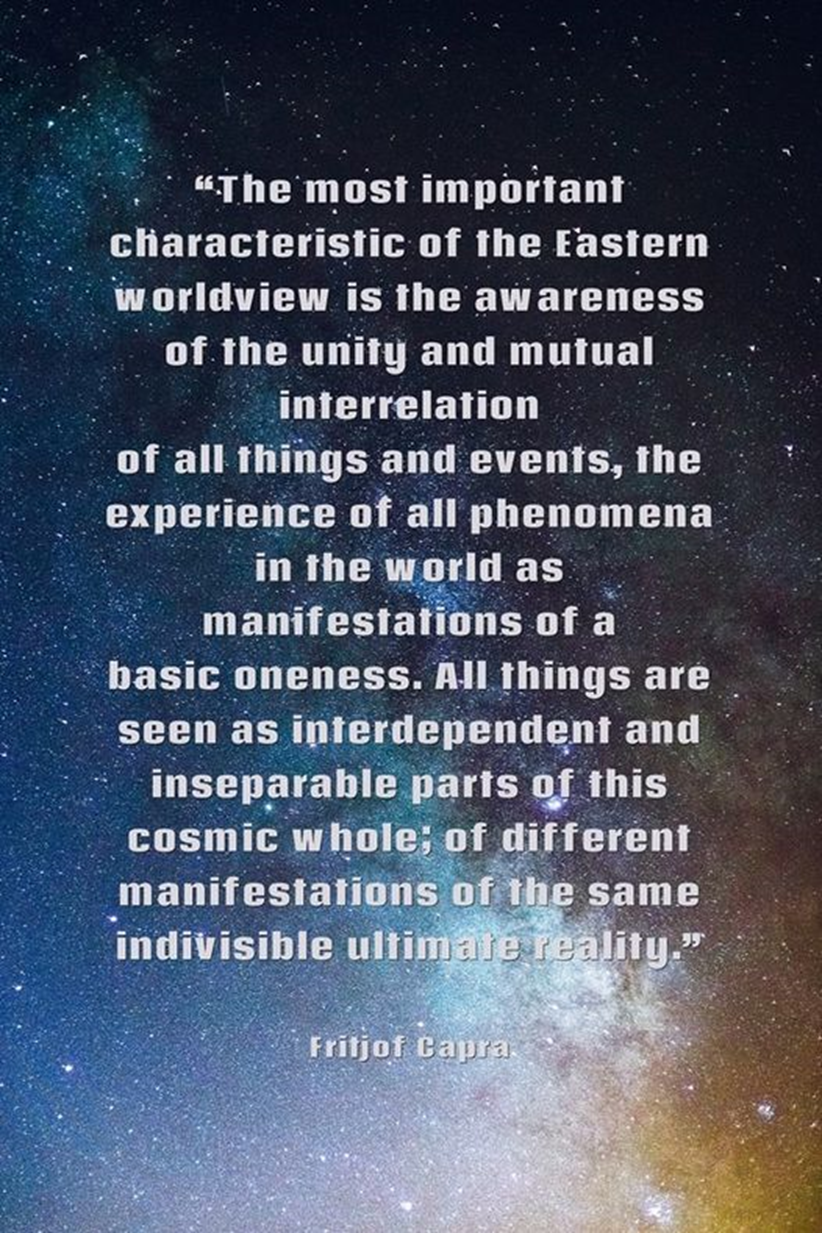


 We are all Interconnected even with the Universe