

“How Did It All Begin”
29 Dec
Steven Hawking, George Ellis, and Roger Penrose. According to their calculations, time and space had a finite beginning that corresponded to the origin of matter and energy.3 The singularity didn’t appear in space; rather, space began inside of the singularity. Prior to the singularity, nothing existed, not space, time, matter, or energy – nothing. So where and in what did the singularity appear if not in space? We don’t know. We don’t know where it came from, why it’s here, or even where it is. All we really know is that we are inside of it and at one time it didn’t exist and neither did we. There was no explosion; there was (and continues to be) an expansion. Rather than imagining a balloon popping and releasing its contents, imagine a balloon expanding: an infinitesimally small balloon expanding to the size of our current universe. Anonymous
And so without even quoting about string theory or M theory, the obvious question that goes beyond our present ability to understand is the question “How did it all begin” or “Where did the massive energy that appeared to become our known universe originate?”, etc. These questions can also become the fodder for religious thought, ie “God created the Universe” and it can be left at that for at this point science just can’t answer that question. Neither “answer” can be “correct” because science admits it is unanswerable and religion takes it on faith. So, as T. Carlyle says, the world is an inscrutable and magical place. Rodger

Touch and Mental and Physical Well-Being
29 Dec
Touch strengthens your immune system, improves sleep, reduces stress, and ramps up the body’s production of its natural painkillers.
The connection between touch and mental and physical well-being is extremely potent, according to research. Touch stimulates the vagus nerve, which has branches running through your entire body. “The nerve’s primary role is to slow the nervous system,” says Tiffany Field, Ph.D.. “As a result, your heart rate goes down, your blood pressure drops, and your stress-hormone levels fall.”
These effects have a huge impact on your health, studies have found. In Field’s research on adults with illnesses like AIDS and cancer, massage therapy was shown to boost participants’ natural killer cells, which attack bacterial, viral, and cancer cells. Because of the calming effect of touch, massages can improve sleep patterns, allowing you to spend more time in the restorative deep stages of sleep. Other research shows that touch makes the body stronger and more resistant to pain, and it increases your levels of oxytocin, which is the hormone responsible for those warm, fuzzy feelings that come with being around those you love.

Reflections about The Buddha’s Teaching: Seeing Without Illusion
18 DecRodger R Ricketts, Psy.D.
The Buddha placed primary importance on our thinking and volition. In fact, our difficulties arise when our thinking is unwholesome, in the past and in the present. Our citta or heart/mind is our kingdom or our own mentality. It is our private place where the swirl of thoughts continually passes across our mind. Only you can know what truly goes on there. There is both privacy and the possible control to think the thoughts you want. You can choose which thoughts to accept or refuse. Whichever thoughts you allow will shortly be expressed through your volition in the outer environment. Once you think the thoughts, you cannot take them back. Your choice lies in thinking or not thinking about them in the first place. The more you think unwholesome thoughts, it is like taking a substance that will sicken you both physically and mentally. What your mind dwells on will sooner or later become your ‘world’ and you will attract those energies to you. To entertain and encourage thoughts and feelings of anger, jealousy, resentment, greed, etc., is certain to not only damage your health in some way but also cause a lot of trouble and suffering in your life. So, the Buddha taught you to be Mindful or aware from every moment onwards, to watch even your habitual thinking with utmost care and nurture and promote only wholesome and skillful thinking. May All Beings Be Well and Happy.
The Buddha emphatically declared that the first beginning of existence is something inconceivable. “When this exists, that comes to be; with the arising of this, that arises. When
this does not exist, that does not come to be; with the cessation of this, that ceases, namely: dependent on ignorance, arise volitional formations … and so on … Thus is the ending of this whole mass of suffering.” There is a flux of
psychological and physiological changes, a conflux of mind and body (nāma-rūpa). Anamatagga Saṃyutta, S II 179
‘And even now in physics, they say that ‘Now’ is not something that moves forward but it is the empirically-always-present field of change which is the domain in which events are created. Therefore, the future is always indeterminate and creating new possibilities opening for genuine free will.’ Ruth E. Kastner
The young man said to the Buddha, ‘I will take up the Eightfold Path when I am older, but first I want to enjoy myself and have fun.’ Many people have this idea that by following the Eightfold Path they will be giving up things like intense sense pleasures and self-importance as well as riches and beautiful objects that they will regret not having experienced later. Instead this misses the big picture which is that what one truly comes to sacrifice by personal development through the Buddha’s teachings is selfishness, fear, alienation, insecurity, physical malady, unwholesome pleasures, pride, vanity, doubt, jealousy, self-pity, cravings, anger, hatred, etc. and, instead, what one gains through the Bhavana training includes immeasurably more happiness, peace, joy, compassion, bliss, serenity and vastly improved relationships with all sentient beings as well as oneself. So only giving up things that are not truly worth having and instead of gaining that which is, is the final ample compensation for proceeding diligently on the Eightfold Path until achieving Enlightenment.
The Buddha gave to all a practical method (Eightfold Path) for the development of the mind and heart for the shaping of our lives to eventually achieve Awakening or Enlightenment. He did not teach theology or doctrinal orthodoxy. The Buddha understood that all religious doctrines and theology are human inventions built up by the particular authors out of their own mentalities and foisted on people’s minds from the outside. Instead, The Buddha was the teacher who gave the lessons and, if we so want, we are the ones who practice sincerely what he taught and thereby develop our own insights and knowledge of especially the primary Three Universal Truths of Impermanence, No-Self and the existence of Suffering. In Buddhism, this is entirely a matter that each individual has to settle for him/herself. But if one makes the effort sincerely- the benefits appear immediately.
A wonderful and powerful practice is with especially people we have difficulty with but also all people- when you see or interact with that difficult person imagine seeing their living Buddha Nature and then you will see the layers and type of ignorance with which you are interacting. This practice is good for not only maintaining our own composure but also helps in our judgment of the difficulty of the situation. With metta.
The Realms or Worlds from ‘hell’ to ‘heaven’ are commonly described as extra-human realms but they are also instructive to us when viewed as all our ranges of mental experience created by our conscious as well as non-conscious mental or cognitive processes.
Whatever we give our attention to is what governs our life – mentally and physically. We have freedom in our ability to choose what we direct and maintain our attention on. What we consistently pay attention to becomes our ‘world’ and habitually dominates it. If we constantly direct our attention on the ever-changing, impermanent outer world we suffer anxiety and uncertainty; if we direct our attention on nothing then nothing, in particular, is expressed in our life with uncertainty and boredom. If we direct our attention to the four divine internal states and eventually arrive at Emptiness we experience happiness/bliss, good health, compassion, wisdom and certainty in the Truth of the Four Noble Truths.
Metta (loving-kindness) is defined as follows: Loving-kindness has the mode of friendliness for its characteristic. Its natural function is to promote friendliness. It is manifested as the disappearance of ill-will. Its footing is seeing with kindness. When it succeeds it eliminates ill-will. When it fails it degenerates into selfish affectionate desire. Eventually, one can begin to practice loving-kindness towards a dearly beloved companion, and then towards a neutral person as very dear, or towards an enemy as neutral. It is when dealing with an enemy that anger can arise, and all means must be tried to get rid of it. As soon as this has succeeded, one will be able to regard an enemy without resentment and with loving-kindness in the same way as one does the admired person, the dearly loved friend and the neutral person. Then with repeated practice, jhana absorption should be attained in all cases. Loving-kindness can now be effectively maintained in being towards all beings.
Ñanamoli Thera
However, those who believe in a soul only too often override the limits set by experience and concern themselves with “something completely unknowable,” as Bertrand Russell says. Moving along these wrong tracks of thought, they readily admit that all cognizable and experiential constituents of the “personality” are subject to constant change, to an unceasing rise and fall; and for that reason, they, of course, cannot be considered as an abiding ego. But it is, so they believe, just from behind or beyond the cognizable and experiential components of the personality that the true eternal self or soul appears which, naturally, must be beyond cognition and experience. What is wrong in such a position and in these conclusions, has chiefly to be attributed to the fact that an empty concept has been raised to the dignity of man’s true essence or core—a concept obtained by mere abstract ratiocination, having nothing in common with observation and experience. The futility of such a play with words has been shown by Kant. For him, a way of thinking that transgresses the limits drawn by experience is playing with ideas, and the alleged vision of something imperceptible is “a poetic fiction transcending everything imaginable, a mere whim.” The Buddha and his monks, however, are no dreamers chasing after metaphysical phantoms. They are sober realists who will not admit such groundless speculations even to the range of their considerations or refutations. Dr. Anton Kropatsch, Vienna
I’ve looked at life from both sides now
From up and down and still somehow
It’s life’s illusions I recall
I really don’t know life at all -Joni Mitchell
This is the true question that the Buddha’s teachings really address – ‘Do I Really Know Life At All?’ And in investigating the question, the answer becomes quite clear- for the uninvestigated mind, No…I don’t. All existence is much too complex, interrelated, and deep for us prideful humans to truly comprehend and indeed mystery is the result. But this is not a defeat but an affirmation of our embeddedness and interrelatedness with All of other existence. Not the folly, alienation, and separateness of the conceit of humans being the supreme being of the universe or even earth but the authentic identification of the true ecological, co-arising nature of all things. You will hear people say, ‘I am trying to find myself.’ But if you want to find yourself, then transcend yourself. When we transcend our-self, we truly find each other and our interconnection with all. We are not alone! Just look around you, there are creatures of life everywhere. If we feel alone, that is our blindness to life all around us, our suffering of alienation created by the illusion of separateness and ‘I’.
The Buddha understood how humans create “conceptual proliferation”- thinking, a representational and abstracting process that they believe and attach to. This is another way to speak about that:
‘When the animals evolved the talent to produce a virtual presence, they acquired a soul.
Then there was a God to be adored.
And an Adam was created.
As the production of virtual presences increases, man’s tie to the Real decreases. Soon, he praises innovation and inhuman courage. He invents thrills and excitement. He relies on myths and mysteries. He downgrades Nature with a reckless chisel. Life becomes the Grand Illusion. With a facility in the manipulation of virtual presences, the primal Superman was born. With perfection in the art, a second Devil took charge. It was then that man came to defy the God. The interminable conflict thrusting the virtual presences against the real intensifies.’ R. G. H. Siu
Upon Awakening the Buddha realized emptiness and the illusion of duality and a substantial Self- the consequences of the ignorance of dualistic thinking is expressed well in the following quote by Professor l. k. Tong-‘And so you opted for the substantialist’s art of self-making, Cutting off all umbilical cords to the Mother of Field-Being. You first dignify yourself in the kingly robes of an independent entity, enthroning yourself in the lonely kingdom of ego-substance. Then with the projective magic of your subjective substantiality, you objectify everything on your way to Godlike rigidity. And with the pointing of the substantializing wand, a bond was broken; a shade of mutuality has withered and waned. Now everything becomes merely external and separate from everything else. External is your objective world, you objectified a God, and your objectified self. Anything you cannot safely possess and control you relegate to the dark side of the Other, the Hell, the objective pole, and condemned it as ugly, or evil. Oh, in carrying your Godlike rigidity to all eternity (as if you were in fact rigidly eternal), you, a virtuoso in dualization, have created the most unhappy situation.’
In the Kalama Sutta, the Buddha said, ‘Now, Kalamas, don’t go by reports, by legends, by traditions, by scripture, by logical conjecture, by inference, by analogies, by agreement through pondering views, by probability, or by the thought, ‘This contemplative is our teacher.’ When you know for yourselves that, ‘These qualities are skillful; these qualities are blameless; these qualities are praised by the wise; these qualities, when adopted & carried out, lead to welfare & to happiness’ — then you should enter & remain in them.’
Many honest seekers today of the Truth, like the Kalamas, become confused and worried by the many conflicting and inconsistent sects and theologies that are pronounced daily by so many people calling themselves the ‘light to follow’. The Buddha provided a simple and direct test to guide us to know the truth of his teaching: trust yourself, your own experience, and through your experience of the correct teachings which you have found to be reliable and insightful – follow and use. Those people who are “the wise” will teach with the plan that you will see the benefit for yourself through your experience and transformation and not through blind faith and, therefore, you don’t become a slave to their wisdom, instead, you use your reason, your common sense, and your own experience as the ultimate guide and confirmation. So, you develop insights for yourself ultimately. While you can benefit from reading books and listening to teachers, etc., your true reliance is upon your real understanding created through the real work that must ultimately be done in transforming and purifying our individual mind. In the end, you know for yourself the confirmation of the Buddha’s teachings – there is suffering and the ending of suffering- and this is the only authority needed or desirable.
‘To avoid all evil, to cultivate good, and to purify one’s mind—this is the teaching of the Buddhas.’ (Dhammapada 183.) Throughout human history, innumerable plans and schemes and doctrines have been invented to make people happy, serene, and compassionate by making changes in human’s external conditions while leaving the quality of the mentality untouched and the result has over and over again been the same- failure. The Buddha taught that this failure is so because the very nature of our external existence is only changed by the purification of our conscious awareness. The difficulty for human history and never finding the key to happiness and compassion is that purification of one’s mind takes effort, diligence, and devoted practice to be successful. We must have constant unceasing vigilance and mindfulness to break the old unwholesome mental habits which are so troublesome. The Buddha understood this but also understood the benefits that arise when we do the Eightfold Path with the result of Nibbana. ‘This is peace, this is exquisite — the resolution of all fabrications, the relinquishment of all acquisitions, the ending of craving; dispassion; cessation; Nibbana.’— AN 3.32
To purify our mind as the Buddha taught, we need to release any anger or resentment toward others or our self. When we experience hurt, disappointment, deception, etc, from other people, these feelings sink into our memory and cause inflamed and festering emotional/psychological wounds of anger, resentment and possibly revenge. To purify our mind, we need to forgive. Forgiveness is a conscious, willing decision to release any feelings of resentment or vengeance toward a person or group who has harmed you, regardless of whether they deserve your forgiveness. Forgiveness is difficult and it does not mean condoning or excusing offenses, nor does it obligate you to reconcile with the person who harmed you or releases them from accountability. Instead, forgiveness brings the forgiver peace of mind and frees him or her from corrosive anger and resentment. Forgiveness involves letting go of deeply held negative feelings but also maintaining a feeling of at least neutral goodwill toward everyone who may have injured you in any way. In that way, you recognize the pain you suffered without letting that pain define you, enabling you to heal. By forgiveness, you set yourself free from the attachment to the link that you maintain even mentally to the past and the negativity. Setting yourself free from the attachment, releases you. This includes forgiveness of oneself for actions you did that you now understand were unwholesome and unskillful. Through purification and letting go of the guilt or resentment, happiness and peace will follow as well as increased wisdom and equanimity.
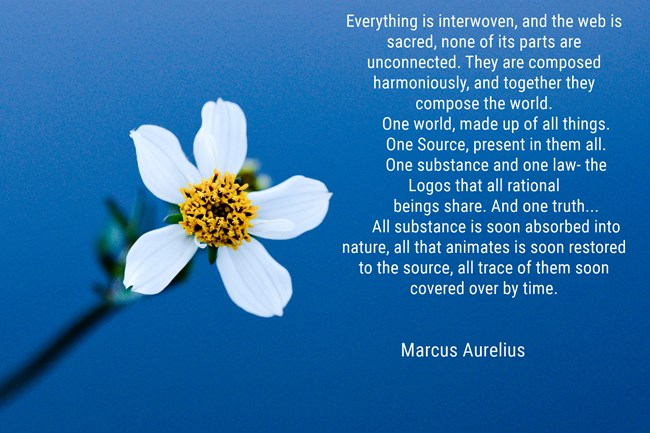

 We are all Interconnected even with the Universe