Archive | September, 2025

Neurobiology of Transformation

30 Sep

Dr. Shiv D. Talwar is a founding member of Spiritual Heritage Education Network Inc. He also has served on its Board of Directors as its president since its very inception in year 2000. Shiv’s work is intended to be used for raising consciousness for the care of each other and that of the planet on which we liveSpiritual Heritage Education Network Inc. (SHEN) partners with Ubiquity University to offer degree programs in the Neurobiology of Transformation. While Ubiquity is a global university for inner and outer regeneration, science-based education which transforms the whole person, is the purpose of SHEN’s existence.

https://copilot.microsoft.com/shares/podcasts/LABSJgHC2yvhHUmBtCLFm

“Quantum jazz”

29 Sep


The Biological Origin of “Self”

‘The body is a quantum coherent organism which creates and recreate herself from moment to moment.” Mae -Wan Ho likes to call this process “Quantum jazz”, which is the music of the organism dancing life into being. She goes on to write that: “Quantum jazz is played out by the whole organism, in every nerve and sinew, every muscle, every single cell, molecule, atom, and elementary particle, a light and sound display that spans seventy octaves in all the colors of the rainbow. There is no conductor or choreographer. Quantum jazz is written while it is being performed; each gesture, each phrase is new, shaped by what has gone before, though not quite. The organism never ceases to experience her environment, taking it in (entangling it) for future reference, modifying her liquid crystalline matrix and neural circuits, recoding and rewriting her genes. Quantum coherence is the ‘I’ in everyone that gives unity to conscious experience.”

 As we can see from these examples of a new understanding about the significance of biological regulation and coherence of the organism, the previously intuitive construct of the “Cartesian Theater” in the brain, wherein the self sits as a spectator on the world and self acts as the CEO executive of all decision making, is exposed as an illusion. Clearly, the biologically based core functions of organization, selectivity, and coherence are necessary for organism survival. The abstracted cognitive embellishments serve as relative, convenient designations or identifications, which constructs a virtual presence of the ‘self’ illusion, and is based in ignorance, and through steadfast identification creates craving and suffering. Only now are we able to empirically support the Buddha’s insights of ‘anatta or no-self’ which he gained through the introspective practice of bhavana, or meditation.

Image

Apocalypse and Glory- Rumi

28 Sep
Image

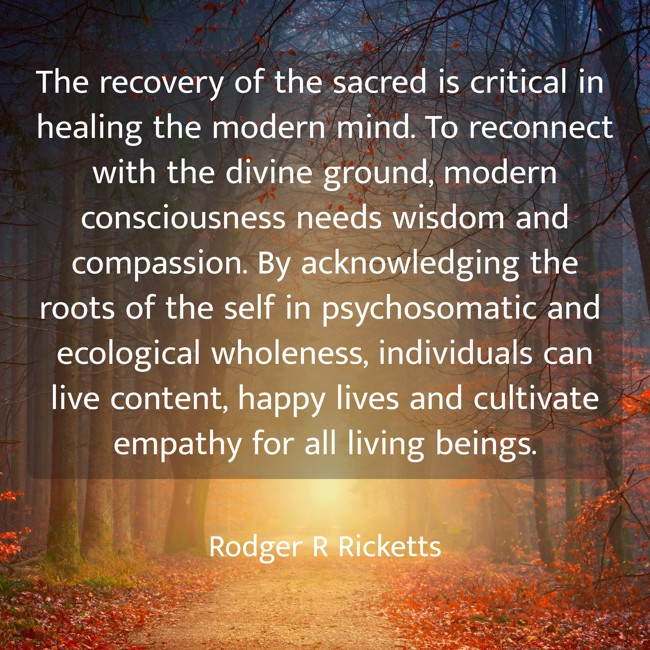
The Recovery of the Sacred

24 Sep

Excerpt from Chapter 8 – The Garden of Eden- In this Life – Relative Truths

24 Sep

Other living species such as flowers have striking leaf patterns visible only in
the ultraviolet range of the spectrum, something that can only attract the attention of their pollinators, such as bees. A consequence of perceptual relativity and the observer-dependent universe is the realization that human’s worldview comprehends relatively little of what is available; hence, claimed hu
man knowledge and awareness of the external world and universe should be approached with guidance. In fact, individually, at any one moment, we each know a very small amount of our humanity’s total knowledge and our species knows very little of how the universe really is.
Our sensory apparatus was designed by evolution to help us in our everyday lives, enabling us to survive and thrive in our environment, but it is not designed to help us understand the complexity of the universe. None of us can know any absolute truths; our human minds are by their accustomed finite subject-object relationships in relativity. The best we can do is know many relative truths, some being much better relative truths than others.While relative certainty and wisdom are necessary for us in our everyday lives, ultimately, the fact that no human can know an absolute truth should lead
people to accept that uncertainty is a natural response to this lack of knowledge.

More Apophatic Quotes…

23 Sep

God is “incomprehensible and immeasurable, beyond the grasp of the human mind.” “Human minds cannot behold God as He is in Himself” Origen of Alexandria

“He is celebrated by all beings according to the analogy that all things bear to him as their Cause. But the most divine knowledge of God, that in which he is known through unknowing, according to the union that transcends the mind, happens when the mind, turning away from all things, including itself, is united with the dazzling rays, and there and then illuminated in the unsearchable depth of wisdom” “The most Godlike knowledge of God is that which is known by unknowing.” Pseudo Dionysius

theology does “not start by making the assumption of defining God; as St John Damascene remarks, In God we cannot say what he is” “What God actually is always remains hidden from us. And this is the
highest knowledge one can have of God in this life, that we know Him to be above every thought that we are able to think of Him” Thomas Aquinas

“Entering the darkness that surpasses understanding, we shall find ourselves brought, not just to brevity of speech, but to perfect silence and unknowing.” philosopher-monk

“what He is by His essence and nature, this is altogether beyond our comprehension and knowledge” John of Damascus

“He who thinks that God is not comprehended, by him God is comprehended; but he who thinks that God is comprehended knows him not,God is unknown to those who know him and is known to those who do not know him at all.” Kena Upanishads

“The essence of your knowledge of Him, O my brother, is your firm admission that you are completely ignorant of His true essence” Baya ibn Pakudah

“In the contemplation of His essence, our comprehension and knowledge prove insufficient; in the examination of His works, how they necessarily result from His will, our knowledge proved to be ignorance, and in the endeavour to extol Him in words, all our efforts in speech are mere weakness and failure” Maimonides

“From the sayings of some early kabbalists, it is apparent that they are careful not even to ascribe personality to God. Since He is beyond everything—beyond even imagination, thought, or will—nothing can be said of him that is within the grasp of our thought” Gershom Scholem

God is “above and beyond all categories of human thought and imagination, for He is beyond all that they describe of Him” (Q. 6:100b, cited in Nasr 1987:314). He is One Who“cannot be comprehended by vision” (Q. 6:101); “Vision comprehendeth Him not,but He comprehendeth [all] vision.” He is One Incomparable: “There is naught like unto Him” (Q.42:11; cf. 16:60; 32:27). He is supremely “All-High, Transcendent or Exalted” (al-`alíy Q. 4:34; 22:62; 31:30). Qur‘án

‘The Divine Essence (al-dhát al-iláhiyya) cannot be understood by the rational faculty”. “The Divine Essence is transcendent above the cosmos, independent of the worlds” Ibn `Arabá

“none knows Allah with a real knowledge but He Himself; for every known falls necessarily under the sway and within the province of the Knower” Abu Hámid al-Ghazali

“Regard thou the one true God (ḥaqq) as One Who is apart from, and immeasurably exalted above, all created things. The whole universe reflects His glory, while He is Himself independent of, and transcendeth His creatures. This is the true meaning of Divine Unity(tawḥíd)” Baha’

“Immeasurably exalted is His Essence above the descriptions of His creatures… The birds of men’s hearts, however high they soar, can never hope to attain the heights of His unknowable Essence… Far be it from His glory that human pen or tongue should hint at His mystery, or that human heart conceive His Essence” Bahá’u’lláh

“The Formless Way: We look at it and do not see it; it is invisible. We listen to it and do not hear it; it is inaudible. We touch it and do not feel it; it is intangible. These three elude our inquiries and merge into one.” “The unity is said to be the mystery. Mystery of mysteries, the door to all wonders.” Laozi

AI generated copy of my new book’s content description— Interesting highlighting.

23 Sep

Apophatic Quotes

21 Sep

“By religious feeling, what I mean altogether independently of anydogma, credo, organization of the Church, Holy Scripture, the hope of personal salvation, etc.—the simple and direct fact of a feeling of the‘eternal.’ This feeling is, in truth, subjective in nature. It is a contact.” Romain Rolland

“‘God’ must be free of properties and is thus unlike anything else, and indescribable.”Moses Maimonides

“an unqualifiable and attribute-less is the nature of ‘God.’”Mulla Rajab

“If you understand, it is not God.” St. Augustine or Augustine of Hippo

“The Tao [the absolute principle underlying the universe] that can be spoken is not the eternal Tao. The
name that can be named is not the eternal name. The Nameless is the origin of Heaven and Earth.”Lao Tzu

“God has no form, no shape, no color, no differences, no race, no religion, no country, no place, no name, neither beginning nor end. God is the grace that lives within all lives.”Bawa Muhaiyaddeen

“You should love [God] as he is a non-God, a non-spirit, a non-person, a non-image, but as he is a pure, unmixed bright ‘One,’ separated from all dualities; and in that One we should eternally sink down, out of something into nothing.” Meister Eckhart

“The name Christ, an unknown significance, just as the title ‘God’ is not a name, but represents the idea, innate in human nature, of an inexpressible reality” Justin Martyr

Image

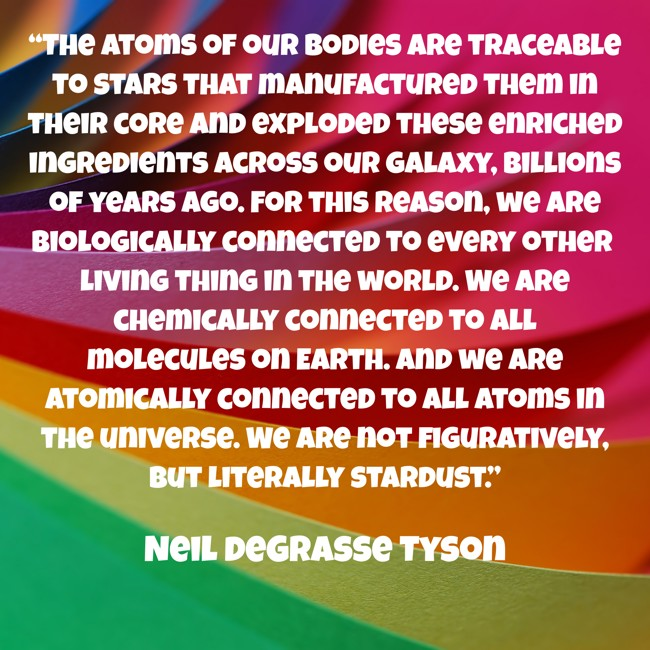
We are Literally Stardust

15 Sep

The Garden of Eden in This Life

10 Sep

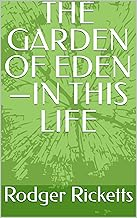
Today is the launch of my new book- The Garden of Eden in This Life. It is available in paperback, hardcover and kindle on Amazon. The following is the book description. With Metta, Rodger Ricketts.

What if the story of the Garden of Eden wasn’t just ancient myth, but a timeless guide to reclaiming our original wholeness? What if the “fall” from innocence was not the end, but an invitation to return—consciously—to a deeper unity with ourselves, each other, and the world?

In The Garden of Eden in This Life, Dr. Rodger R. Ricketts—a clinical psychologist, mindfulness teacher, and lifelong student of the Buddha’s teachings—unveils a profound perspective linking ancient wisdom, modern psychology, and the apophatic (negative) spiritual tradition. Drawing from over forty years of study and practice, he explores how non-dualistic teachings from Buddhism, science, and multiple faith traditions reveal the limits of language, the illusions of separation, and the path back to an integrated state of being.

You will journey through concepts like Sunyata (emptiness), the via negativa, and the psychology of transcendence—discovering how humanity’s separation from nature and spirit can be healed through direct experience, compassionate living, and expanded awareness.

This is more than a philosophical exploration—it’s a practical roadmap for living with clarity, joy, and interconnectedness. Through cross-cultural insights, reflective practices, and meditative approaches, Dr. Ricketts shows how embracing the ineffable mystery of life can dissolve division, foster ecological and social harmony, and restore our inner paradise.

Whether you are a seeker, a meditator, a student of comparative religion, or someone simply longing for a more meaningful existence, The Garden of Eden in This Life will inspire you to see beyond duality and step into a living experience of unity.

If you are ready to move beyond dogma, transcend the limits of language, and reawaken to the timeless ground of being—this book will guide you there.
Open these pages and begin your journey back to the Garden… in this life.