Archive | Astrophysics RSS feed for this section

NONLOCALITY AND ENTANGLEMENT – Interconnectedness

29 Jul

Nonlocality describes the apparent ability of objects to instantaneously know about each other’s state, even when separated by large distances (potentially even billions of light years), almost as if the universe at large instantaneously arranges its particles in anticipation of future events.

Thus, in the quantum world, despite what Einstein had established about the speed of light being the maximum speed for anything in the universe, instantaneous action or transfer of information does appear to be possible. This is in direct contravention of the “principle of locality”, the idea that distant objects cannot have a direct influence on one another and that an object is directly influenced only by its immediate surroundings, an idea on which almost all of physics is predicated.

Nonlocality suggests that the universe is in fact profoundly different from our habitual understanding of it and that the “separate” parts of the universe are actually potentially connected in an intimate and immediate way.
An entangled pair of particles can be seen to have complementary properties when measured.
Nonlocality occurs due to the phenomenon of entanglement, whereby particles that interact with each other become permanently correlated, or dependent on each other’s states and properties, to the extent that they effectively lose their individuality and in many ways behave as a single entity. The two concepts of nonlocality and entanglement go very much hand in hand, and, peculiar though they may be, they are facts of quantum systems which have been repeatedly demonstrated in laboratory experiments.

For example, if a pair of electrons are created together, one will have a clockwise spin and the other will have an anticlockwise spin (spin is a particular property of particles whose details need not concern us here, the salient point being that there are two possible states and that the total spin of a quantum system must always cancel out to zero). However, under quantum theory, a superposition is also possible, so that the two electrons can be considered to simultaneously have spins of clockwise-anticlockwise and anticlockwise-clockwise respectively. If the pair are then separated by any distance (without observing and thereby decohering them) and then later checked, the second particle can be seen to instantaneously take the opposite spin to the first, so that the pair maintains its zero total spins, no matter how far apart they may be, and in total violation of the speed of light law. https://www.physicsoftheuniverse.com/

The Universe Is Expanding

28 Jul

Steven Hawking, George Ellis, and Roger Penrose. According to their calculations, time and space had a finite beginning that corresponded to the origin of matter and energy.”3 The singularity didn’t appear in space; rather, space began inside of the singularity. Prior to the singularity, nothing existed, not space, time, matter, or energy – nothing. So where and in what did the singularity appear if not in space? We don’t know. We don’t know where it came from, why it’s here, or even where it is. All we really know is that we are inside of it and at one time it didn’t exist and neither did we. There was no explosion; there was (and continues to be) an expansion. Rather than imagining a balloon popping and releasing its contents, imagine a balloon expanding: an infinitesimally small balloon expanding to the size of our current universe. anonymous

This science certainly confirms the Mystics’ intuition that all is not only interconnected but One.

Image

One Continuous and Harmonious Cosmos.

26 Jul
Image

Everything is connected and interrelated

26 Jul
Image

All phenomena in the world as manifestations of a basic oneness.

26 Jul

No person is alone, no man is an island

9 Jun

In a very real sense, no person is alone, no man is an island. We are not isolated atoms, each jostling and competing against the rest in a Darwinian struggle for survival of the fittest. Instead, each of us is supported and constituted, ultimately, by all there is in the universe. We are at home in the universe. In this entangled universe, we cannot do violence to our fellow human beings or our fellow inhabitants of the Earth without doing violence to ourselves. And the most effective way to benefit oneself may be to benefit others. Most of all we are not impotent observers outside nature, subject to the slings and arrows of outrageous fortune. Instead, we are participants in the creation drama that is constantly unfolding. We are constantly co-creating and re-creating ourselves and other organisms in the universe, shaping our common futures, making our dreams come true, and realizing our potentials and our ideals. Mae Wan Ho

Image

All is One

9 Jun

Imagine

9 Jun

Human thinking can only imagine reality, just as a portrait represents a person. And as a portrait is not “the person” it represents, likewise any theory is not “the reality” it describes. We then must humbly recognize that our minds’ coherence and logic do not necessarily match the consistency of reality. And that also entails that reality does “occur” and that we cannot conclude it is an “illusion of our minds” simply because we cannot make sense of it. Henri Salles

Image

Everything is interconnected…

16 Feb

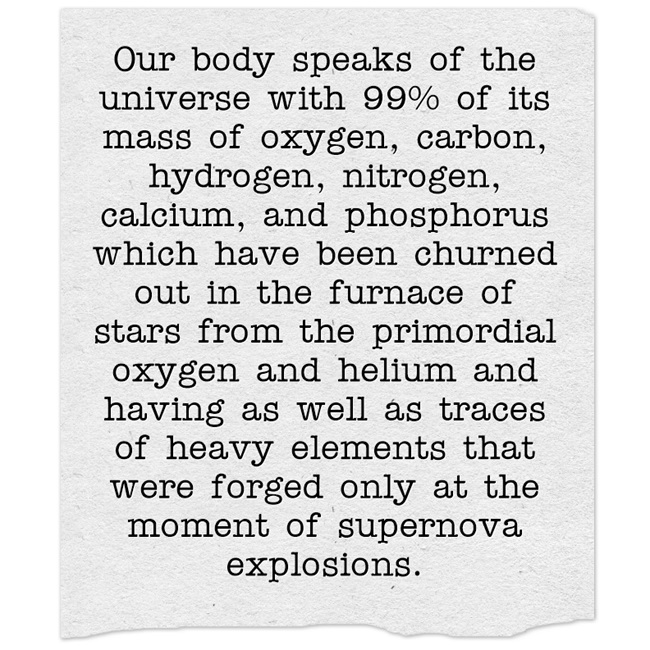
Our-body-speaks-of-the

INTERDENDENCE of Humans and Nature: We Are One

21 Jul

f51d237a58f3ee74528865387e6c99bf[1]

As I have written in my newest book- The Buddha’s Radical Psychology: Explorations, there are direct implications for ecological ethics throughout the Buddha’s teachings. There is a holism. The Buddha emphasized the interdependence of human and non-human life, the importance of the ecosystem and of natural processes. By rejecting the concept of a substantial ‘self’, and comprehension of the interdependency of all phenomena, the importance of the distinction we usually make between ourselves and other living beings lessens. Such an attitude views the world as a vast interdependent field, in which no life form, no matter how insignificant it may seem, is an outsider. There is a state of connectedness and interdependence of all phenomena. The significant realization that there is no independent ‘self’– that the perception of ‘self’, of ‘me’, of ‘mine’ is only an egotistical representation, therefore leads every person to inter-dependently co-exist. Undercutting the usual ignorant anthropomorphic view of the validity of the successful domination and control of the environment by humans, naturalist Aldo Leopold claimed that, ‘The biotic (life factor) mechanism is so complex that its working may never be fully understood.’ There is a deeper ecology that recognizes the inherent worth of other beings aside from their utility.

Another writer who expressed a similar deep view of ecology was R.G.H. Siu:

‘The term Ecology, as used locally, does not have the connotation of the “environment” as used in America. There is no separation of man and his environment; rather there is a fusion of man and his environment. Ecology represents the study of the ecological entity as a whole. When a given ecological complex appears unfavourable from the standpoint of man, for example, he does not have a prior claim to adjustment on the part of the other elements of the complex. The others have just as much “right” to demand modification of his behaviour as he has on theirs. All are one in Nature. There is an appreciation of this Oneness and the delicate interrelationships of its diffusions.’

So humans are not an isolated island in a sea of existence, but rather their being is shared ultimately with all. This becomes a clear and apparent relationship with all existence through the Buddha’s teaching of anatta.