
Angelus Silesius wrote, ‘God’ is a pure No-thing; concealed in now and here; the less you reach for ‘Him’, the more ‘He’ will appear.’ The All is the divine immanence that embraces all.
My new book is about the human species adopting an ancient, truer, sound economic, and more empathic perspective, as the present one continues to be a major disaster and will continue so into the future. For example, let’s look at war which right now is demonstrating again its evil ugliness of human duality obsessions.. Arguably the most evil and catastrophic human activity ever.
According to a New York Times article: What is a war?
War is defined as an active conflict that has claimed more than 1,000 lives.
Has the world ever been at peace?
Of the past 3,400 years, humans have been entirely at peace for 268 of them or just 8 percent of recorded history.
How many people have died in war?
At least 108 million people were killed in wars in the twentieth century. Estimates for the total number killed in wars throughout all of human history range from 150 million to 1 billion. War has several other effects on the population, including famine, environmental desolation, the killing of plants, and animals, etc. decreasing the birth rate by taking men away from their wives. The reduced birth rate during World War II is estimated to have caused a population deficit of more than 20 million people. Let’s repeat this again, Of the past 3,400 years, humans have been entirely at peace for 268 of them, or just 8 percent of recorded history.
We need a new common perspective Badly not only for war but the intelligent perspective of integrating all into the One- Non Dualism…!!!

All living things are interconnected.
All living things have DNA. And whether it comes from you, a pea plant, or your pet rat, it’s all the same molecule. It’s the order of the letters in the code that makes each organism different.
Plants, like all other known living organisms, pass on their traits using DNA. Plants however are unique from other living organisms in the fact that they have chloroplasts. Like mitochondria, chloroplasts have their own DNA.
We all came from a common ancestor. In other words, we all started out with the same DNA way back when. The different animals we see today are due to lots of small changes that have happened in living things since then.
Many small DNA changes are kept when they help the animal live better in its environment. Eventually, there are enough changes that it is a whole new animal.
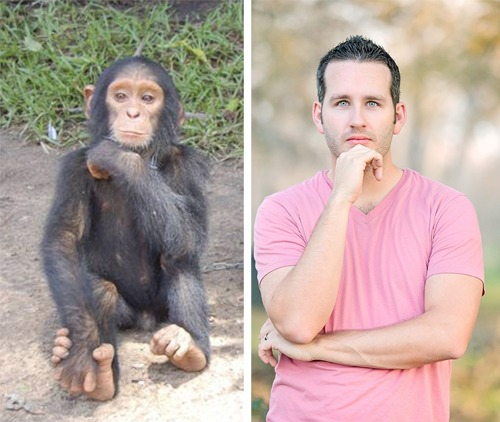
Your DNA is 99% identical to a chimpanzee’s. And it’s 95% identical to a monkey’s. And why you are about 79% identical to a mouse and even 36% identical to a little fruit fly!
In fact, you even do some things a bacterium does. You have a membrane enclosing your cells. And you both have to use oxygen and sugar to make energy. So your DNA is 7% identical to that bacterium!
But if we all started out with the same DNA, how did we end up with any differences at all? The short answer is evolution.
All living things have lots in common with each other.
DNA has the instructions for making a creature. This DNA is split up into many different sections called genes.
Each gene has a specific job. One gene might have the instructions for making something that carries oxygen in our blood. Another might have the instructions that give a person brown eyes.
No matter how different all living things may look, we all have things in common. Monkeys, people, lizards, frogs, etc. all need to breathe, see, move around, etc.
These common activities are the result of common genes. So creatures that have to do similar things will often share similar DNA.
The stringy stuff in the test tube is DNA. But you can’t tell which one of these organisms it came from just by looking at it. That’s because DNA looks exactly the same in every organism on Earth.
All humans have the same genes arranged in the same order. And more than 99.9% of our DNA sequence is the same. But the few differences between us (all 1.4 million of them!) are enough to make each one of us unique. On average, a human gene will have 1-3 bases that differ from person to person. These differences can change the shape and function of a protein, or they can change how much protein is made, when it’s made, or where it’s made.
College of Education. © University of Hawai‘i.



 We are all Interconnected even with the Universe