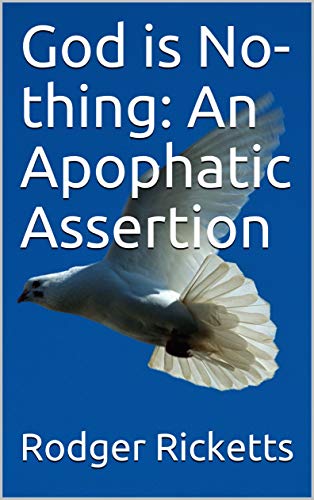
This is an unsolicited AI review of a chapter from my book cited above that was sent to me in my mailbox. I include it here for your consideration of some interesting points.
Overview
This chapter offers an in-depth exploration of apophatic theology—an approach that emphasizes what cannot be said about the divine—while weaving together both ancient and modern perspectives on mysticism, existential philosophy, and scientific insights. The text positions the apophatic tradition as a valuable, though historically underrepresented, perspective within religious and spiritual discourse. Drawing on references that span neuroscience, quantum physics, and Buddhist teachings, the chapter paints a comprehensive picture of human consciousness as inherently interdependent and open to non-dualistic experience.
Strengths
- Interdisciplinary Breadth
The chapter deftly incorporates insights from neuroscience, psychology, quantum physics, and religious studies. This interdisciplinary approach highlights the convergences of empirical science with apophatic wisdom traditions. By citing modern authors such as Thomas Metzinger, Steven Pinker, and others, the chapter underscores how age-old practices align with contemporary research on consciousness, perception, and cognition. - Clarity in Explaining Apophatic Thought
Despite the inherently mysterious and paradoxical nature of apophatic spirituality (i.e., knowing God through recognizing the limitations of what can be positively affirmed), the text manages to articulate the main thrust of via negativa in relatively accessible language. Concepts like “I-Thou” relationships, non-duality, and interbeing are introduced in ways that should resonate with readers from various backgrounds. - Use of Concrete Examples and Quotations
Several key figures—Martin Buber, the Buddha, Jesus, and others—are introduced as exemplars of non-dualistic insight. Quotes from Buber and Buddhist teachings concretize abstract ideas, showing how real people have incorporated “I-Thou” relational practices in daily life. This effectively grounds the sometimes lofty theoretical framework in personal and communal experiences. - Emphasis on Ethical Consequences
The chapter does not merely focus on the theoretical underpinnings of apophatic spirituality; it also details the moral implications. Themes such as compassion, empathy, and loving-kindness are shown to be organic outgrowths of a more unified awareness. This reaffirms how apophatic insights can have transformative effects on personal conduct and broader social relations.
Points for Consideration
- Structuring and Transitional Cues
While the chapter is rich in content, it sometimes shifts quickly between academic, mystical, and scriptural references. Additional subheadings or transition paragraphs might help ensure a smoother flow, guiding the reader through the various themes such as neuroscience, historical background, apophatic theology, and interpersonal relations. - Integration of Scientific Perspectives
The chapter draws on a wide range of scientific sources—from neuroscience to quantum theory—to illustrate points about perception and consciousness. Occasional deeper explanation or a clearer bridge between the scientific claims and the apophatic viewpoint would further strengthen the argument. For instance, elaborating on how quantum mechanics influences the concept of non-duality, or how neuroscience specifically supports the idea of “co-creating” reality, could give readers a clearer sense of how the disciplines align.
Notable Contributions
- Historical Context: The text illuminates how apophatic teachings have often been marginalized in favor of cataphatic approaches, offering a historical perspective on the conflicts that shaped religious traditions.
- Contemporary Validation: By referencing modern experiments in psychology and linguistics, the chapter gives credibility to the notion that apophatic experiences are not only culturally or historically bound but also supported by scientific frameworks.
- Comprehensive Reference List: The variety of references—from classical religious texts to works in cognitive science—serves as a useful resource for readers who wish to explore these ideas in greater depth.
Conclusion
Chapter 14 provides a comprehensive and thought-provoking account of how apophatic spirituality, grounded in non-dualistic awareness, transcends traditional theistic frameworks to offer a unifying and compassionate vision of existence. The blend of philosophical argumentation, empirical research, and ethical guidance offers a multi-layered examination of what it means to “know No-Thing.” Overall, the transformative implications for personal and collective well-being are powerfully conveyed, encouraging readers to contemplate and possibly experience directly the non-dual nature of reality.




 We are all Interconnected even with the Universe