Non-Duality – literally means “not two,” that two things we have understood as separate from one another are in fact not separate at all. At the core of existence, non-duality is a fundamental wholeness that arises from a single, unified source that transcends seeming divisions. Everything is interconnected and inseparable, making dualities—an erroneous perception of difference and separation—illusory. Awakening to non-duality offers profound benefits for personal well-being, fosters harmonious social relationships, and provides a deeper understanding of existence.
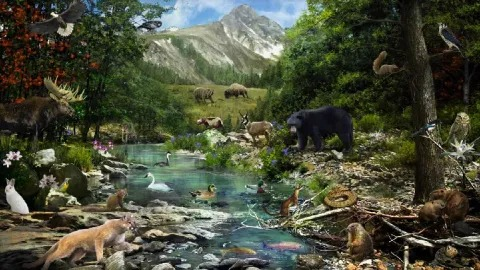
1. Unity with All Beings- Everything is interconnected with concurrent, dynamic interactions. Moving beyond superficial perception, we realize our shared essence with all life. Recognizing our deep affinity with life fosters unity, compassion, and empathy toward all living beings.
2. Living in the Present Moment- Non-duality allows us to remain fully present, helping us detach from past regrets and future anxieties. We cultivate inner serenity, empathy and clarity by embracing each moment without judgment or interpretation.
3. Transcendence of Duality. The illusion of duality is the mistaken perception that separates experience into distinct entities. When one realizes the unified nature of existence, this illusion vanishes. Non-dual awareness moves us beyond the limitations of binary thinking and frees us from splitting and rigid categorization, such as mind and body or self and other. These distinctions can lead to suffering; emotional dysregulation, and behavioural issues like aggression, causing psychological pain and instability. Non-dual awareness promotes a broader openness, freeing us from the illusions of separation and their biases.
4. Psychological Well-Being – Non-dual awareness has profound psychological and emotional benefits, for individuals, society and the planet. When we see ourselves as part of a larger whole, the fear of death begins to fade. Instead of viewing death as an end, we can see it as a transformation within the ongoing life cycle making us more psychologically flexible.
5. Embracing the Mystery of Existence – Non-duality invites us to acknowledge the mystery of living and embrace uncertainty. We realize that we cannot know Reality because everything is always changing, and our senses know a fraction of existence. which opens the mystery of living. We aren’t just observers of existence but also an integral part of it. Rather than seeking absolute dominance, we honor and respect the vast reactive complexities that lie beyond our understanding.
6. Non-duality Throughout History. Non-dualism is revealed in universal, ancient, and recent scientific discoveries that all echo similar perspectives which provide an in-depth format for a transpersonal perspective and training. Awakening to Sunyata or “emptiness” is achieved with the help of planned psychological and emotional transformation, that is consistently practiced by motivated students who seek to move from a reactive way of life, in acting, thinking, and feeling, to align themselves with awareness to the universal principles of interconnectedness and impermanence. “The cosmos is within us. We are made of star-stuff. We are a way for the universe to know itself.” – Carl Sagan
A human sees the world in 3 dimensions. That is a simplification. Humans are fundamentally limited, generalizing creatures living on autopilot. Categorization is the brain’s tool to organize nearly everything we encounter in our daily lives. Grouping information into categories simplifies our complex world and helps us to react quickly and effectively to new experiences. Categorization and classification allow humans to organize things, objects, and ideas that exist around them and simplify their understanding of the world. Categorization is like your brain’s very own personal assistant, grouping similar things together so you can find what you need, when you need it.
Our brain categorizes continuously: not only chairs during childhood, but any information at any given age. What advantage does that give us? Pieter Goltstein says: “Our brain is trying to find a way to simplify and organize our world. Without categorization, we would not be able to interact with our environment as efficiently as we do.” In other words: We would have to learn for every new chair we encounter that we can sit on it. Categorizing sensory input is therefore essential for us, but the underlying processes in the brain are largely unknown.
Social categorization is a fundamental human cognitive process because it allows for the quick simplification of complex social information. Scientists at the Max Planck Institute of Neurobiology have now shown that also mice categorize surprisingly well. The researchers identified neurons encoding learned categories and thereby demonstrated how abstract information is represented at the neuronal level.
While categorization is a natural and necessary mechanism to cope with the complexity of our world, it perilously inhibits our ability to address the most pressing and tangible problems of our time. The psychological force at play here is a need to categorize — to fit things into neatly defined, clearly labeled boxes. In times of increasing complexity, such categorization can be extremely useful, creating order in a world that is fundamentally messy and establishing structures so that we can better organize, analyze, and manage it. Yet also, extremely limiting in understanding the natural deeper complexity of life.
All humans, plants, animals and the Earth itself are built from the ashes left behind after the death of stars. We are fashioned from the nuclear waste that remains after massive stellar explosions. You Are Made of Stardust “Every atom we are made of has an origin that can be traced back to before the solar system was formed,” Prof Sir Martin Rees said to a full house at the Royal Irish Academy in Dublin. “We are literally the ashes of dead stars or the nuclear waste left behind.”“The thing we learn from astronomy is we shouldn’t think of a culmination,” he said. “The universe may have an infinite life ahead of it.”
Though the billions of people on Earth may come from different areas, we share a common heritage: we are all made of stardust! From the carbon in our DNA to the calcium in our bones, nearly all of the elements in our bodies were forged in the fiery hearts and death throes of stars.The building blocks for humans, and even our planet, wouldn’t exist if it weren’t for stars. If we could rewind the universe back almost to the very beginning, we would just see a sea of hydrogen, helium, and a tiny bit of lithium.
Prof Sir Martin Rees also suggested that, although very small compared to the rest of the universe, the Earth may be very important in cosmological terms as the place where sentient life originated before being dispersed to other planets.




 We are all Interconnected even with the Universe