Copyright Rodger Ricketts Psy.D.,2024. All rights reserved. Protected by international copyright conventions. No part of this chapter may be reproduced in any manner whatsoever, or stored in a retrieval system or transmitted, without express permission of the Author-publisher, except in case of brief quotations with due acknowledgement.
THE INTERCONNECTED UNIVERSE
‘Causes and results are infinite in number and variety. Everything affects everything. In this universe, when one thing changes, everything changes.’
Sri Nisargadatta Maharaj
Spiritual Teachings and Interdependence
Both science and spiritual and metaphysical teachings recognize that all things and events are interconnected, and part of a greater Whole. Every part of the universe is directly or indirectly related to every other part, and the description of any one part is inseparable from the description of the whole. Sufi teacher Murat Yagan: “Interdependence is a state of mutual support for the greater good of the Whole.” The concept of an interconnected universe appears throughout history, in philosophical and spiritual writings:
- Egyptian magus Hermes Trismegistus: “The without is like the within of things; the small is like the large.”
- Greek philosopher Empedocles: “The nature of God is a circle of which the centre is everywhere and the circumference is nowhere.”
- Hindu Avatamsaka Sutra: “Each object in the world is not merely itself, but involves every other object and, in fact, is everything else.”
- Buddhist Fa-Tsang: “Suspending a candle in the middle of a room full of mirrors represents the relationship of the One to the Many; placing a polished crystal in the centre of the room so that it reflects everything around it, shows the relationship of the Many to the One.”
- Oglala Sioux medicine man Black Elk: “Anywhere is the centre of the world.” And, he reported in a vision “seeing in a sacred manner the shapes of all things in the Spirit, and the shapes of all shapes as they must live together as one being.”
The world-view of traditional Eastern spiritual teachings is based on the underlying unity of all that exists and the interdependent relationship of all phenomena. In The Tao of Physics, physicist Fritjof Capra describes this connected and interactive universe: “The most important characteristic of the Eastern worldview is the awareness of the unity and mutual interrelation of all things and events, the experience of all phenomena in the world as manifestations of a basic oneness. All things are seen as interdependent and inseparable parts of this cosmic whole; of different manifestations of the same indivisible ultimate reality.”
Although the various schools of Eastern mysticism differ in many details, they all emphasize the basic unity of the universe which is the central feature of their teachings. The highest aim for their followers – whether they are Hindus, Buddhists or Taoists – is to become aware of the unity and mutual interrelation of all things, to transcend the notion of an isolated individual self and to identify themselves with the ultimate reality . . . In the Eastern view, then, the division of nature into separate objects is not fundamental and any such objects have a fluid and ever-changing character. The Eastern worldview is therefore instrinsically dynamic and contains time and change as essential features. The cosmos is seen as one inseparable reality – forever in motion, alive, organic; spiritual and material at the same time. (1)
One of the fundamental principles of Buddhism is the ‘interdependent nature of all things.’ This takes the form of an infinite network of interrelationships among all forms of existence. Zen roshi Philip Kapleau: “Everything is connected and interrelated; all things are mutually dependent for their existence. All things in the universe depend upon one another, the influence of each mutually permeating and thereby making a universal symphony of harmonious totality.” In Zen Keys, Vietnamese Zen teacher Thich Nhat Hanh writes: The expression “the interdependent relational nature” of things is tied directly to the concept of non-identity. To see things in their interdependent relational nature is to perceive their nature of non-identity. Put another way, it is to recognize their existence, even when they are not present. Let us look, for example, at a table. It exists at this very moment. We recognize its existence only when the interdependent conditions, upon which its presence is grounded, converge; but we cannot recognize its existence before these conditions are brought together. Nevertheless, the table existed before being there; it existed formerly through the play of interdependent factors such as the wood, the saw, the nails, the carpenter, and the multitude of other elements directly or indirectly connected with its existence. If one can see the existence of the table through these interdependent conditions, one can also see it in unlimited space and infinite time. (2)
The Dalai Lama articulates the traditional Tibetan Buddhist understanding of the interdependence of all phenomena in The New Physics and Cosmology: Dialogues with the Dalai Lama: “[Interdependence] does not entail that these interacting events or facts have some kind of intrinsic, objective reality in and of themselves, but rather that this absence, or emptiness, of independent existence is at the heart of their existence. Their existence and reality can make sense only within the context of interrelationships and interconnectedness.”
This accords with the core teachings of Mahayana Buddhism which describes the world as “a perfect network of mutual relations where all things and events interact with each other in an infinitely complicated way.” Buddhist scholar Lama Anagarika Govinda:
The Buddhist does not believe in an independent or separately existing external world, into whose dynamic forces he could insert himself. The external world and his internal world are for him only two sides of the same fabric, in which the threads of all forces and of all events, of all forms of consciousness and of their objects, are woven into an inseparable net of endless, mutually conditioned relations. (3)
An interconnected universe in which all parts are, at some level, related to all other parts is at odds with simple cause and effect models of reality. In fact, no event occurs in isolation, as multiple interdependent causes may be involved. “Everything is interlinked, and therefore everything has numerous causes. The entire universe contributes to the least thing. A thing is as it is, because the world is as it is.” Sufi author and teacher Idries Shah argues that cause and effect is a “primitive short-term rule of thumb.”
For example, we tend to look at events one-sidedly. We also assume, without any justification, that an event happens as it were in a vacuum. In actual fact, all events are associated with all other events. It is only when we are ready to experience our interrelation with the organism of life that we can appreciate mystical experience. If you look at any action which you do, or which anyone else does, you will find that it was prompted by one of many possible stimuli; and also that it is never an isolated action – it has consequences, many of them ones which you would never expect, certainly which you could not have planned. (4)
Other spiritual traditions agree with this contention. According to Advaita Vedanta, the principle of cause and effect is only a conceptual category. Sri Nisargadatta Maharaj: “It is the illusion of time that makes you talk of causality. When the past and the future are seen in the timeless now, as parts of a common pattern, the idea of cause-effect loses its validity and creative freedom takes its place.”
Like everything mental, the so-called law of causation contradicts itself. No thing in existence has a particular cause; the entire universe contributes to the existence of even the smallest thing; nothing could be as it is without the universe being what it is. When the source and ground of everything is the only cause of everything, to speak of causality as a universal law is wrong. The universe is not bound by its content, because its potentialities are infinite; besides it is a manifestation, or expression of a principle fundamentally and totally free . . . For everything there are innumerable causal factors. But the source of all that is, is the Infinite possibility, the Supreme Reality, which is in you and which throws its power and light and love on every experience. But, this source is not a cause and no cause is a source. Because of that, everything is uncaused. You may try to trace how a thing happens, but you cannot find out why a thing is as it is. A thing is as it is, because the universe is as it is.
(5)
Gurdjieff and ‘Reciprocal Maintenance’
One of the cornerstones of Gurdjieff’s Fourth Way cosmological teachings is the concept of ‘reciprocal maintenance’ or ‘reciprocal feeding.’ In his magnum opus Beelzebub’s Tales to His Grandson, he termed this process as Trogoautoegocrat (“I keep myself by feeding”), and described it as a universal principle which interrelates all levels of the universe and results in the reciprocal maintenance or feeding of “All and Everything.” In Gurdjieff: Making a New World, John G. Bennett succinctly outlines the main features of this cosmic process: “The transformation of energies depends on the relationship of entities, whereby each maintains the existence of others in a kind of universal mutual support system. Each order of beings is endowed with a form of energy that enables it to play its part in the cosmic process.”
Reciprocal maintenance in its special sense connotes that the universe has a built-in structure or pattern whereby every class of existing things produces energies or substances that are required for maintaining the existence of other classes. Gurdjieff uses the terms involution and evolution to describe the process. Involution is the transformation process in which a high level of energy acts on lower energies through an apparatus which provides the necessary environment and conditions. The human body is such an apparatus and so is any other living organism. The earth also provides an environment for high level energy – such as solar radiation – to act upon the more passive elements of the earth’s crust and atmosphere. Involution is entropic, that is to say the overall level of energy is always lowered in all involutionary changes. Evolution is the reverse process. It is the production of high level energy from a lower level source. This also requires an apparatus, but of a different kind, for the ‘up-grading’ of energy is improbable and cannot occur at all unless some high level energy is present. Life is an evolutionary process that goes against the direction of probability. The work by which man is transformed is evolutionary. It goes against the stream of life. (6)
In a talk to his students in 1918, Gurdjieff presented the theoretical basis of the principle of reciprocal maintenance: the transformation of matter and energy as a universal process of descent (involution) and ascent (evolution):
Everything in the world is material and – in accordance with universal law – everything is in motion and is constantly being transformed. The direction of this transformation is from the finest matter to the coarsest, and vice versa. Between these two limits there are many degrees of density of matter. At some points in the development there are, as it were, stops or transmitting stations. These stations are everything that can be called organisms in the broadest sense of the word – the sun, the earth, man and microbe. These stations are commutators which transform matter both in its ascending movement, when it becomes finer, and in its descending movement, toward greater density . . . This transformation of substances in two directions, which is called evolution and involution, proceeds not only along the main line from the absolutely fine to the absolutely coarse and vice versa, but at all intermediate stations, on all levels, it branches aside. A substance needed by some entity may be taken by it and absorbed, thus serving the evolution or involution of that entity. Everything absorbs, that is, eats something else, and also serves as food. This is what reciprocal exchange means. This reciprocal exchange takes place in everything, in both organic and inorganic matter. (7)
According to Gurdjieff, the universe was created as an unending chain of systems bound by universal interdependence. In this cosmic process of ‘exchange of substances’ everything that exists is dependent on and connected to everything else; nothing is separate:
The principle of universal interdependence is certainly not found only in the teaching of Gurdjieff. It appears in many traditional teachings. But his convincing exposition of it is indisputably original. A generalized non-separability characterizes the universe of Gurdjieff. Systems on different scales have their own autonomy, for according to the terminology of Gurdjieff, the Absolute only intervenes directly at the creation of the first cosmos. The other cosmoses formed themselves freely by self-organizing principles – always, however, in submission to the law of three and the law of seven. In this way the diversity of the universe is assured. On the other hand, the interaction of the different cosmoses by means of the universal exchange of energy-substances assures unity in diversity. Life itself appears not as an accident, but as a necessity in this universe of universal interdependence . . . Gurdjieff’s universe is not a static universe, but a universe in perpetual movement and change, not only on the physical plane, but also on the biological and psychic planes. Evolution and involution are always at work in the different worlds. And when we consider the important number of different matters characterized by different degrees of materiality, we can understand the essential role of the universal exchange of substances in evolution and involution. (8)
Gurdjieff emphasized the importance of reciprocal maintenance in the overall organization and functioning of the cosmos. Reciprocal maintenance shows how existing forms interact with other forms in a symbiotic relationship of mutual support. Functionally, higher levels of reality “spiritualize” lower levels of existence by organizing and then transforming them, under the direction of fundamental cosmic laws, into “higher patterns of meaning and value.” John G. Bennett: “Our customary way of thinking and talking about the world is in terms of objects and events, both of which are abstractions. Gurdjieff saw the world as the universal process of the transformation of energies, regulated by two fundamental laws (the law of three and the law of seven) and various ‘second-grade’ laws arising from their interaction. The two basic realities are relations and transformations.”
The world was brought into existence because ‘being’ and ‘time’ are mutually destructive. Everything separate and closed within itself must perish for lack of a principle of renewal. There is partial renewal by borrowing energy from outside, but this is not enough. Full renewal requires full mutuality. It is by Universal giving and receiving of energies that Cosmic Harmony is maintained. This, in turn, requires an organized structure which is given by the interaction of the different classes and levels of reality. (9)
Some contemporary physicists have noted a correspondence between Gurdjieff’s idea of reciprocal maintenance and the ‘bootstrap’ principle of modern physics. The bootstrap concept implies that at every level of nature there is an underlying unity which is maintained by a dynamic intelligence in permanent evolution. Such a universe is capable of self-creation and self-organization, without any other external intervention of other energies and forces. In the words of physicist Paul Davies: “The universe fills itself exclusively from within its own physical nature with all the energy necessary to create animate matter.” Physicist Basarab Nicolescu expresses a similar idea: “It seems evident that self-creation and self-organization only have meaning in a universe which is made up of an infinite chain of systems regulated by universal interdependence. Unity in diversity and diversity through unity are the conditions for selfcreation and self-organization. Otherwise there is nothing but the law of accident that can act.”
The trogoautoegocratic process of Gurdjieff presents a remarkable correspondence to the ‘bootstrap’ principle formulated in physics around 1960 by American physicist Geoffrey Chew. This word “bootstrap” also implies “to pull yourself up by your own bootstraps.” The closest equivalence in the scientific context would be ‘self-consistency.’ In the bootstrap theory, the part appears at the same time as the whole. What is put in question in bootstrap theory is the very notion of a particle’s identity: it substitutes instead the notion of the relationship between “events.” It is the relations between events which are responsible for the appearance of what we call a particle. There is no object in itself possessing its own identity, that we could define in a separate or distinct manner from other particles. A particle is what it is because all other particles exist at the same time: the attributes of a determined physical entity are the results of interactions with all the other particles. According to bootstrap, there really is a “law of reciprocal maintenance” of all quantum particles. Also, as in the trogoautoegocratic process, a system is what it is because all other systems exist at the same time. The role of self-consistency in the construction of reality should be emphasized – a self-consistency which assures the coherence of the All. (10)
Science and Interrelationship
Science has revealed that a pattern of mutual relationships occurs at all levels of the universe, from the minute quantum world of sub-atomic physics to the inconceivably vast realm of stars, nebulae, supernovas, quasars, black holes and galaxies studied by modern astronomy. The relationships between the different elements and levels of the natural world can take a variety of forms: equivalent, symmetrical, mutually supportive, hierarchical, or asymmetric.
The fundamental laws of physics are universal and apply throughout the universe. They reveal that an intrinsic interconnectivity pervades the entire universe at all levels of reality, linking disparate phenomena in a harmonious, indivisible whole. In The Tao of Physics, Fritjof Capra writes: “The universe is seen as a dynamic web of interrelated events. None of the properties of any part of this web is fundamental; they all follow from the properties of other parts, and the overall consistency of their mutual interrelations determines the structure of the entire web.”
The concept of the hologram has been applied to describe a universe in which everything is interrelated and part of a greater whole, and supposed dualities are recast as complementary polarities. This ‘unity in diversity’ is one of the hallmarks of the new vision of the cosmos enunciated by leading thinkers and scientists. In this paradigm, all things in the phenomenal world are intrinsic elements in an integral whole: “The holographic nature of the manifest world enables the coherent oneness, the integral wholeness of the universe, to be expressed through the many facets of cosmic order at all scales of existence. It is the means by which every aspect of the cosmos can relate to and interface with every other aspect as well as the whole.”
For much of human history, the visible universe was conceived as a “machine” composed of separate, independent objects. The discoveries of quantum physics in the early 20th century changed this prevailing paradigm and ushered in a completely new world-view characterized by energy fields, subatomic particles, probability, complementarity, uncertainty, and dynamic relationship. Physicist Max Planck: “In quantum mechanics it is impossible to obtain an adequate version of the laws for which we are looking, unless the physical system is regarded as a whole. According to field theory, each individual particle of the system, in a certain sense, at any one time, exists simultaneously in every part of the space occupied by the system.”
Modern physics now recognizes the unbroken wholeness of a reality in which the universe is seen not as a collection of discrete physical objects, but rather as a vast nexus of relationships between the various parts of a unified whole. Quantum theory supports the notion of a basic interconnectedness of all the constituent parts of the universe. Physicist David Bohm: “We say that inseparable quantum interconnectedness of the whole universe is the fundamental reality, and that relatively independently behaving parts are merely particular and contingent forms within this whole.”
Our work brings out in an intuitive way just how and why a quantum manybody system cannot properly be analyzed into independently existent parts, with fixed and determinate dynamical relationships between each of the parts. Rather, the “parts” are seen to be in immediate connection, in which their dynamical relationships depend, in an irreducible way, on the state of the whole system (and indeed on that of broader systems in which they are contained, extending ultimately and in principle to the entire universe). Thus, one is led to a new notion of unbroken wholeness which denies the classical idea of analyzability of the world into separately and independently existent parts. We now find that the relationships between any two particles depend on something going beyond what can be described in terms of these particles alone. Indeed, more generally, this relationship may depend on the quantum state of even larger systems, within which the system in question is contained, ultimately going on to the universe as a whole. (11)
Interconnectivity also operates at the human physiological level. For instance, the human body is constantly renewing itself as it interacts with the surrounding environment – a process sometimes called a “biodance” or the “dance of life.” Dr. Larry Dossey: “Each body structure has its own rate of reformation: the lining of the stomach renews itself in a week; the skin is entirely replaced in a month; the liver is regenerated in six weeks. Some tissue is relatively resistant to the constant turnover, such as the supporting tissue called collagen and the iron in the blood’s hemoglobin molecules. But even though these rates of replacement differ, after five years one can presume that the entire body is renewed even to the very last atom.”
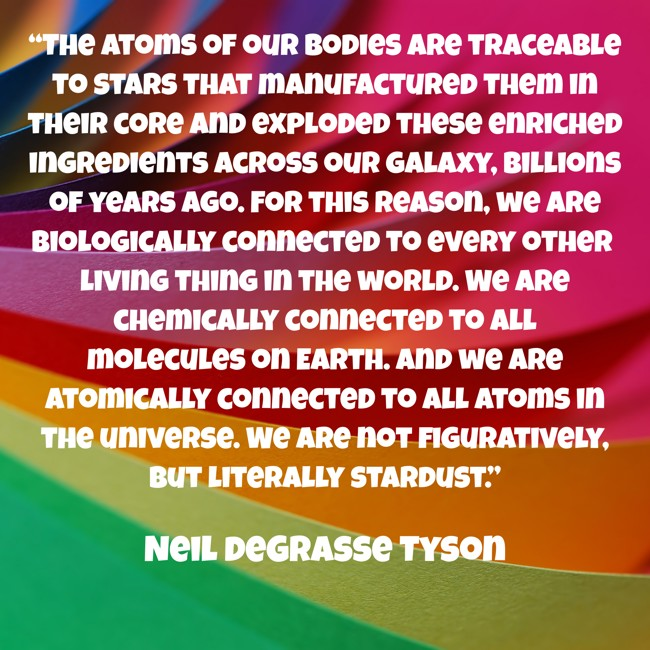
Biodance – the endless exchange of the elements of living things with the earth itself – proceeds silently, giving us no hint that it is happening. It is a dervish dance, animated and purposeful and disciplined; and it is a dance in which every living organism participates. These observations simply defy any definition of a static and fixed body. Even our genes, our claim to biologic individuality, constantly dissolve and are renewed. We are in a persistent equilibrium with the earth. Yet the boundary of our body has to be extended even farther than the earth itself. We know that certain elements in our body, such as the phosphorus in our bones, were formed at an earlier stage in the evolution of our galaxy. Like many elements in the earth’s crust, it was cycled through the lifetime of several stars before appearing terrestrially, eventually finding its way into our body. A strictly bounded body does not exist. The concept of a physical I that is fixed in space and that endures in time is at odds with our knowledge that living structures are richly connected with the world around them. Our roots go deep; we are anchored in the stars. (12)
Humanity has a deep spiritual responsibility for the welfare of the mineral, plant and animal kingdoms, and a recognition of the primacy of Great Nature, for which we depend for so many of our needs. One of the consequences of the fact of universal interdependency is to awaken a respect for all forms of life. Fourth Way author Keith Buzzell: “We live in one continuous and harmonious cosmos. Studies in many diverse fields of science reveal a cosmos of such grandeur and subtlety, of such tightly interwoven and interdependent energies, that past myth, imagery and analogy pale in their ability to convey its real dimensions.”
Everything, every state of matter or energy, every idea, feeling and motion in our entire Cosmos is interconnected (webbed and woofed) into one great moving whole. This interconnectedness is not an abstract, indifferent, mechanical process but is, rather, an endless, multi-layered feeding – sustaining – nurturing. Since everything is essential and has its roles to fulfill within the whole, everything is to be valued in balanced proportion. The balanced proportion can only be approached if man’s third brain is constantly alerted to and reminded of the real hazard of egoism and enabled to explore and create new and more harmonious personal (first brain) and social (second brain) images . . . If so, then we can only encourage you to consider with care and sobriety, the world inside and outside of us. Consider the uncountable wars and the unremitting weight of suffering of the mothers and children of this world. Consider what we have done to this beautiful, fragile planet. Is this what we wish for our children and for all children to come? (13)
Systems Theory
A useful approach to understanding the interrelationship of all things is the framework known as systems theory, sometimes called “general systems theory.” The systems view of life studies the world in terms of patterns and relationships. A system is defined as an integrated whole whose properties cannot be reduced to those of its parts. Psychologist Lawrence LeShan: “Primarily, objects and events are part of a pattern which itself is part of a larger pattern, and so on until all is included in the grand plan and pattern of the universe. Individual objects and events exist, but their individuality is distinctly secondary to their being part of the unity of the pattern.”
Fritjof Capra:
Natural systems are wholes whose specific structures arise from the interactions and interdependence of their parts. Systemic properties are destroyed when a system is dissected, either physically or theoretically, into isolated elements. Although we can discern individual parts in any system, the nature of the whole is always different from the mere sum of its parts. Systems are intrinsically dynamic. Their forms are not rigid structures but are flexible yet stable manifestations of underlying processes . . . Living systems tend to form multi-leveled structures of systems within systems. For example, the human body contains organ systems composed of several organs, each organ being made up of tissues, and each tissue made up of cells. All these are living organisms or living systems which consist of smaller parts and, at the same time, act as parts of larger wholes. Living systems, then, exhibit a stratified order, and there are interconnections and interdependencies between all systems levels, each level interacting and communicating with its total environment. (14)
The natural world offers many examples of the collective action of individual members of a species creating larger, more complex systems embodying a group mind or intelligence.
Patterns of such collective coordination can be seen in highly integrated insect communities: “Extreme examples are the social insects – bees, wasps, ants, termites, and others – that form colonies whose members are so interdependent and in such close contact that the whole system resembles a large multi-creatured organism. Bees and ants are unable to survive in isolation, but in great numbers they act almost like the cells of a complex organism with a collective intelligence and capabilities for adaptation far superior to those of its individual members.”
Examples of systems abound in nature. Every organism – from the smallest bacterium through the wide range of plants and animals to humans – is an integrated whole and thus a living system. Cells are living systems, and so are the various tissues and organs of the body, the human brain being the most complex example. But systems are not confined to individual organisms and their parts. The same aspects of wholeness are exhibited by social systems – such as an anthill, a beehive, or a human family – and by ecosystems that consist of a variety of organisms and inanimate matter in mutual interaction. What is preserved in a wilderness area is not individual trees or organisms but the complex web of relationships between them. (15)
Systems theorists have identified some of the principal laws of nature exhibited by systems:
- Coherence: Complex systems are organized in such a way that each of its parts is linked with every other part. Coherence can exist both within the components of a given system (internal viability) and between other systems (external adaptation).
- Interaction: New forms and functions emerge as diverse elements interact. Interaction creates interconnection, which produces coherence. “The hallmark of a system of such coherence is that its parts are correlated in such a way that what happens to one part also happens to the other parts – hence it happens to the system as a whole.”
- Complementarity: Polarity is a basic characteristic of living systems. Opposites balance each other in a state of equilibrium (e.g., yin/yang).
- Recursion: The parts and elements of the whole have similar patterns which repeat each other at successively deeper levels. “Coherent systems are inevitably complex. A higher form of organization in a complex system does not just repeat the structure on the lower levels, but adds novelty, while repeating key patterns that remain invariant.”
- Instability: There are limits to the growth of a coherent system – beyond a critical point, systems become unstable and break down into their individual components.
- Evolution: The evolution of natural systems is towards higher levels of coherence and complexity. “There is a progression from level to level of structure and complexity in nature: from the atomic to the molecular, from the molecular to the multimolecular, from the multimolecular to the cellular and multicellular, and from there to the ecological and bio-spherical.”
Through the action of the above, and other related laws, complexity emerges in the universe as evolution creates more and more complex and coherent atomic, molecular, biological and psychosocial structures and systems.
The self-organization of systems is a recurring feature at all levels of the universe: “The recursive system of self-organization, where every layer curves back on itself to monitor another layer, pervades physics and biology. Self-organization is embedded in the fabric of the cosmos, acting like an invisible, offstage choreographer to drive evolution.” In You Are the Universe, Deepak Chopra and Menas Kafatos discuss this important concept:
In a self-organizing system, each new layer of creation must regulate the prior layer. So, the generation of every layer in the universe, from particle to star to galaxy to black hole, cannot be considered random, given that it was created from a pre-existing layer that in turn was regulating the layer that produced it. The same holds true throughout nature, including the workings of the human body. Cells form tissues, which in turn form organs, the organs form systems, and finally, the entire body has been created. Each layer emerges from the same DNA, but they stack up, as it were, until the pinnacle of achievement, the human brain, crowns it all . . . Whether we are speaking of genes and the brain or solar systems and galaxies, self-organization is present. Existence requires balance, which demands feedback. By monitoring itself, a system can correct imbalances automatically. Every new bit of the universe, however minuscule, must create a feedback loop with what gave rise to it. Otherwise it wouldn’t be connected to the whole. (16)
The building blocks of most systems are based on the principle of hierarchy, which determines the levels of organization and the nature and structure of the interconnections. Each living component possesses its own self-organization and a limited degree of autonomy within the larger system. These systems exist in a hierarchy in which higher levels subsume and regulate lower levels. “Every system does its job, being more or less responsible for its own survival and reproduction (within its niche in the whole organism), at the same time being controlled by one or more superordinate regulatory systems.” Many systems, both natural and manmade, are organized in a hierarchical structure:
Nature appears to be structured as levels of organization or complexity. Elementary particles give rise to atoms, atomic structures form molecules, which in turn form macromolecules such as proteins and DNA, which are the basis for living organelles and cells, which congregate and cooperate to form the profusion of living organisms populating the planet. Evolution, as a progressive complexification of matter and psycho-biotic systems, is ostensibly a dynamic process of ever-increasing levels of complexity and organization. In the sense of nested systems within systems, hierarchy is an accurate and appropriate description of nature . . . If we picture nature’s nested systems as circles within circles within circles, where the boundaries of all the circles are permeable, then hierarchy permits the flow of information and energy both up and down, and laterally, between systems at all levels. Hierarchy involves the communication of information and energy through “upward causation,” from lower-level (meaning less complex) systems to higher level (meaning more complex and organized) systems, and “downward causation,” from higher-level systems to their component parts; as well as horizontal causation (laterally between systems on the same level). In this systems view of hierarchy, power resides in the cooperative relationships between the various systems and their parts. (17)
In summary, the systems view of the universe is essentially holistic and integrative; it looks at the world in terms of interrelatedness and interdependency, linking all levels of existence in a unified whole. “Living systems are organized in such a way that they form multi-leveled structures, each level consisting of subsections which are wholes in regard to their parts, and parts with respect to the larger wholes. All entities – from molecules to human beings – can be regarded as wholes in the sense of being integrated structures, and also as parts of larger wholes at higher levels of complexity.”
Information and Inter-Communication
Science has traditionally held that matter and energy are the foundations of physical reality. But an emerging viewpoint posits that a more subtle, but equally fundamental, factor is also important: information. In Science and the Akashic Field, Ervin Laszlo stresses the importance of information for the interdependent functioning of the cosmos: “Information links all things in the universe, atoms as well as galaxies, organisms and minds. This discovery transforms the fragmented world-concept of the mainstream sciences into an integral, holistic worldview.”
In order to account for the presence of a significant number of particles in the universe, and for the ongoing evolution of the existing things, we need to recognize the presence of a factor that is neither matter nor energy. The importance of this factor is now acknowledged not only in the human and the social sciences, but also in the physical and the life sciences. It is information – information as a real and effective factor setting the parameters of the universe at its birth, and thereafter governing the evolution of its basic elements into complex systems. Information is an inherent aspect of both physical and biological nature . . . Information is not a human artefact, not something we produce by writing, calculating, speaking, and messaging. As ancient sages knew, and as scientists are now rediscovering, information is present in the world independent of human volition and action and is a decisive factor in the evolution of the things that furnish the real world. The basis for creating a genuine “theory of everything” is the recognition that “information” is a fundamental factor in nature. (18)
Laszlo provides a useful operational definition of information (or “in-formation”): “Information is the subtle, quasi-instant, non-evanescent and non-energetic connection between things at different locations in space and events at different points in time. Such connections are termed “nonlocal” in the natural sciences and “transpersonal” in consciousness research. In-formation links things (particles, atoms, molecules, organisms, ecologies, solar systems, entire galaxies, as well as the mind and consciousness associated with some of these things), regardless of how far they are from each other and how much time has passed since connections were created between them.”
A number of scientists have suggested that some of the quandaries of current cosmological theories can be resolved through the concept of information. “A common theme among researchers trying to look beyond general relativity and quantum theory to a more unified understanding of nature is that something else lies at the root of all things: information.”
The discoveries of quantum physicists in the early 20th century had tremendous implications for understanding the nature of reality. In The Field, Lynne McTaggart stresses the importance of their findings: “They realized that the very underpinnings of our universe is a heaving sea of energy – one vast quantum field. If this were true, everything would be connected to everything else like some invisible web.”
They also discovered that we were made of the same basic material. On our most fundamental level, living beings, including human beings, were packets of quantum energy constantly exchanging information with this inexhaustible energy sea. Information about all aspects of life, from cellular communication to the vast array of controls of DNA, was relayed through an information exchange on the quantum level. Even our minds operated according to quantum processes. Thinking, feeling – every higher cognitive function – had to do with quantum information pulsing simultaneously through our brain and body. Human perception occurred because of interaction between the subatomic particles of our brains and the quantum energy sea. We literally resonated with our world. In a stroke, they had challenged many of the most basic laws of biology and physics. What they may have uncovered was no less than the key to all information processing and exchange in our world, from the communication between cells to perception of the world at large. More fundamentally, they had provided evidence that all of us connect with each other and the world at the very undercoat of our being. (19)
One of the strangest features of quantum physics is the phenomenon of “nonlocality” or “entanglement.” Physicists discovered that some pairs of sub-atomic particles or atoms are entangled or correlated, and remain instantly connected over time: “Their nonlocality respects neither time nor space: it exists whether the distance that separates the particles and the atoms is measured in millimeters or in light-years, and whether the time that separates them consists of seconds or millions of years.”
As Niels Bohr, a Nobel prize-winning pioneer of quantum physics, discovered, once subatomic particles such as electrons or photons are in contact, they remain forever influenced by each other instantaneously and for no apparent reason, over any time or any distance. When particles are entangled, the actions of one will always influence the other in the same or the opposite direction, no matter how far they are separated. They act like a pair of star-crossed lovers who are forced to separate and live independently forever, but who continue not only to know each other’s moves but also to imitate the other’s every activity for the rest of their days. Albert Einstein had refused to accept nonlocality, disparaging the theory as “spooky action at a distance.” Einstein claimed this type of instantaneous connection couldn’t occur because it would require information traveling faster than the speed of light, which he considered the absolute outer boundary of how quickly one thing can affect something else. Even subatomic particles were not supposed to be able to affect other particles faster than the time it would take the first to travel to the second at the speed of light. (20)
In 1972, physicist John Bell proposed a possible test of the validity of nonlocality – taking measurements on a pair of quantum particles which were initially in contact but later separated. A decade later in Paris, physicist Alain Aspect and his team conducted an actual experiment which confirmed Bell’s theory. In The Holographic Universe, Michael Talbot describes the results: “Aspect’s real-life experiment showed that when two photons were fired off from a single atom, the measurement of one photon affected the position of the second photon. Whatever happened to one was identical to, or the very opposite of, what happened to the other. A comparison of the measurements showed that both were the same. Some invisible wire appeared to be connecting these two quantum particles across space, to make them follow each other forever.”
The phenomenon of nonlocality and the transmission of information across levels of the universe appears in fields as diverse as cosmology, evolutionary biology, ecology and consciousness research:
It is clear that nonlocal coherence has important implications. It signals that there is not only matter and energy in the universe, but also a more subtle yet real element: an element that connects, and which produces the observed quasi-instant forms of coherence. Identifying this connecting element could solve the puzzle at the forefront of scientific research and point the way toward a more fertile paradigm. We can take the first step toward this goal by affirming that information is present, and has a decisive role, in all principal domains of nature. Of course, this information that is present in nature is not the everyday form of information but a special kind: it is “in-formation” – the active, physically effective variety that “forms” the recipient, whether it is a quantum, a galaxy, or a human being. (21)
Although nonlocality or entanglement was first discovered at the quantum level, it is not limited to this domain, and also surfaces at macroscopic scales in the universe, such as electromagnetic and other fields. Ervin Laszlo proposes that the structures and processes of the manifest physical world are determined by interacting waves or patterns of energy and information embedded in the “Akashic field.”
A world where connection, coherence, and coevolution are fundamental features is not a fragmented and fragmentable world, but an integral one. In this world nonlocality is a fundamental factor: things that occur at one place and time also occur at other places and times – in some sense, they occur at all places and times . . . There is an urgent need for a paradigm in which nonlocality is a basic feature – the paradigm of a world that is intrinsically nonlocal. Such a paradigm is now emerging at the leading edge of scientific inquiry. It is based on a new understanding of how parts interact within wholes; ultimately how the parts we know as quanta and the macroscale entities built as coordinated sequences of quanta interact within the larger whole we call “cosmos.” The basic concept that can convey scientific meaning and legitimacy to this understanding is field. Fields are bona fide elements of the physical world, although they are not in themselves observable. They are like fishing nets so fine that their strands cannot be seen. The fields themselves are not visible, but they produce observable effects. Fields connect phenomena. Local fields connect things within a particular region of space and time, but there are also universal fields that connect things throughout space and time. Quanta, and the things constituted of quanta, interact through fields, and they interact universally. (22)
Scientists are becoming aware of the primary role of information in describing the laws and workings of physical reality. “Information really is physical and it literally in-forms our Universe, while at the same time transforming our view of what we actually mean by the term physical.”
The laws of motion and thermodynamics that define how matter and energy move and how they interact are basically laws of information. The concept of information content and flow is starting to be used powerfully to describe physical phenomena at deeper and more all-encompassing levels. The two twentieth century pillars of science, the quantum and relativity theories, are also being re-evaluated as informational theories, a development that is being seen as having the potential to finally bring together these as yet unreconciled perspectives of our Universe. This is just the first step to a much more encompassing perception, one that not only aims to understand the completeness of the physical world but also proposes a cosmology that encompasses all aspects of existence and experience and seeks answers to the deeper question of not only how reality is as it is but also why. (23)
Information exchange seems to occur at all levels of reality. For instance, an electron is much more than a simple structureless point. The active use of information by electrons, and indeed by all sub-atomic particles, indicates that the ability to respond to meaning is an innate characteristic not only of consciousness but of all matter. There is also evidence that at the smallest atomic scale, space-time is pixellated, suggesting that this is the foundational level for information and holographic reality.
The content and flow of information creates patterns and relationships between and within all scales of existence. The events and processes at each level of reality are not random or based on chance – rather, they are dependent on the information they embody. In The Cosmic Hologram, Jude Currivan writes: “Our Universe is fundamentally interconnected as a unified entity that is underpinned and permeated by information. The universal speed limit exhibited by light ensures that information is transferred at a constant and finite limit within space-time, maintaining causality and enabling our universe to experience and evolve.”
Information literally in-forms all that we call physical reality, and from the innate instructions, conditions, ingredients, recipe, and container, of the information that make up the cosmic hologram, enables the outcome of a universe that nurtures the evolution of complexity and ever more self-aware consciousness – makes a universe that is perfect for us. To understand the essential wholeness of reality requires that the principles and laws of physics be restated in informational terms. At every scale from the most minute up to its entirety, the reality of our Universe is indeed being restated in this way, revealing itself as being constituted of holographically expressed information, which is more fundamental than space-time and energy-matter . . . There’s no fundamental difference between quantum and macroscopic scales. They only appear different owing to the difficulty of informationally isolating larger entities from their surroundings. This shows that our Universe is innately coherent and nonlocally unified, where everything is fundamentally interconnected and informational in nature. (24)
The fundamental flow of information is integral to the ordering and evolution of the universe and the development of individual biological entities. Ervin Laszlo: “The network of information applies to all scales, from the genesis and evolution of the universe itself to the development and increase in complexity and ordering of matter – leading all the way to the emergence of the order defining biological organisms and systems expressing self-awareness, by which the universe is ultimately aware of itself.”
Information exchange is the key to understanding the evolution of the universe. The laws and processes of the flow of information provide a deeper understanding of the nature of physical reality as well as integrating quantum theory (which describes universally conserved energy-matter) and relativity theory (universally entropic space-time). “The origin of our universe, in an extraordinarily ordered state, embodied its minimum informational entropy that ever since has increased inexorably, causing the arrow of time to flow and the principle of causality within space-time to be inviolate.” In The Cosmic Hologram, Jude Currivan explores the significance of information in the evolution of the universe:
From its birth, [the universe] encoded the complete information and algorithmic instructions that ensured that all laws of physics pertaining to the behavior of energy-matter and that are described by quantum theory prevail universally and so enable it to exist as a unified entity. Such encoding and coherence also empowered the creation of elementary particles and the fundamental processes and interactions that progressively gave rise to stars, galaxies, and the evolution of ever-greater complexity and diversity. Information expressed as energy-matter, visible and dark, is both conserved and balances exactly to zero throughout its entire lifetime. Such conservation of information expressed as energy-matter on a universal basis is a statement of the first law of information. As such, the first law of information is essentially also the generalized expression of quantum theory . . . The continually increasing entropic flow of information within space-time, rising to a maximum at the end of the lifetime of our Universe, has enabled the development of ever-higher levels of consciousness and self-awareness to be expressed, embodied, and experienced. The nature of time itself can even be considered as being the accumulated flow of informational entropy, ever increasing from past to present to future. Indeed, just as the first law of information is an expression of quantum theory, so the second law of information is that for relativity theory. The first law of information enables our Universe to exist; the second law enables it to evolve. (25)
References
- Fritjof Capra The Tao of Physics (Boulder: Shambhala, 1975), p. 24.
- Thich Nhat Hanh Zen Keys (New York: Anchor Books, 1974), pp. 88-89.
- Lama Anagarika Govinda Foundations of Tibetan Mysticism (New York: Samuel Weiser, (1974), p. 93.
- Idries Shah The Sufis (London: Octagon Press, 1984), pp. 71-72.
- Sri Nisargadatta Maharaj I Am That (Durham, North Carolina: The Acorn Press, 2005), pp. 9-11.
- John G. Bennett Gurdjieff: Making a New World (New York: Harper & Row, 1973), pp. 189-190.
- G.I. Gurdjieff Views from the Real World: Early Talks of Gurdjieff (New York: E.P. Dutton, 1973), pp. 209-210.
- Basarab Nicolescu “Gurdjieff’s Philosophy of Nature” in Jacob Needleman and George Baker, eds. Gurdjieff: Essays and Reflections on the Man and His Teaching (New York: Continuum, 1996), pp. 48-49.
- John G. Bennett Gurdjieff: Making a New World (New York: Harper & Row, 1973), p. 206.
- Basarab Nicolescu “Gurdjieff’s Philosophy of Nature” in Jacob Needleman and George Baker, eds. Gurdjieff: Essays and Reflections on the Man and His Teaching (New York: Continuum, 1996), pp. 49-50.
- Bob Toben Space-Time and Beyond (New York: E.P. Dutton, 1975), p. 135.
- Larry Dossey Space, Time & Medicine (Boulder: Shambhala, 1982), pp.74-75.
- Keith Buzzell Man – A Three-Brained Being (Salt Lake City: Fifth Press, 2007). pp. 58-59.
- Fritjof Capra “The New Vision of Reality: Towards a Synthesis of Eastern Wisdom and Western Science” in Stanislav Grof, ed. Ancient Wisdom and Modern Science (Albany: State University of New York, 1984), pp. 139-140.
- Fritjof Capra The Turning Point (New York: Simon and Schuster, 1982), pp. 266-267.
- Deepak Chopra and Menas Kafatos You Are the Universe (New York: Harmony Books, 2017), pp. 71-72.
- Ervin Laszlo Science and the Reenchantment of the Cosmos (Rochester, Vermont: Inner Traditions, 2006), pp. 118-119.
- Ervin Laszlo Science and the Akashic Field (Rochester, Vermont: Inner Traditions, 2007), p. 13.
- Lynne McTaggart The Field (New York: Harper Perennial, 2003), pp. xvii-xviii.
- Michael Talbot The Holographic Universe (New York: Harper Perennial, 2011), pp. xiii-xiv.
- Ervin Laszlo Science and the Akashic Field (Rochester, Vermont: Inner Traditions, 2007), pp. 60-61.
- Ervin Laszlo The Self-Actualizing Cosmos Rochester, Vermont: Inner Traditions, 2014), pp. 8-9.
- Jude Currivan The Cosmic Hologram (Rochester, Vermont: Inner Traditions, 2017), pp. 2-3.
- Jude Currivan The Cosmic Hologram (Rochester, Vermont: Inner Traditions, 2017), pp. 112-113.
- Jude Currivan The Cosmic Hologram (Rochester, Vermont: Inner Traditions, 2017), pp. 113-115.
Tags: consciousness, Knowledge, life, philosophy, physics, reality, Science, Spirituality




 We are all Interconnected even with the Universe