According to NASA, ‘Is there life beyond Earth? So far, the silence is deafening.’ And yet!!!!!!!! How easily some dismiss the preciousness of Life by destroying and harming it continuously with such greed and fervor. Instead, as Nobel Prize recipient A. Schweitzer said…’ Ethics is nothing other than Reverence for Life. Reverence for Life affords me my fundamental principle of morality, namely, that good consists in maintaining, assisting and enhancing life, and to destroy, to harm or to hinder life is evil.’
My new book is about the human species adopting an ancient, truer, sound economic, and more empathic perspective, as the present one continues to be a major disaster and will continue so into the future. For example, let’s look at war which right now is demonstrating again its evil ugliness of human duality obsessions.. Arguably the most evil and catastrophic human activity ever.
According to a New York Times article: What is a war?
War is defined as an active conflict that has claimed more than 1,000 lives.
Has the world ever been at peace?
Of the past 3,400 years, humans have been entirely at peace for 268 of them or just 8 percent of recorded history.
How many people have died in war?
At least 108 million people were killed in wars in the twentieth century. Estimates for the total number killed in wars throughout all of human history range from 150 million to 1 billion. War has several other effects on the population, including famine, environmental desolation, the killing of plants, and animals, etc. decreasing the birth rate by taking men away from their wives. The reduced birth rate during World War II is estimated to have caused a population deficit of more than 20 million people. Let’s repeat this again, Of the past 3,400 years, humans have been entirely at peace for 268 of them, or just 8 percent of recorded history.
We need a new common perspective Badly not only for war but the intelligent perspective of integrating all into the One- Non Dualism…!!!
All living things have DNA. And whether it comes from you, a pea plant, or your pet rat, it’s all the same molecule. It’s the order of the letters in the code that makes each organism different.
Plants, like all other known living organisms, pass on their traits using DNA. Plants however are unique from other living organisms in the fact that they have chloroplasts. Like mitochondria, chloroplasts have their own DNA.
We all came from a common ancestor. In other words, we all started out with the same DNA way back when. The different animals we see today are due to lots of small changes that have happened in living things since then.
Many small DNA changes are kept when they help the animal live better in its environment. Eventually, there are enough changes that it is a whole new animal.
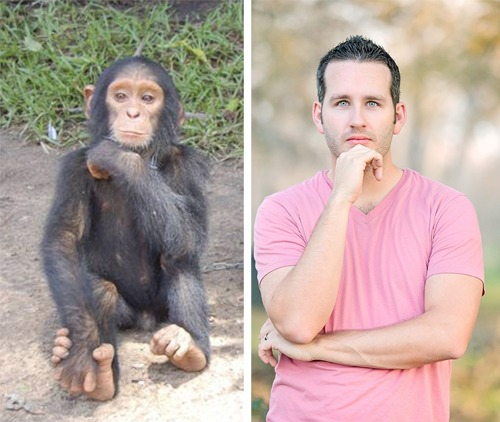
Your DNA is 99% identical to a chimpanzee’s. And it’s 95% identical to a monkey’s. And why you are about 79% identical to a mouse and even 36% identical to a little fruit fly!
In fact, you even do some things a bacterium does. You have a membrane enclosing your cells. And you both have to use oxygen and sugar to make energy. So your DNA is 7% identical to that bacterium!
But if we all started out with the same DNA, how did we end up with any differences at all? The short answer is evolution.
All living things have lots in common with each other.
DNA has the instructions for making a creature. This DNA is split up into many different sections called genes.
Each gene has a specific job. One gene might have the instructions for making something that carries oxygen in our blood. Another might have the instructions that give a person brown eyes.
No matter how different all living things may look, we all have things in common. Monkeys, people, lizards, frogs, etc. all need to breathe, see, move around, etc.
These common activities are the result of common genes. So creatures that have to do similar things will often share similar DNA.
The stringy stuff in the test tube is DNA. But you can’t tell which one of these organisms it came from just by looking at it. That’s because DNA looks exactly the same in every organism on Earth.
All humans have the same genes arranged in the same order. And more than 99.9% of our DNA sequence is the same. But the few differences between us (all 1.4 million of them!) are enough to make each one of us unique. On average, a human gene will have 1-3 bases that differ from person to person. These differences can change the shape and function of a protein, or they can change how much protein is made, when it’s made, or where it’s made.
Thinking and learning about evolution and cooperation between species is hampered by a number of rationalistic principles. Western rationalism … places a strong emphasis on the individual ego that is in a world full of things with qualities, but also on the view that humans are superior to other living beings (Korthals 2018). The view that man is a symbiotic being contradicts this idea of individuality. Men as symbionts means there is no ‘I’, there is everywhere a (widespread) we-process, composed of different species, namely symbionts of life and death. Because of our inadequate senses, our unilateral communication ability through spoken language, and the growth of our brains, people believe that other beings do not communicate. That is why it took so long to discover communicative and cognitive skills in other species (Meijer and Bovenkerk).
The evolutionary achievements of the brain have simultaneously equipped man with very deficient senses. The brain has shrunk the senses (Wilson, 2014) Language is an extensive network of useful communication with the world for people and therefore the specific possibilities the senses can realize are diminished. With spoken language and a thinking brain, people see themselves as separate beings, separate from plants, animals, and microbes. Man is secluded (alienated) at the top of evolution, or sees himself as a world-shaping against all those other world-blind beings. As a result of this anthropocentrism, man is blind to important, life-feeding interactions and communications between other animals, plants, and dead matter. Due to the great emphasis on language as a superior communication system, other communication systems are not covered. But animals and plants have other, equally effective communication systems that enable co-evolution. Slowly we become a little smarter in research into how living beings live, communicate and, above all, feed themselves and others (De Waal 2016). In Western philosophy, many barriers have been raised against the elaboration of this idea. In particular, the view that man is an exceptional being due to rationality or consciousness makes it difficult to see that animals and plants also think, feel, and communicate in a certain way. This anthropocentrism can still be found in leading philosophers.Anthropocentrism erects a barrier between humans and other living organisms and therefore denies the wide variety of processes of communication, valuing, and solidarity with non-human animals.
Humanity in the Living, the Living in Humans Michiel Korthals






 We are all Interconnected even with the Universe