Omniscient Love is unconditional love in its most self-less, objective mode: “A love that is open to and nonjudgmental about all perceptions, cognitions, and intuitions.” It is the ‘enlightened’ state of consciousness sought in the meditative practices entailed in all human disciplines—viz, spiritual, artistic, intellectual, therapeutic, corporal, social, and so forth. As the highest state of love, Omniscient Love is present as an inherent potential in all humans. It embodies our ever-present psychoenergetic interconnection with everyone and everything around us— including the Universe itself, and hence, is the access channel to our highest psychic and spiritual proficiencies.
Bradley RT. Love, Consciousness, Energy, and Matter: The Heart’s Vital Role in Coherence and Creation. Cardiol Vasc Res. 2024; 8(1): 1-25.
In the late 1980s, Lieserl, the daughter of the famous genius, donated 1,400 letters, written by Einstein, to the Hebrew University. This is one of them, for Lieserl Einstein.
I ask you to guard the letters as long as necessary, years, decades, until society is advanced enough to accept what I will explain below.There is an extremely powerful force that, so far, science has not found a formal explanation to. It is a force that includes and governs all others, and is even behind any phenomenon operating in the universe and has not yet been identified by us.
This universal force is LOVE.
When scientists looked for a unified theory of the universe they forgot the most powerful unseen force. Love is Light, that enlightens those who give and receive it. Love is gravity, because it makes some people feel attracted to others. Love is power, because it multiplies the best we have, and allows humanity not to be extinguished in their blind selfishness. Love unfolds and reveals. For love we live and die. Love is Divine and Divine is Love.This force explains everything and gives meaning to life. This is the variable that we have ignored for too long, maybe because we are afraid of love because it is the only energy in the universe that man has not learned to drive at will. To give visibility to love, I made a simple substitution in my most famous equation.If instead of E = mc2, we accept that the energy to heal the world can be obtained through love multiplied by the speed of light squared, we arrive at the conclusion that love is the most powerful force there is, because it has no limits.
After the failure of humanity in the use and control of the other forces of the universe that have turned against us, it is urgent that we nourish ourselves with another kind of energy…If we want our species to survive, if we are to find meaning in life, if we want to save the world and every sentient being that inhabits it, love is the one and only answer. Perhaps we are not yet ready to make a bomb of love, a device powerful enough to entirely destroy the hate, selfishness and greed that devastate the planet. However, each individual carries within them a small but powerful generator of love whose energy is waiting to be released.When we learn to give and receive this universal energy, dear Lieserl, we will have affirmed that love conquers all, is able to transcend everything and anything, because love is the quintessence of life.
I deeply regret not having been able to express what is in my heart, which has quietly beaten for you all my life. Maybe it’s too late to apologize, but as time is relative, I need to tell you that I love you and thanks to you I have reached the ultimate answer! “.
The majority of individuals remain unaware that an alternative mode of living exists. They fail to recognize that contemporary society has compelled us to make a detrimental choice: by embracing an artificial environment, we ultimately diminish our capacity to connect with the vital energy of life. Many do not perceive this as a loss, as they are unfamiliar with this innate ability or the boundless potential and exceptional well-being it can provide. Regrettably, artificial stimuli now surpass natural positive signals. For example, a restful night’s sleep offers us positive natural stimuli that nurture our life energy. Similarly, for example, contact with the Earth, exposure to sunlight, consumption of natural foods, and the internal sensations of the body all convey positive signals that help sustain the connection with life energy. Unfortunately, these positive signals are increasingly overwhelmed by artificial and negative stimuli, resulting in a diminished natural sensation and disconnection from energy.
The acceptance of a creative force or source can only bring us to a conclusion of an inherent acceptance of ourselves as being a part of the Divine itself. If the Divine energy creates the great oneness of all things; physical beings, sentient beings, universes, dimensions, even the space that exists between planets, universes and dominions, then we as human beings are an expression of the Divine and this beautiful love-energy. We are not separate from it. We are here to play our part in the work in the great oneness. This beautiful divine thought of creation. Shaolin Buddhist Temple, Slane, Co. Meath, Ireland
Therefore, the body is deeply sacred indeed. The body is a beautiful expression of the spirit come to life. This view about body and spirit has been described by Jorge N. Ferrer, professor of religious psychology as “embodied spirituality.” He wrote that:“Embodied spirituality regards the body as subject, as the home of the complete human being, as a source of spiritual insight, as a microcosm of the universe and the Mystery, and as pivotal for enduring spiritual transformation. The body is not an “It” to be objectified and used for the goals or even spiritual ecstasies of the conscious mind, but a “Thou,” an intimate partner with whom the other human dimensions can collaborate in the pursuit of ever-increasing forms of liberating wisdom.”
For Ferrer the body is the home of the complete human being. It is the physical reality in which we live. It is through the body that we both literally and metaphorically walk our own unique path. The mistake that so many religious understandings have made is that they have seen the body as the prison of the soul. Something that the spirit or soul needs to be liberated from. He claims that the mystery of incarnation never suggested that spirit entered into the body but that the spirit became flesh. To quote John’s Gospel “In the beginning was the Word, and the Word was God…And the Word became flesh.” Through our bodies, our lives, the way we live our lives the spirit comes to life. We are here for a reason, life truly means something and it is our task to bring that something to life, through our lives, through our bodily existence.
Embodied spirituality is about fully inhabiting our lives, our thoughts, our feelings our relationships with ourselves, our lives, each other and the mystery that connects all life. It’s about being fully present in our bodies and lives and therefore fully experiencing our potential, being fully alive. The body is not just a suit that clothes our being. It is through the body that we experience what it is to be fully alive. They say “listen to your body”, sage wisdom indeed. For me the body is not a separate entity to spirit, I cannot agree with this dualistic view, it seems to me that it is through the body that spirit comes alive and further through the body that the spirit is fed.
Embodied spirituality views every aspect of our humanity, whether that be body, spirit, heart, mind and consciousness as equal partners in bringing the self, community and world into a fuller alignment with the mystery that brings into being all life, while at the same time connects all life. I suspect it’s a kind of panentheism, that sees all life as being in God and that God is in all life and that little or perhaps infinite more. It sees the full engagement of the body as being vital to spiritual growth and transformation.Rev. Danny Crosby
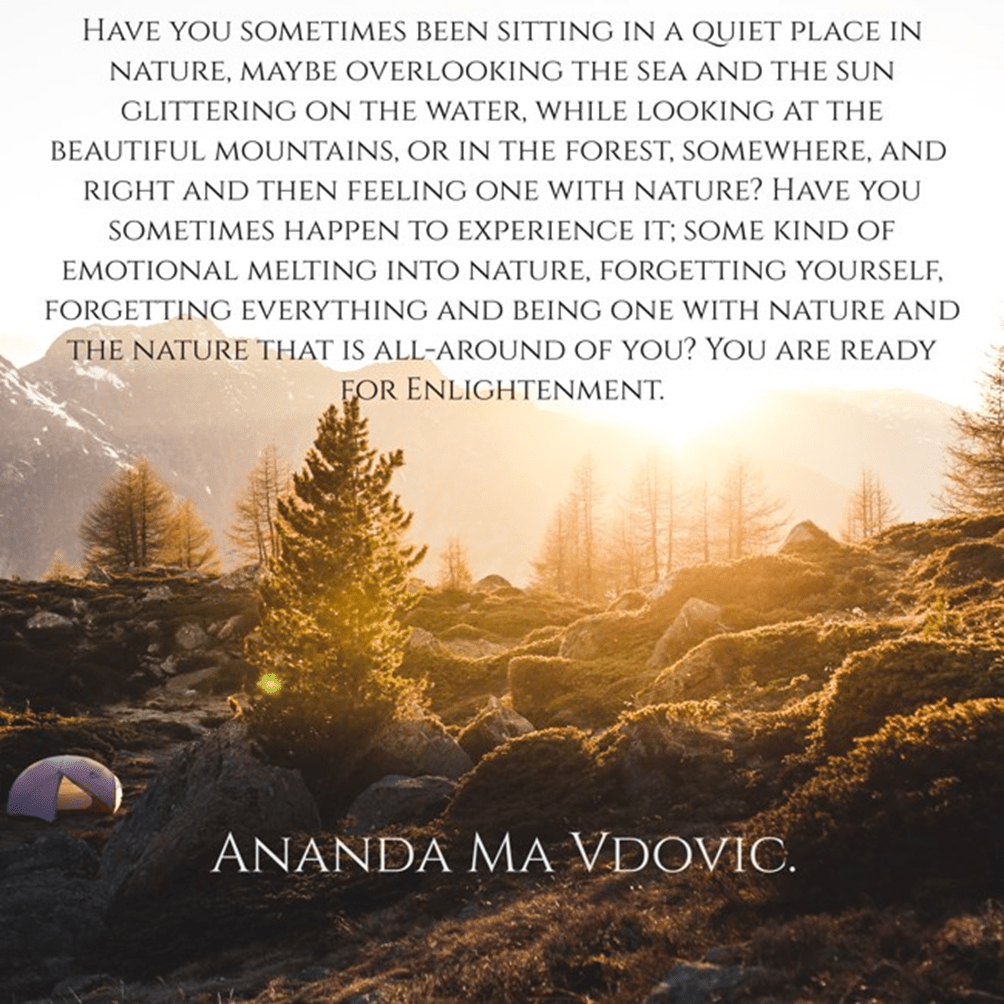
Eutierria can be an antidote to alienation, from nature and society both. Eutierria refers to secular experiences but echoes the “oceanic” feeling identified in various world religious traditions. When it occurs, your perception of the boundaries between yourself and all else—the thoughts and feelings setting you off from the rest of the cosmos—seem to evaporate. The distinction between you and nature (or in the religious versions nature and God) breaks down. You become one with the universe. A reassuring sense of harmony and connection with the world infuses your consciousness. It’s an experience that matches up with the knowledge of your own dependence on and connection to the world. Consider for a moment what this all means for identity and personhood. Each person is always living in a precise and unique position and moment. Nobody else receives all the same perceptual stimuli as you because you’re always at different positions on the planet, in the universe. That is, you exist at a unique juncture in the world and thus absorb a unique trajectory of sensory experiences that exactly match nobody else’s. et me conclude by noting that experiences of eutierria can be a powerful antidote to the over-separateness of our modern world. The rise of individualism over communitarianism and conceptions of the unity of nature in the West from early modern times, as I write in my book Invisible Nature, has left us with feelings and experiences of alienation from nature and lots of social alienation as well.[3] By placing the individual at the center of concern rather than the whole community of life, modernity can create loneliness. Seeking out eutierria can help heal the divide. Kenneth Worthy Ph.D.


 We are all Interconnected even with the Universe