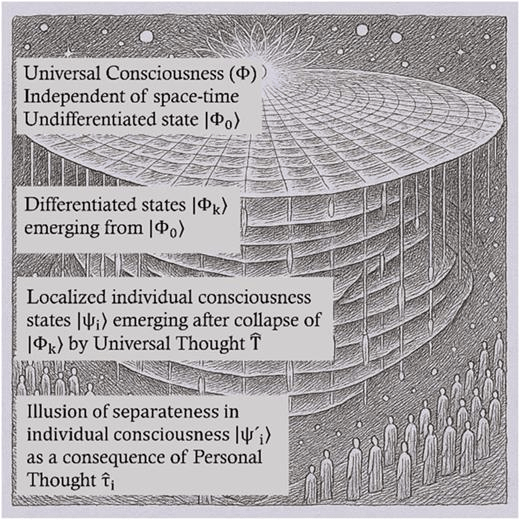
Illustration of the proposed framework and its implications for sentient beings. The universal consciousness field (Φ) exists beyond space–time in an undifferentiated state (. Through differentiation, it gives rise to localized excitations (), which manifest as physical structures or individual consciousness. Following the Big Bang, Φ evolves, generating complex systems capable of awareness—sentient beings with individual consciousness ψ) localized in space–time. Once differentiated, personal thought (τ) shapes individual awareness and perception, producing evolving subjective interpretations of reality ψ over time. This process creates the illusion of separateness, even though all individual consciousness remains intrinsically connected within the universal consciousness field.
Universal consciousness as foundational field: A theoretical bridge between quantum physics and non-dual philosophy
Science has traditionally held that matter and energy are the foundations of physical reality. But an emerging viewpoint posits that a more subtle, but equally fundamental, factor is also important: information. In Science and the Akashic Field, Ervin Laszlo stresses the importance of information for the interdependent functioning of the cosmos: “Information links all things in the universe, atoms as well as galaxies, organisms and minds. This discovery transforms the fragmented world-concept of the mainstream sciences into an integral, holistic worldview.”
In order to account for the presence of a significant number of particles in the universe, and for the ongoing evolution of the existing things, we need to recognize the presence of a factor that is neither matter nor energy. The importance of this factor is now acknowledged not only in the human and the social sciences, but also in the physical and the life sciences. It is information – information as a real and effective factor setting the parameters of the universe at its birth, and thereafter governing the evolution of its basic elements into complex systems. Information is an inherent aspect of both physical and biological nature . . . Information is not a human artefact, not something we produce by writing, calculating, speaking, and messaging. As ancient sages knew, and as scientists are now rediscovering, information is present in the world independent of human volition and action and is a decisive factor in the evolution of the things that furnish the real world. The basis for creating a genuine “theory of everything” is the recognition that “information” is a fundamental factor in nature. (18)
Laszlo provides a useful operational definition of information (or “in-formation”): “Information is the subtle, quasi-instant, non-evanescent and non-energetic connection between things at different locations in space and events at different points in time. Such connections are termed “nonlocal” in the natural sciences and “transpersonal” in consciousness research. In-formation links things (particles, atoms, molecules, organisms, ecologies, solar systems, entire galaxies, as well as the mind and consciousness associated with some of these things), regardless of how far they are from each other and how much time has passed since connections were created between them.”
A number of scientists have suggested that some of the quandaries of current cosmological theories can be resolved through the concept of information. “A common theme among researchers trying to look beyond general relativity and quantum theory to a more unified understanding of nature is that something else lies at the root of all things: information.”
The discoveries of quantum physicists in the early 20th century had tremendous implications for understanding the nature of reality. In The Field, Lynne McTaggart stresses the importance of their findings: “They realized that the very underpinnings of our universe is a heaving sea of energy – one vast quantum field. If this were true, everything would be connected to everything else like some invisible web.”
They also discovered that we were made of the same basic material. On our most fundamental level, living beings, including human beings, were packets of quantum energy constantly exchanging information with this inexhaustible energy sea. Information about all aspects of life, from cellular communication to the vast array of controls of DNA, was relayed through an information exchange on the quantum level. Even our minds operated according to quantum processes. Thinking, feeling – every higher cognitive function – had to do with quantum information pulsing simultaneously through our brain and body. Human perception occurred because of interaction between the subatomic particles of our brains and the quantum energy sea. We literally resonated with our world. In a stroke, they had challenged many of the most basic laws of biology and physics. What they may have uncovered was no less than the key to all information processing and exchange in our world, from the communication between cells to perception of the world at large. More fundamentally, they had provided evidence that all of us connect with each other and the world at the very undercoat of our being. (19)
One of the strangest features of quantum physics is the phenomenon of “nonlocality” or “entanglement.” Physicists discovered that some pairs of sub-atomic particles or atoms are entangled or correlated, and remain instantly connected over time: “Their nonlocality respects neither time nor space: it exists whether the distance that separates the particles and the atoms is measured in millimeters or in light-years, and whether the time that separates them consists of seconds or millions of years.”
As Niels Bohr, a Nobel prize-winning pioneer of quantum physics, discovered, once subatomic particles such as electrons or photons are in contact, they remain forever influenced by each other instantaneously and for no apparent reason, over any time or any distance. When particles are entangled, the actions of one will always influence the other in the same or the opposite direction, no matter how far they are separated. They act like a pair of star-crossed lovers who are forced to separate and live independently forever, but who continue not only to know each other’s moves but also to imitate the other’s every activity for the rest of their days. Albert Einstein had refused to accept nonlocality, disparaging the theory as “spooky action at a distance.” Einstein claimed this type of instantaneous connection couldn’t occur because it would require information traveling faster than the speed of light, which he considered the absolute outer boundary of how quickly one thing can affect something else. Even subatomic particles were not supposed to be able to affect other particles faster than the time it would take the first to travel to the second at the speed of light. (20)
In 1972, physicist John Bell proposed a possible test of the validity of nonlocality – taking measurements on a pair of quantum particles which were initially in contact but later separated. A decade later in Paris, physicist Alain Aspect and his team conducted an actual experiment which confirmed Bell’s theory. In The Holographic Universe, Michael Talbot describes the results: “Aspect’s real-life experiment showed that when two photons were fired off from a single atom, the measurement of one photon affected the position of the second photon. Whatever happened to one was identical to, or the very opposite of, what happened to the other. A comparison of the measurements showed that both were the same. Some invisible wire appeared to be connecting these two quantum particles across space, to make them follow each other forever.”
The phenomenon of nonlocality and the transmission of information across levels of the universe appears in fields as diverse as cosmology, evolutionary biology, ecology and consciousness research:
It is clear that nonlocal coherence has important implications. It signals that there is not only matter and energy in the universe, but also a more subtle yet real element: an element that connects, and which produces the observed quasi-instant forms of coherence. Identifying this connecting element could solve the puzzle at the forefront of scientific research and point the way toward a more fertile paradigm. We can take the first step toward this goal by affirming that information is present, and has a decisive role, in all principal domains of nature. Of course, this information that is present in nature is not the everyday form of information but a special kind: it is “in-formation” – the active, physically effective variety that “forms” the recipient, whether it is a quantum, a galaxy, or a human being. (21)
Although nonlocality or entanglement was first discovered at the quantum level, it is not limited to this domain, and also surfaces at macroscopic scales in the universe, such as electromagnetic and other fields. Ervin Laszlo proposes that the structures and processes of the manifest physical world are determined by interacting waves or patterns of energy and information embedded in the “Akashic field.”
A world where connection, coherence, and coevolution are fundamental features is not a fragmented and fragmentable world, but an integral one. In this world nonlocality is a fundamental factor: things that occur at one place and time also occur at other places and times – in some sense, they occur at all places and times . . . There is an urgent need for a paradigm in which nonlocality is a basic feature – the paradigm of a world that is intrinsically nonlocal. Such a paradigm is now emerging at the leading edge of scientific inquiry. It is based on a new understanding of how parts interact within wholes; ultimately how the parts we know as quanta and the macroscale entities built as coordinated sequences of quanta interact within the larger whole we call “cosmos.” The basic concept that can convey scientific meaning and legitimacy to this understanding is field. Fields are bona fide elements of the physical world, although they are not in themselves observable. They are like fishing nets so fine that their strands cannot be seen. The fields themselves are not visible, but they produce observable effects. Fields connect phenomena. Local fields connect things within a particular region of space and time, but there are also universal fields that connect things throughout space and time. Quanta, and the things constituted of quanta, interact through fields, and they interact universally. (22)
Scientists are becoming aware of the primary role of information in describing the laws and workings of physical reality. “Information really is physical and it literally in-forms our Universe, while at the same time transforming our view of what we actually mean by the term physical.”
The laws of motion and thermodynamics that define how matter and energy move and how they interact are basically laws of information. The concept of information content and flow is starting to be used powerfully to describe physical phenomena at deeper and more all-encompassing levels. The two twentieth century pillars of science, the quantum and relativity theories, are also being re-evaluated as informational theories, a development that is being seen as having the potential to finally bring together these as yet unreconciled perspectives of our Universe. This is just the first step to a much more encompassing perception, one that not only aims to understand the completeness of the physical world but also proposes a cosmology that encompasses all aspects of existence and experience and seeks answers to the deeper question of not only how reality is as it is but also why. (23)
Information exchange seems to occur at all levels of reality. For instance, an electron is much more than a simple structureless point. The active use of information by electrons, and indeed by all sub-atomic particles, indicates that the ability to respond to meaning is an innate characteristic not only of consciousness but of all matter. There is also evidence that at the smallest atomic scale, space-time is pixellated, suggesting that this is the foundational level for information and holographic reality.
The content and flow of information creates patterns and relationships between and within all scales of existence. The events and processes at each level of reality are not random or based on chance – rather, they are dependent on the information they embody. In The Cosmic Hologram, Jude Currivan writes: “Our Universe is fundamentally interconnected as a unified entity that is underpinned and permeated by information. The universal speed limit exhibited by light ensures that information is transferred at a constant and finite limit within space-time, maintaining causality and enabling our universe to experience and evolve.”
Information literally in-forms all that we call physical reality, and from the innate instructions, conditions, ingredients, recipe, and container, of the information that make up the cosmic hologram, enables the outcome of a universe that nurtures the evolution of complexity and ever more self-aware consciousness – makes a universe that is perfect for us. To understand the essential wholeness of reality requires that the principles and laws of physics be restated in informational terms. At every scale from the most minute up to its entirety, the reality of our Universe is indeed being restated in this way, revealing itself as being constituted of holographically expressed information, which is more fundamental than space-time and energy-matter . . . There’s no fundamental difference between quantum and macroscopic scales. They only appear different owing to the difficulty of informationally isolating larger entities from their surroundings. This shows that our Universe is innately coherent and nonlocally unified, where everything is fundamentally interconnected and informational in nature. (24)
The fundamental flow of information is integral to the ordering and evolution of the universe and the development of individual biological entities. Ervin Laszlo: “The network of information applies to all scales, from the genesis and evolution of the universe itself to the development and increase in complexity and ordering of matter – leading all the way to the emergence of the order defining biological organisms and systems expressing self-awareness, by which the universe is ultimately aware of itself.”
Information exchange is the key to understanding the evolution of the universe. The laws and processes of the flow of information provide a deeper understanding of the nature of physical reality as well as integrating quantum theory (which describes universally conserved energy-matter) and relativity theory (universally entropic space-time). “The origin of our universe, in an extraordinarily ordered state, embodied its minimum informational entropy that ever since has increased inexorably, causing the arrow of time to flow and the principle of causality within space-time to be inviolate.” In The Cosmic Hologram, Jude Currivan explores the significance of information in the evolution of the universe:
From its birth, [the universe] encoded the complete information and algorithmic instructions that ensured that all laws of physics pertaining to the behavior of energy-matter and that are described by quantum theory prevail universally and so enable it to exist as a unified entity. Such encoding and coherence also empowered the creation of elementary particles and the fundamental processes and interactions that progressively gave rise to stars, galaxies, and the evolution of ever-greater complexity and diversity. Information expressed as energy-matter, visible and dark, is both conserved and balances exactly to zero throughout its entire lifetime. Such conservation of information expressed as energy-matter on a universal basis is a statement of the first law of information. As such, the first law of information is essentially also the generalized expression of quantum theory . . . The continually increasing entropic flow of information within space-time, rising to a maximum at the end of the lifetime of our Universe, has enabled the development of ever-higher levels of consciousness and self-awareness to be expressed, embodied, and experienced. The nature of time itself can even be considered as being the accumulated flow of informational entropy, ever increasing from past to present to future. Indeed, just as the first law of information is an expression of quantum theory, so the second law of information is that for relativity theory. The first law of information enables our Universe to exist; the second law enables it to evolve. (25)
Rodger R Ricketts
Ervin Laszlo Science and the Akashic Field (Rochester, Vermont: Inner Traditions, 2007), p. 13.
Lynne McTaggart The Field (New York: Harper Perennial, 2003), pp. xvii-xviii.
Michael Talbot The Holographic Universe (New York: Harper Perennial, 2011), pp. xiii-xiv.
Ervin Laszlo Science and the Akashic Field (Rochester, Vermont: Inner Traditions, 2007), pp. 60-61.
Ervin Laszlo The Self-Actualizing Cosmos Rochester, Vermont: Inner Traditions, 2014), pp. 8-9.
Jude Currivan The Cosmic Hologram (Rochester, Vermont: Inner Traditions, 2017), pp. 2-3.
Jude Currivan The Cosmic Hologram (Rochester, Vermont: Inner Traditions, 2017), pp. 112-113.
Jude Currivan The Cosmic Hologram (Rochester, Vermont: Inner Traditions, 2017), pp. 113-115.
After 40 years of active study and practice of the Buddhist teachings and having written four books on what I call Buddha inspired psychology, I recently found a very insightful perspective that elaborated on what I had learned before. The insight is that the Buddhist teachings are a mysticism, which inherently undercuts any easy attempts at codification. Therefore, union with the divine or emptiness is experienced rather than defined and categorized through limited language. such an emphasis on first-hand experience runs contrary to abstract, ‘positive’ cataphatic theology. this book is the unique and cogent perspective that incorporates the Buddhist teachings as a ‘negative’ apophatic theology.
While there are some scholarly books and research articles on the topic of apophatic theology, very few incorporate the Buddha’s teachings. I hope to show in this book that indeed Buddhist teachings and wisdoms are succinctly integrated into this apophatic spiritual tradition that spans cultures and time. Within the larger scope of the typology of ‘via negative’, the Buddhist teachings of nothingness or emptiness or Sunyata are clearly a part of the apophatic spiritual tradition.
Therefore, this book goes beyond what is usually taught in traditional Buddhist texts. My aim is to make accessible from a modern perspective what the Buddha was universally teaching for those who are on their own spiritual path of personal discovery.
–I have always been struck by the universal applicability of the Buddha’s teachings, which transcend geographical and temporal constraints. The integration of these teachings with proponents of apophatic theology has only reinforced my belief in their universality. Despite four decades of rigorous research, temple retreats, lectures, and meditation practice, it is only now that I have uncovered this enlightening connection between the Buddha’s teachings and the apophatic traditions. It is my sincere desire to share this newfound insight with my fellow spiritual seekers.
-I have always appreciated that the Buddha taught universal truths that are applicable everywhere and throughout time. Integration of these truths with other teachers of the Apophatic theology has affirmed my belief in this universality of the Buddha’s teachings. Even with my forty years of research studies, attendance of temple retreats with monks and lay lectures and meditation practice, I have only now found this instructive link between the Buddha’s teachings with other teachers of the Apophatic tradition, and I want to share this with my fellow spiritual path voyagers. I believe they will also find it as interesting and illuminating as I have.
The Apophatic emphasis on firsthand experience hence knowledge, stands in stark contrast to abstract, ‘positive’ cataphatic theology. This latest work of mine presents a unique and compelling perspective that positions the Buddha’s teachings firmly within a ‘negative’ apophatic theological framework.
While there are scholarly works and research articles on apophatic theology, very few incorporate the profound teachings of the Buddha. In this book, I aim to demonstrate how Buddha’s wisdom can be seamlessly integrated into this spiritual tradition that transcends cultural and temporal boundaries. Within the broader context of the ‘via negativa’ typology, the Buddhist concepts of nothingness, emptiness, or Sunyata are undeniably intertwined with the apophatic spiritual tradition. It is my sincere desire to share this newfound insight with my fellow spiritual seekers.
Non-duality is the recognition that at the core of existence lies a fundamental wholeness, ultimately arising from a single, unified source. It is understanding that everything is interconnected and inseparable, and that perceived dualities—such as self and other, or subject and object—are ultimately illusions. Awakening to non-duality offers profound benefits for our well-being, relationships, and understanding of life. Interestingly, recent advances in various branches of science are beginning to echo these insights.
1. Unity with All Beings – Everything is interconnected and constantly interacting. We are all connected on a deep level and when we see beyond the surface-level distinctions, we embrace the oneness of everything. When we realize our affinity with All that share this gift of Life, we experience a profound sense of unity and wholeness and have a deep sense of compassion and empathy towards all living beings.
2. Living in the Present Moment – Non-duality helps us release attachment to the past and anxieties about the future, allowing us to remain serenely fully in the present. Free from judgment or rigid interpretation, we experience life with greater clarity and peace.
3. Transcendence of Duality – By realizing non-duality, we move beyond the limitations of binary thinking—such as mind vs. body or self vs. other. While categorization is useful for practical navigation, it can also be a source of suffering. Non-dual awareness fosters a broader, more flexible perspective, freeing us from illusions of separation and the biases they create.
4. Enhancing Psychological Well-Being – Non-dual awareness has profound psychological and emotional benefits, not just for individuals but for society and the planet. Also, when we no longer see self as a separate entity, the fear of death diminishes; it is understood not as annihilation but as a transformation within the continuum of existence.
5. Embracing the Mystery of Existence – Non-duality invites us to appreciate life’s mysteries and accept the unknown. Rather than resisting uncertainty, we learn to welcome the vast possibilities and complexities of existence.
6. A Path of Awakening – Non-dualism spans ancient traditions and modern teachings, offering a structured path for personal and transpersonal growth. True awakening involves a transformative shift from conditioned ways of thinking, feeling, and acting toward a life aligned with universal principles.
“ ‘This is what pure experience is: neither the world nor “I” in it other than experience.’ Susan Hamilton
‘The seeing of Truth cannot be dualistic (a ‘thing’ seen). It cannot be seen by a see-er, or via a see-er. There can only be a seeing which itself is Truth.’ Wei Wu Wei
‘The outside world of form-and-name and the inner world of thought and feeling are both no more than the construction of mind, and when the mind ceases, the weaving-out of a world of particulars is stopped. This stopping is called emptiness or no birth, but it is not the wiping out of existence, it is on the contrary viewing it truthfully unhammered by discriminative categories.’ D-T. Suzuki
‘The ‘world’ of experience is not given in experience: it is constructed by thought from the data of sense.’ C.I. Lewis
‘In whatever egotistic terms they think of an object, it becomes that. And therein, verily, lies its falseness, the puerile deceptive phenomenon that it is.’ S N v. 916
‘Bhikkhu, ‘I am’ is a conceiving; ‘I am this’ is a conceiving; ‘I shall be’ is a conceiving; ‘I shall not be’ is a conceiving; I shall be possessed of form’ is a conceiving; ‘I shall be formless’ is a conceiving; ‘I shall be non-percipient’ is a conceiving. Conceiving is a disease, conceiving is a tumour, conceiving is a barb. By overcoming all conceiving, bhikkhu, one is called a sage at peace.’(M.N. 140.31)
This is more than a philosophical exploration—it’s a practical roadmap for living with clarity, joy, and interconnectedness. Through cross-cultural insights, reflective practices, and meditative approaches, Dr. Ricketts shows how embracing the ineffable mystery of life can dissolve division, foster ecological and social harmony, and restore our inner paradise.
Whether you are a seeker, a meditator, a student of comparative religion, or someone simply longing for a more meaningful existence, The Garden of Eden in This Life will inspire you to see beyond duality and step into a living experience of unity.
If you are ready to move beyond dogma, transcend the limits of language, and reawaken to the timeless ground of being—this book will guide you there.
Oneness isn’t a mystical achievement or something you arrive at after years of effort; it’s simply what is already happening.
The effort usually comes from trying to feel connected, when in fact nothing was ever disconnected to begin with.
We are not in the universe like an object placed inside a container; we are something the universe is doing here and now just as a wave is something the ocean does.
Our thoughts, our breath, our body, and our relationships are not private events occurring in isolation, but expressions of the same ongoing process that moves clouds, grows trees, and turns seasons.
When this is seen, and not believed as an idea, but noticed as an experience, the sense of isolation softens.
Life stops feeling like a personal struggle to justify your place in the world and begins to feel more like participation in a larger movement, a dance you were never outside of, only momentarily imagining you were.
When we reflect on the idea of oneness, that we aren’t separate objects in a world of other objects but part of a single unfolding process, it can help us understand why events in one place ripple outward and affect people elsewhere.
The suffering and struggle communities face in any place around the world are not isolated ‘situations happening over there.’ They are part of a larger human system, shaped by shared histories, politics, economics, and our collective choices about how we govern, how we care for one another, and how we respond.
Seeing through the lens of interconnectedness, we notice that these aren’t isolated headlines: they are expressions of how we still grapple with systems that separate people into categories of ‘us’ versus ‘them.’
Oneness doesn’t mean ignoring real differences or injustices; it means recognizing that every human being’s pain and joy matters, and that the well-being of one community inevitably affects the well-being of others.
When one group is harmed or denied dignity, the reverberations are felt far beyond that community, shaping how all of us see justice, compassion, and our shared humanity.
We are not separate, what happens to one place touches the whole and indifference is not neutral.
To see our interconnectedness is to be quietly, insistently called into responsibility.
Connection is not a feeling we wait for; for it is something we practice through attention, through refusal, to care.
To resist, in this sense, is not only to oppose violence and injustice where we see it, but to interrupt the habits that allow harm to be normalized, distant, or forgotten. It is to listen, to speak, to show up, to protect one’s other dignity in ways small and structural,
Resistance rooted in oneness does not harden the heart, it sharpens it. It says: your suffering is not outside my concern; your freedom is bound up with mine. And so we act. Not because we are heroes or saviors but because separation was never real to begin with.
To connect us is to refuse the lie that some lies are disposable. To resist is to insist, again and again, on a world organized around love and care rather than domination, relationship rather than erasure.
This is not abstract philosophy it is lived practice. And it begins wherever we are.
If we take interconnectedness seriously, then awareness alone is not enough,
Seeing what is happening calls us into action. This means refusing silence when harm is justified or ignored. It means learning, naming what we see, and standing publicly against policies and systems that dehumanize, whether through state violence, displacement, occupation, or enforced poverty.
Action looks like showing up for communities under attack, amplifying voices that are being erased, demanding accountability from those in power, and materially supporting people on the front lines through mutual aid, organizing and sustained pressure.
To connect is to commit. To resist is to act in ways that make separation harder to maintain.
We choose where to spend our money, how we use our platforms, which stories we repeat, and which injustices we refuse to normalize.
We build networks of care, protect one another, and insist again and again that no one is disposable.
This is how oneness becomes practice, not theory: through collective action that interrupts harm and moves us toward a world organized around dignity, justice, and shared responsibility.
Wherever you are, whoever you are, all of us stand eye to eye, stand in love and solidarity with you.
Top physicist and inventor of the microprocessor & touch screen, Federico Faggin, for an intriguing conversation into the nature of reality. Federico once had a materialistic scientific perspective on consciousness and reality until one day a spontaneous spiritual awakening changed his perspective forever. In this episode he shares that very experience and how it has shaped his current view on reality. With this deeper knowing, he spent decades researching reality, today he shares his findings. He reveals why computers can never be conscious, who we are our essence, what carries on after death, and our unbreakable connection to something larger than ourselves. He also discusses the very real force of love that underlies all things, the secret to spiritual growth, and why humans can never be replaced by artificial intelligence.
“Love is the feeling out of which all other feelings emerge.
It’s the force that motivates you to find out who you are.”
– Federico Faggin
The Hard Problem of Consciousness
David Chalmers formulated the “hard problem” of consciousness as the question of how and why neural activity in the brain gives rise to subjective experiences (qualia). Traditional science considers consciousness an emergent property of brain complexity, but Faggin offers a radically different perspective:
Consciousness is fundamental and primary: it is not a byproduct of the brain but exists independently of matter.
The material world is an expression of consciousness: rather than consciousness emerging from matter, matter itself is shaped by consciousness.
The Self is irreducible and unified: each individual is a unique manifestation of a universal consciousness.
Information alone cannot explain consciousness: unlike computers and AI, which process information but lack subjectivity and intentionality, consciousness involves direct experience.
Faggin proposes a reinterpretation of quantum mechanics based on the primacy of consciousness. He builds upon key quantum phenomena that challenge materialist views and integrates them into his metaphysical framework.
Federico Faggin’s Quantum Metaphysics
One of the most enigmatic and debated aspects of quantum mechanics is the collapse of the wavefunction. In the standard interpretation of quantum mechanics, physical systems exist in a superposition of multiple states until they are observed. This raises the profound question: what causes the collapse of possibilities into a single reality?
Federico Faggin’s metaphysical interpretation suggests that consciousness itself plays an active role in this process. Rather than being a passive observer of an already-determined reality, consciousness participates in shaping what is actualized. In this view, observation is not merely an act of measurement but an act of creation, where consciousness determines the outcome of quantum potentialities.
This perspective aligns with interpretations of quantum mechanics that emphasize the role of the observer, such as the von Neumann–Wigner interpretation, but extends further by positing consciousness as the foundational element of reality rather than an emergent property of the brain.
This framework naturally leads to the idea that the universe is fundamentally interconnected, a notion strongly supported by the phenomenon of quantum entanglement. When two particles become entangled, their states remain correlated regardless of the distance between them, even across vast cosmic scales. The speed at which this correlation manifests exceeds the limits of classical physics, defying the constraints of locality.
If consciousness is indeed fundamental, then this interconnectedness might not be merely a physical anomaly but a reflection of a deeper unity within reality itself. The separation between objects, beings, and events could perhaps appears from our limited perception, while at the most fundamental level, all things are interwoven within a single, complex and conscious reality. This evokes the concept of Wholeness which is central to our research in the Science & Philosophy Institute.
However, contrasting with our approach, Faggin suggest that matter itself is not independent of consciousness but rather a manifestation of it. Classical physics treats matter as the fundamental substrate of reality, governed by deterministic laws. However, quantum mechanics reveals a world in which particles do not have fixed properties until they are measured, existing instead as a field of probabilities.
Faggin argues that these probabilities are not mere abstract mathematical constructs but expressions of consciousness interacting with the physical world. In this sense, what we perceive as “matter” is not an independent entity but rather the structured unfolding of consciousness into form. As such, the laws of physics do not emerge from an abstract mathematical framework but from an intrinsic intelligence embedded within reality itself.
This leads to a redefinition of information at the quantum level. In classical computation and physics, information is treated as a purely quantitative measure, devoid of intrinsic meaning. However, if consciousness is primary, then quantum information is not just numerical data—it is qualitative and experiential.
What Faggin proposes is not merely an extension of quantum theory but a profound rethinking of reality itself, where consciousness and matter are inseparably intertwined, and the universe is understood as a living, conscious whole.
A new Model of Reality: Internal and External Reality
Faggin introduces a dual model of reality, which he calls “Internal Reality” and “External Reality”:
External Reality (Material World): the world described by classical and quantum physics, governed by objective laws but devoid of subjectivity.
Internal Reality (Consciousness): the domain of subjective experience, intuition, and creativity.
According to Faggin, consciousness is not a byproduct of the brain but the fundamental essence from which the material universe emerges. Internal Reality shapes and informs External Reality.
If consciousness is fundamental and the universe is its manifestation, several profound implications arise:
Science must integrate subjectivity: the purely objective study of reality is insufficient and a new paradigm is needed that acknowledges the active role of consciousness.
Computers will never achieve consciousness: while AI can simulate intelligence, it will never possess true awareness, or a subjective experience deeply interconnected to its larger context.
Quantum mechanics must be reinterpreted: the observer’s role is not just epistemological (as in the Copenhagen interpretation) but ontological.
Life has an inherent purpose: if consciousness is primary, then the universe is not random or mechanical but follows an evolution guided by conscious purpose.
Federico Faggin’s theory offers a revolutionary perspective on consciousness and reality, proposing that consciousness is the fundamental essence of existence, while matter is merely one of its expressions. His theory provides a possible answer to the hard problem of consciousness and suggests a new interpretative framework for quantum mechanics, moving beyond reductionist materialism toward a metaphysical vision where each individual is a unique manifestation of the universal primeval consciousness.

 We are all Interconnected even with the Universe