Tag Archives: buddha’s teachings

One doesn’t become a Buddha

22 Mar

I saw this statement: All Humans can become a Buddha. If the definition of to become is, ‘to come into existence’ my personal understanding is different as written below.

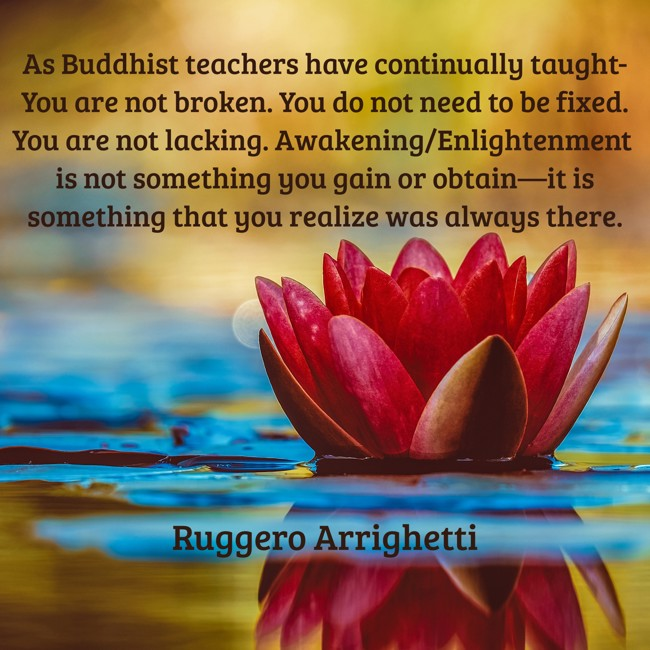
Or every human being have a Buddha-nature and by following the Eightfold Path they can realize it fully. For example, if you have a gift that is well wrapped in coverings, once you unwrap the gift completely, you finally realize what the gift is, which, in fact, is the same as when it was wrapped. It is the same about the Buddha. We are all intrinsically a Buddha, it is just that we have veils that hide our realization of that. The veils are lifted with the Path of ethical conduct (Sila), mental discipline (Samadhi) and wisdom (Panna). One doesn’t ‘gain’ Buddhahood but instead removes the veils or obstructions that prevent one from knowing that their nature is already Awakened.

Image

Awakening/Enlightenment

12 Mar

Doctrine of Kamma/Karma

12 Mar


The Doctrine of Karma or Kamma is not a mystical force and does not entail fatalism. Instead, it is a natural phenomenon, like gravity. Our thoughts create consequences inside our mind which we then act on. The doctrine refers to our intentional mental actions- our volitions. What we are now is determined by our thoughts and actions in the past and what we do next, in the future, is determined by our thoughts and actions in the present. Therefore, our kamma has the potential to continuously change depending on the development of our thoughts and actions.

The Buddha was very clear in teaching the Noble Eightfold Path that we can transform the quality of our mind and action for the better and ultimately achieve Enlightenment. So, Karma does not mean that we have a fixed destiny across lifetimes that we must passively accept or that bad or good things happen only because of our past actions.


Non-Duality: What the World Needs Now

14 Feb

Preface

After 40 years of active study and practice of the Buddhist teachings and having written four books on what I call Buddha inspired psychology, I recently found a very insightful perspective that elaborated on what I had learned before. The insight is that the Buddhist teachings are a mysticism, which inherently undercuts any easy attempts at codification. Therefore, union with the divine or emptiness is experienced rather than defined and categorized through limited language. such an emphasis on first-hand experience runs contrary to abstract, ‘positive’ cataphatic theology. this book is the unique and cogent perspective that incorporates the Buddhist teachings as a ‘negative’ apophatic theology.

While there are some scholarly books and research articles on the topic of apophatic theology, very few incorporate the Buddha’s teachings. I hope to show in this book that indeed Buddhist teachings and wisdoms are succinctly integrated into this apophatic spiritual tradition that spans cultures and time. Within the larger scope of the typology of ‘via negative’, the Buddhist teachings of nothingness or emptiness or Sunyata are clearly a part of the apophatic spiritual tradition.

Therefore, this book goes beyond what is usually taught in traditional Buddhist texts. My aim is to make accessible from a modern perspective what the Buddha was universally teaching for those who are on their own spiritual path of personal discovery.

–I have always been struck by the universal applicability of the Buddha’s teachings, which transcend geographical and temporal constraints. The integration of these teachings with proponents of apophatic theology has only reinforced my belief in their universality. Despite four decades of rigorous research, temple retreats, lectures, and meditation practice, it is only now that I have uncovered this enlightening connection between the Buddha’s teachings and the apophatic traditions. It is my sincere desire to share this newfound insight with my fellow spiritual seekers.

-I have always appreciated that the Buddha taught universal truths that are applicable everywhere and throughout time. Integration of these truths with other teachers of the Apophatic theology has affirmed my belief in this universality of the Buddha’s teachings. Even with my forty years of research studies, attendance of temple retreats with monks and lay lectures and meditation practice, I have only now found this instructive link between the Buddha’s teachings with other teachers of the Apophatic tradition, and I want to share this with my fellow spiritual path voyagers. I believe they will also find it as interesting and illuminating as I have.

The Apophatic emphasis on firsthand experience hence knowledge, stands in stark contrast to abstract, ‘positive’ cataphatic theology. This latest work of mine presents a unique and compelling perspective that positions the Buddha’s teachings firmly within a ‘negative’ apophatic theological framework.

While there are scholarly works and research articles on apophatic theology, very few incorporate the profound teachings of the Buddha. In this book, I aim to demonstrate how Buddha’s wisdom can be seamlessly integrated into this spiritual tradition that transcends cultural and temporal boundaries. Within the broader context of the ‘via negativa’ typology, the Buddhist concepts of nothingness, emptiness, or Sunyata are undeniably intertwined with the apophatic spiritual tradition. It is my sincere desire to share this newfound insight with my fellow spiritual seekers.

Rodger R Ricketts

The Importance of Experiencing Non-Duality

14 Feb

The Importance of Experiencing Non-Duality

Non-duality is the recognition that at the core of existence lies a fundamental wholeness, ultimately arising from a single, unified source. It is understanding that everything is interconnected and inseparable, and that perceived dualities—such as self and other, or subject and object—are ultimately illusions. Awakening to non-duality offers profound benefits for our well-being, relationships, and understanding of life. Interestingly, recent advances in various branches of science are beginning to echo these insights.

1. Unity with All Beings – Everything is interconnected and constantly interacting. We are all connected on a deep level and when we see beyond the surface-level distinctions, we embrace the oneness of everything. When we realize our affinity with All that share this gift of Life, we experience a profound sense of unity and wholeness and have a deep sense of compassion and empathy towards all living beings.

2. Living in the Present Moment – Non-duality helps us release attachment to the past and anxieties about the future, allowing us to remain serenely fully in the present. Free from judgment or rigid interpretation, we experience life with greater clarity and peace.

3. Transcendence of Duality – By realizing non-duality, we move beyond the limitations of binary thinking—such as mind vs. body or self vs. other. While categorization is useful for practical navigation, it can also be a source of suffering. Non-dual awareness fosters a broader, more flexible perspective, freeing us from illusions of separation and the biases they create.

4. Enhancing Psychological Well-Being – Non-dual awareness has profound psychological and emotional benefits, not just for individuals but for society and the planet. Also, when we no longer see self as a separate entity, the fear of death diminishes; it is understood not as annihilation but as a transformation within the continuum of existence.

5. Embracing the Mystery of Existence – Non-duality invites us to appreciate life’s mysteries and accept the unknown. Rather than resisting uncertainty, we learn to welcome the vast possibilities and complexities of existence.

6. A Path of Awakening – Non-dualism spans ancient traditions and modern teachings, offering a structured path for personal and transpersonal growth. True awakening involves a transformative shift from conditioned ways of thinking, feeling, and acting toward a life aligned with universal principles.

Rodger R Ricketts

One Transcends the Subject/Object Duality. Pure Experience.

14 Feb


‘This is what pure experience is: neither the world nor “I” in it other than experience.’ Susan Hamilton


‘The seeing of Truth cannot be dualistic (a ‘thing’ seen). It cannot be seen by a see-er, or via a see-er. There can only be a seeing which itself is Truth.’
Wei Wu Wei


‘The outside world of form-and-name and the inner world of thought and feeling are both no more than the construction of mind, and when the mind ceases, the weaving-out of a world of particulars is stopped. This stopping is called emptiness or no birth, but it is not the wiping out of existence, it is on the contrary viewing it truthfully unhammered by discriminative categories.’
D-T. Suzuki


‘The ‘world’ of experience is not given in experience: it is constructed by thought from the data of sense.’
C.I. Lewis


‘In whatever egotistic terms they think of an object, it becomes that. And therein, verily, lies its falseness, the puerile deceptive phenomenon that it is.’ S N v. 916


‘Bhikkhu, ‘I am’ is a conceiving; ‘I am this’ is a conceiving; ‘I shall be’ is a conceiving; ‘I shall not be’ is a conceiving; I shall be possessed of form’ is a conceiving; ‘I shall be formless’ is a conceiving; ‘I shall be non-percipient’ is a conceiving. Conceiving is a disease, conceiving is a tumour, conceiving is a barb. By overcoming all conceiving, bhikkhu, one is called a sage at peace.’(M.N. 140.31)

The things of this world are merely conventions of our own making.

14 Feb


The things of this world are merely conventions of our own making. Having established them, we get lost in them and refuse to let go, giving rise to personal views and opinions. … Now, if we know conventional reality then we’ll know liberation…If we clearly know liberation then we’ll know convention.
.’


Ajahn Chah

The Buddha’s transcendence of the Subject and Object

14 Feb

The Buddha’s transcendence of the Subject and Object

 “…the world is steeped in the notion of duality.It grasps either this end, or the other end. Hard it is for the world to understand the stance of the arahant couched in the cryptic phrase, neither here nor there nor in between the two”.The worldling is accustomed to grasp either this end or the other end.’

Bhikkhu Katukurunde Ñāṇananda

“Quantum jazz”

29 Sep


The Biological Origin of “Self”

‘The body is a quantum coherent organism which creates and recreate herself from moment to moment.” Mae -Wan Ho likes to call this process “Quantum jazz”, which is the music of the organism dancing life into being. She goes on to write that: “Quantum jazz is played out by the whole organism, in every nerve and sinew, every muscle, every single cell, molecule, atom, and elementary particle, a light and sound display that spans seventy octaves in all the colors of the rainbow. There is no conductor or choreographer. Quantum jazz is written while it is being performed; each gesture, each phrase is new, shaped by what has gone before, though not quite. The organism never ceases to experience her environment, taking it in (entangling it) for future reference, modifying her liquid crystalline matrix and neural circuits, recoding and rewriting her genes. Quantum coherence is the ‘I’ in everyone that gives unity to conscious experience.”

 As we can see from these examples of a new understanding about the significance of biological regulation and coherence of the organism, the previously intuitive construct of the “Cartesian Theater” in the brain, wherein the self sits as a spectator on the world and self acts as the CEO executive of all decision making, is exposed as an illusion. Clearly, the biologically based core functions of organization, selectivity, and coherence are necessary for organism survival. The abstracted cognitive embellishments serve as relative, convenient designations or identifications, which constructs a virtual presence of the ‘self’ illusion, and is based in ignorance, and through steadfast identification creates craving and suffering. Only now are we able to empirically support the Buddha’s insights of ‘anatta or no-self’ which he gained through the introspective practice of bhavana, or meditation.

Image

Radiate Kindness…

31 Aug