Physicists are searching for the particle responsible for the gravitational force.
One is gravity. Gravity is the force by which a planet or other body draws objects toward its center. The force of gravity keeps all of the planets in orbit around the sun. Gravity: an invisible force that pulls objects toward each other. Earth’s gravity is what keeps you on the ground and what makes things fall. Anything that has mass also has gravity. Objects with more mass have more gravity. Gravity also gets weaker with distance. So, the closer objects are to each other, the stronger their gravitational pull is.
Earth’s gravity comes from all its mass. All its mass makes a combined gravitational pull on all the mass in your body. That’s what gives you weight. And if you were on a planet with less mass than Earth, you would weigh less than you do here.
Yet, gravity is one of the most mysterious forces in the Universe. gravity remains on many levels fundamentally mysterious. Why is it so weak compared with the other forces? Why does it only pull, not push? And why is the strength of “Big G” (whose value is, incidentally, notoriously difficult to pin down) so apparently finely tuned to allow life to emerge? If it were just a little less, the expansion of space would have overwhelmed the pull of gravity on the matter in the newborn universe, stars and galaxies would never have formed. If it were just a little more, any wannabe stars or galaxies would quickly have collapsed in on themselves and each other, while space-time would have folded up the whole universe in a big crunch. We have a lot to thank for gravity being like it is.
As physicists are searching for the particle responsible for the gravitational force, there is hope to find the graviton. So why hasn’t anyone found a graviton yet? The problem with searching for gravitons is that gravity is incredibly weak. Individual gravitons are thought to be massless and interact very feebly, and we are only held to the planet because the Earth emits so many of them. Because a single graviton is so weak, it is impossible for us to directly detect individual classical gravitons. So, in the end, while the effects of gravity are easily seen, at this time it remains a mystery.
Then also there other mysterious aspects of the forces of the universe.
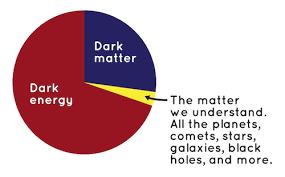
For example, the expansion of the universe has not been slowing due to gravity, as previously thought, it has been accelerating. No one expected this, no one knew how to explain it. But something was causing it. Theorists still don’t know what the correct explanation is, but they have given the solution a name. It is called dark energy.
More is unknown than is known. We know how much dark energy there is because we know how it affects the universe’s expansion. Other than that, it is a complete mystery. But it is an important mystery. It turns out that roughly 68%of the universe is dark energy. Dark matter makes up about 27%. The rest – everything on Earth, everything ever observed with all of our instruments, all normal matter – adds up to less than 5% of the universe. Come to think of it, maybe it shouldn’t be called “normal” matter at all, since it is such a small fraction of the universe.
What is dark matter?
We are much more certain what dark matter is not than we are what it is. First, it is dark, meaning that it is not in the form of stars and planets that we see. Observations show that there is far too little visible matter in the universe to make up the 27% required by the observations. Second, it is not in the form of dark clouds of normal matter, matter made up of particles called baryons. We know this because we would be able to detect baryonic clouds by their absorption of radiation passing through them. Third, dark matter is not antimatter, because we do not see the unique gamma rays that are produced when antimatter annihilates with matter. Finally, we can rule out large galaxy-sized black holes on the basis of how many gravitational lenses we see. High concentrations of matter bend light passing near them from objects further away, but we do not see enough lensing events to suggest that such objects make up the required 25% dark matter contribution. So, in other words, no one knows what Dark Matter is.
NASA SCIENCE
NASA Science

 We are all Interconnected even with the Universe