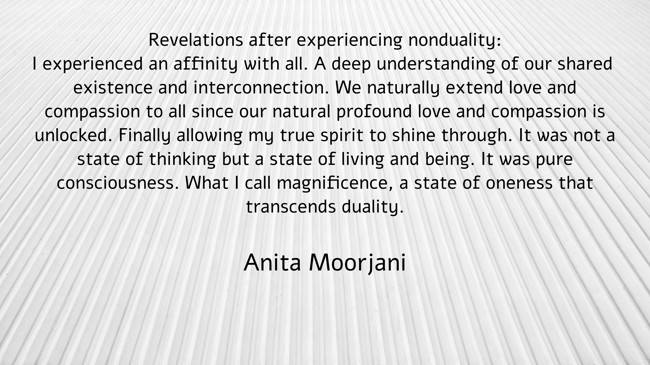
Tags: Anita Moorjani, Happiness, Knowledge, life, Magnicence, NDE, Non-duality, reality, Spirituality
I saw this statement: All Humans can become a Buddha. If the definition of to become is, ‘to come into existence’ my personal understanding is different as written below.
Or every human being have a Buddha-nature and by following the Eightfold Path they can realize it fully. For example, if you have a gift that is well wrapped in coverings, once you unwrap the gift completely, you finally realize what the gift is, which, in fact, is the same as when it was wrapped. It is the same about the Buddha. We are all intrinsically a Buddha, it is just that we have veils that hide our realization of that. The veils are lifted with the Path of ethical conduct (Sila), mental discipline (Samadhi) and wisdom (Panna). One doesn’t ‘gain’ Buddhahood but instead removes the veils or obstructions that prevent one from knowing that their nature is already Awakened.
The human body is a miraculous, self-repairing organism.
Let’s look at a few of the many important reasons that science explains. Homeostasis is how your body regulates your internal systems so they function correctly. Your body works best when its internal environment — including things like temperature or oxygen levels — is just right. Balance is key because too much of even the most essential things can be harmful. In fact, you can’t survive without homeostasis and the processes that drive it.
The body features a brain that can store roughly 2.5 million gigabytes of information and a heart that pumps approximately 2,000 gallons of blood daily and beats over 3 billion times in a normal lifetime. Our blood vessels, if laid end-to-end, could circle the Earth four times, while the nose can distinguish over 1 trillion odor mixtures and the eyes can distinguish roughly 10 million different colors. The Microbiome contains about 35 trillion cells, and microorganisms can outnumber these cells to 39 trillion. Every minute, 300 million body cells die, but that’s really just a small fraction of the total cells we have. We produce 300 billion new cells every day and your body is constantly repairing and rebuilding.
Stardust Component: The atoms in your body are billions of years old, forged in exploding stars. Finding and maintaining the balance of homeostasis takes careful planning, that can make a big difference in your quality of life. The human body is indeed an astounding and sophisticated, interconnected and constantly interacting, both internally and externally, organism and we need to honor this gift with care and love.
A famous quote regarding this concept is by Chief Seattle: “Humankind has not woven the web of life. We are but one thread within it. Whatever we do to the web, we do to ourselves. All things are bound together. All things connect”. This emphasizes human interdependence with nature and responsibility for the ecosystem.
Here are more quotes highlighting that we are part of the web of life:
The Doctrine of Karma or Kamma is not a mystical force and does not entail fatalism. Instead, it is a natural phenomenon, like gravity. Our thoughts create consequences inside our mind which we then act on. The doctrine refers to our intentional mental actions- our volitions. What we are now is determined by our thoughts and actions in the past and what we do next, in the future, is determined by our thoughts and actions in the present. Therefore, our kamma has the potential to continuously change depending on the development of our thoughts and actions.
The Buddha was very clear in teaching the Noble Eightfold Path that we can transform the quality of our mind and action for the better and ultimately achieve Enlightenment. So, Karma does not mean that we have a fixed destiny across lifetimes that we must passively accept or that bad or good things happen only because of our past actions.
A useful approach to understanding the interrelationship of all things is the framework known as systems theory, sometimes called “general systems theory.” The systems view of life studies the world in terms of patterns and relationships. A system is defined as an integrated whole whose properties cannot be reduced to those of its parts. Psychologist Lawrence LeShan: “Primarily, objects and events are part of a pattern which itself is part of a larger pattern, and so on until all is included in the grand plan and pattern of the universe. Individual objects and events exist, but their individuality is distinctly secondary to their being part of the unity of the pattern.”
Fritjof Capra:
Natural systems are wholes whose specific structures arise from the interactions and interdependence of their parts. Systemic properties are destroyed when a system is dissected, either physically or theoretically, into isolated elements. Although we can discern individual parts in any system, the nature of the whole is always different from the mere sum of its parts. Systems are intrinsically dynamic. Their forms are not rigid structures but are flexible yet stable manifestations of underlying processes . . . Living systems tend to form multi-leveled structures of systems within systems. For example, the human body contains organ systems composed of several organs, each organ being made up of tissues, and each tissue made up of cells. All these are living organisms or living systems which consist of smaller parts and, at the same time, act as parts of larger wholes. Living systems, then, exhibit a stratified order, and there are interconnections and interdependencies between all systems levels, each level interacting and communicating with its total environment. (14)
The natural world offers many examples of the collective action of individual members of a species creating larger, more complex systems embodying a group mind or intelligence.
Patterns of such collective coordination can be seen in highly integrated insect communities: “Extreme examples are the social insects – bees, wasps, ants, termites, and others – that form colonies whose members are so interdependent and in such close contact that the whole system resembles a large multi-creatured organism. Bees and ants are unable to survive in isolation, but in great numbers they act almost like the cells of a complex organism with a collective intelligence and capabilities for adaptation far superior to those of its individual members.”
Examples of systems abound in nature. Every organism – from the smallest bacterium through the wide range of plants and animals to humans – is an integrated whole and thus a living system. Cells are living systems, and so are the various tissues and organs of the body, the human brain being the most complex example. But systems are not confined to individual organisms and their parts. The same aspects of wholeness are exhibited by social systems – such as an anthill, a beehive, or a human family – and by ecosystems that consist of a variety of organisms and inanimate matter in mutual interaction. What is preserved in a wilderness area is not individual trees or organisms but the complex web of relationships between them. (15)
Systems theorists have identified some of the principal laws of nature exhibited by systems:
Through the action of the above, and other related laws, complexity emerges in the universe as evolution creates more and more complex and coherent atomic, molecular, biological and psychosocial structures and systems.
The self-organization of systems is a recurring feature at all levels of the universe: “The recursive system of self-organization, where every layer curves back on itself to monitor another layer, pervades physics and biology. Self-organization is embedded in the fabric of the cosmos, acting like an invisible, offstage choreographer to drive evolution.” In You Are the Universe, Deepak Chopra and Menas Kafatos discuss this important concept:
In a self-organizing system, each new layer of creation must regulate the prior layer. So, the generation of every layer in the universe, from particle to star to galaxy to black hole, cannot be considered random, given that it was created from a pre-existing layer that in turn was regulating the layer that produced it. The same holds true throughout nature, including the workings of the human body. Cells form tissues, which in turn form organs, the organs form systems, and finally, the entire body has been created. Each layer emerges from the same DNA, but they stack up, as it were, until the pinnacle of achievement, the human brain, crowns it all . . . Whether we are speaking of genes and the brain or solar systems and galaxies, self-organization is present. Existence requires balance, which demands feedback. By monitoring itself, a system can correct imbalances automatically. Every new bit of the universe, however minuscule, must create a feedback loop with what gave rise to it. Otherwise it wouldn’t be connected to the whole. (16)
The building blocks of most systems are based on the principle of hierarchy, which determines the levels of organization and the nature and structure of the interconnections. Each living component possesses its own self-organization and a limited degree of autonomy within the larger system. These systems exist in a hierarchy in which higher levels subsume and regulate lower levels. “Every system does its job, being more or less responsible for its own survival and reproduction (within its niche in the whole organism), at the same time being controlled by one or more superordinate regulatory systems.” Many systems, both natural and manmade, are organized in a hierarchical structure:
Nature appears to be structured as levels of organization or complexity. Elementary particles give rise to atoms, atomic structures form molecules, which in turn form macromolecules such as proteins and DNA, which are the basis for living organelles and cells, which congregate and cooperate to form the profusion of living organisms populating the planet. Evolution, as a progressive complexification of matter and psycho-biotic systems, is ostensibly a dynamic process of ever-increasing levels of complexity and organization. In the sense of nested systems within systems, hierarchy is an accurate and appropriate description of nature . . . If we picture nature’s nested systems as circles within circles within circles, where the boundaries of all the circles are permeable, then hierarchy permits the flow of information and energy both up and down, and laterally, between systems at all levels. Hierarchy involves the communication of information and energy through “upward causation,” from lower-level (meaning less complex) systems to higher level (meaning more complex and organized) systems, and “downward causation,” from higher-level systems to their component parts; as well as horizontal causation (laterally between systems on the same level). In this systems view of hierarchy, power resides in the cooperative relationships between the various systems and their parts. (17)
In summary, the systems view of the universe is essentially holistic and integrative; it looks at the world in terms of interrelatedness and interdependency, linking all levels of existence in a unified whole. “Living systems are organized in such a way that they form multi-leveled structures, each level consisting of subsections which are wholes in regard to their parts, and parts with respect to the larger wholes. All entities – from molecules to human beings – can be regarded as wholes in the sense of being integrated structures, and also as parts of larger wholes at higher levels of complexity.”
Rodger R Ricketts
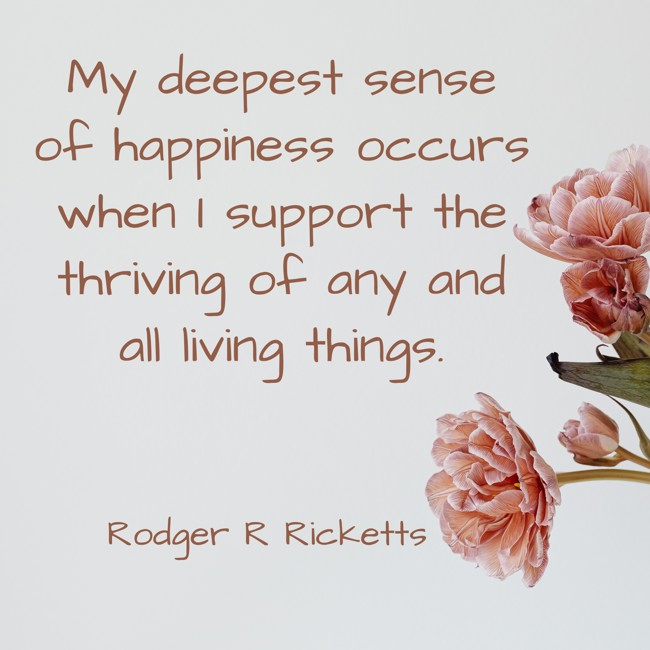
 We are all Interconnected even with the Universe