
Tags: Happiness, Knowledge, life, meditation, psychology, reality, Science
My new book is about the human species adopting an ancient, truer, sound economic, and more empathic perspective, as the present one continues to be a major disaster and will continue so into the future. For example, let’s look at war which right now is demonstrating again its evil ugliness of human duality obsessions.. Arguably the most evil and catastrophic human activity ever.
According to a New York Times article: What is a war?
War is defined as an active conflict that has claimed more than 1,000 lives.
Has the world ever been at peace?
Of the past 3,400 years, humans have been entirely at peace for 268 of them or just 8 percent of recorded history.
How many people have died in war?
At least 108 million people were killed in wars in the twentieth century. Estimates for the total number killed in wars throughout all of human history range from 150 million to 1 billion. War has several other effects on the population, including famine, environmental desolation, the killing of plants, and animals, etc. decreasing the birth rate by taking men away from their wives. The reduced birth rate during World War II is estimated to have caused a population deficit of more than 20 million people. Let’s repeat this again, Of the past 3,400 years, humans have been entirely at peace for 268 of them, or just 8 percent of recorded history.
We need a new common perspective Badly not only for war but the intelligent perspective of integrating all into the One- Non Dualism…!!!

The mysterious Universe…
Simplistically, the number of galaxies in the universe will be the size of the Universe times the average number density of galaxies. In practice, it is difficult to estimate these two numbers accurately.
The total size of the universe is unknown. Recent research suggests it may be infinite, implying that there could be an infinite number of galaxies.
It is estimated that the ‘observable universe’ is a sphere with a diameter of about 92 billion lightyears and a volume of about 410 nonillion (410 thousand billion billion billion) cubic lightyears! A lower estimate of the number of galaxies says that there are between 100 and 200 billion galaxies in the observable universe.
Other astronomers have tried to estimate the number of ‘missed’ galaxies in previous studies and come up with a total number of 2 trillion galaxies in the universe.
Dr Alastair Gunn is a radio astronomer at the Jodrell Bank Centre for Astrophysics at the University of Manchester. February 10, 2023

All living things are interconnected.
All living things have DNA. And whether it comes from you, a pea plant, or your pet rat, it’s all the same molecule. It’s the order of the letters in the code that makes each organism different.
Plants, like all other known living organisms, pass on their traits using DNA. Plants however are unique from other living organisms in the fact that they have chloroplasts. Like mitochondria, chloroplasts have their own DNA.
We all came from a common ancestor. In other words, we all started out with the same DNA way back when. The different animals we see today are due to lots of small changes that have happened in living things since then.
Many small DNA changes are kept when they help the animal live better in its environment. Eventually, there are enough changes that it is a whole new animal.
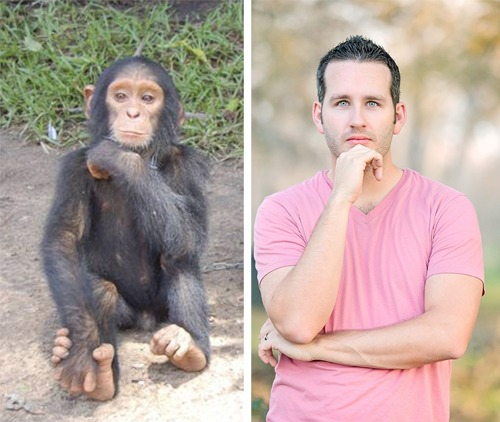
Your DNA is 99% identical to a chimpanzee’s. And it’s 95% identical to a monkey’s. And why you are about 79% identical to a mouse and even 36% identical to a little fruit fly!
In fact, you even do some things a bacterium does. You have a membrane enclosing your cells. And you both have to use oxygen and sugar to make energy. So your DNA is 7% identical to that bacterium!
But if we all started out with the same DNA, how did we end up with any differences at all? The short answer is evolution.
All living things have lots in common with each other.
DNA has the instructions for making a creature. This DNA is split up into many different sections called genes.
Each gene has a specific job. One gene might have the instructions for making something that carries oxygen in our blood. Another might have the instructions that give a person brown eyes.
No matter how different all living things may look, we all have things in common. Monkeys, people, lizards, frogs, etc. all need to breathe, see, move around, etc.
These common activities are the result of common genes. So creatures that have to do similar things will often share similar DNA.
The stringy stuff in the test tube is DNA. But you can’t tell which one of these organisms it came from just by looking at it. That’s because DNA looks exactly the same in every organism on Earth.
All humans have the same genes arranged in the same order. And more than 99.9% of our DNA sequence is the same. But the few differences between us (all 1.4 million of them!) are enough to make each one of us unique. On average, a human gene will have 1-3 bases that differ from person to person. These differences can change the shape and function of a protein, or they can change how much protein is made, when it’s made, or where it’s made.
College of Education. © University of Hawai‘i.

Excerpt from Chapter 8 Transcendental Idealism: A Form of Enlightened Cognition – The God is No-Thing An Apophatic Assertion: An Introduction for Humankind’s Transpersonal Actualization– revised -. Copyright Rodger Ricketts Psy.D.,2023. All rights reserved. Protected by international copyright conventions. No part of this chapter may be reproduced in any manner whatsoever, or stored in a retrieval system or transmitted, without the express permission of the Authorpublisher, except in the case of brief quotations with due acknowledgment.
Chapter 8
Transcendental Idealism: A Form of Enlightened Cognition
That which is called the “external” world, as well as the “internal” world (the world we inhabit), is only a representation or interpretation that we create with our cognitive apparatus. It is not the actual reality itself. In summary, our brain models the world for us. Just as a creative artist creates an art form, we create a picture or representation of reality that has only a resemblance to actuality.
We can never truly know reality because we are limited by (and cannot go beyond), the input of our sense perceptions, and, as well, our cognitive process has evolved to accommodate and service that input egocentrically. The brain brings to bear its prior expectations about what is out there in order to interpret this massive, noisy, and ambiguous sensory information that it continually encounters. In confining an analysis to Earth and its immediate surroundings, some estimate the limitation is about 25% of the total, and if one includes the vastness of the universe beyond the “visible universe” the numbers would be much smaller. So, it is reasonable to say that we only perceive a small fraction of the totality of physical reality.
Physics has informed us that all sensory experience is triggered by photons which power an electrical impulse which is how we become aware of the signal. Our sensory life partakes of physical reality, whereas our thoughts are quite removed from it. Therefore, the one thing we can do if we wish to come in touch with reality is to intentionally redirect our attention from the thought stream and focus on the overall sensation of the mass of the physical body, which is very real. In fact, our entire linguistic framework of conceptual categories is a set of representations or pictures of reality, and the input through our sense organs is only possible because of an integral relationship between aspects of “reality” and our specific sense organs. As cognitive scientist Donald Hoffman explains,
Evolution has shaped us with perceptions that allow us to survive. But part of that involves hiding from us the stuff we don’t need to know. And that’s pretty much all of reality, whatever reality might be.
(Perception refers to the process of acquiring, interpreting, and representing incoming sensory information.)
Perception is the brain’s search for the best interpretation of the stimuli that are presented to us. What we believe to see and hear from the world is essentially modeled by the brain. This model the brain creates is made accurate by our sight and hearing. For some individuals, the model their brain creates is largely different from what is “normal.” Individuals with synesthesia arguably perceive “too much.” whereas individuals with agnosia and colorblindness perceive very little. Our cognitive apparatus or process must filter out unimportant incoming sensory information and, at the same time, it must intensify what is important. Sensory Integration Theory (1989), developed by Dr. A. Jean, explains that the incoming sensory information from the body and the world is continually processed in the brain. When the information is processed well, organized, and in sync, the resulting behavior is regulated, coordinated, and accurately experienced as sensation and emotion. The neuroscience underlying this phenomenon suggests that we—or rather our brains—construct reality for us. A simplified illustration of this is shown in figure 1.
Figure 1: Simplified view of the representation of a cat in the mind
In other words, as the Buddhist scholar Susan Hamilton wrote in her book Early Buddhism; A New Approach (2000),
[…] the reality of experience is experiential. And the reality of Reality is unknowable in (normal) experiential terms. The aim of the Buddhist is to understand the nature and limits of experience by means of understanding the nature and extent of one’s subjective cognitive apparatus. In Buddhist terms, this subjectively and objectively correlated insight is knowing and seeing how things really are.
Given our ordinary, pre-enlightened way of understanding, we assume and believe that the world is as real as we cognitively construct it. However, as the apophatic mystics and cognitive science contend, reality is not ultimately conceptually graspable or verbally articulable. As Albert Einstein wrote, “Behind anything that can be experienced, there is something that the mind cannot grasp and whose beauty and sublimity reaches us only indirectly and as a feeble reflection.”



 We are all Interconnected even with the Universe