The majority of individuals remain unaware that an alternative mode of living exists. They fail to recognize that contemporary society has compelled us to make a detrimental choice: by embracing an artificial environment, we ultimately diminish our capacity to connect with the vital energy of life. Many do not perceive this as a loss, as they are unfamiliar with this innate ability or the boundless potential and exceptional well-being it can provide. Regrettably, artificial stimuli now surpass natural positive signals. For example, a restful night’s sleep offers us positive natural stimuli that nurture our life energy. Similarly, for example, contact with the Earth, exposure to sunlight, consumption of natural foods, and the internal sensations of the body all convey positive signals that help sustain the connection with life energy. Unfortunately, these positive signals are increasingly overwhelmed by artificial and negative stimuli, resulting in a diminished natural sensation and disconnection from energy.
But recently — watching my children, watching your children, watching all of us — I realized we’re falling into a different kind of abyss: the collective digital septic pit.
Right now, as you read this, feel the weight of your body wherever you are and whisper this: Without this body, I do not exist as a human being. Without this body, I cannot experience life. Without this body, my pure connection with the divine cannot evolve in this lifetime. Feel that truth — until it lives as presence.
Today we live in three worlds: – The mental world (in your head) – The digital world (hijacking your attention) – The real world — your body (where you spend maybe 10 percent of your day)And with any more reduction of time living in our bodies? We are committing slow, peaceful suicide.
When we live cut off from the body, the cost is everywhere — in our health, our emotions, and our children. The numbers are staggering: the CDC reports that 60 percent of teenage girls experience depression, 40 percent consider suicide, and nearly one in three have attempted it. More than statistics, these are signals from a world that has drifted too far from embodiment — from the simple, sustaining connection with life that begins in the body. This isn’t only about our kids. It’s about all of us.
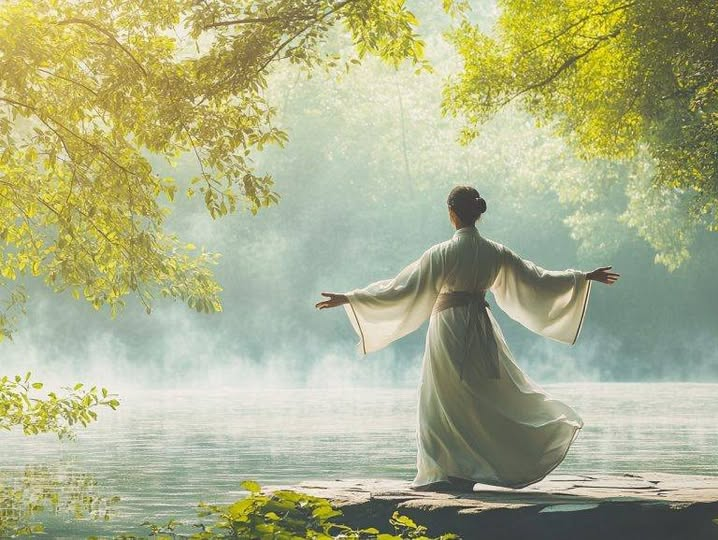
With T’ai Chi we can again experience what it feels like when the mind quiets, the body reawakens, and energy begins to flow freely again.
In this very short reading from my new book. I summarize why the Universe is mysterious to us and always will be. For a thorough explanation of this you can find my book on Amazon.
The acceptance of a creative force or source can only bring us to a conclusion of an inherent acceptance of ourselves as being a part of the Divine itself. If the Divine energy creates the great oneness of all things; physical beings, sentient beings, universes, dimensions, even the space that exists between planets, universes and dominions, then we as human beings are an expression of the Divine and this beautiful love-energy. We are not separate from it. We are here to play our part in the work in the great oneness. This beautiful divine thought of creation. Shaolin Buddhist Temple, Slane, Co. Meath, Ireland
Therefore, the body is deeply sacred indeed. The body is a beautiful expression of the spirit come to life. This view about body and spirit has been described by Jorge N. Ferrer, professor of religious psychology as “embodied spirituality.” He wrote that:“Embodied spirituality regards the body as subject, as the home of the complete human being, as a source of spiritual insight, as a microcosm of the universe and the Mystery, and as pivotal for enduring spiritual transformation. The body is not an “It” to be objectified and used for the goals or even spiritual ecstasies of the conscious mind, but a “Thou,” an intimate partner with whom the other human dimensions can collaborate in the pursuit of ever-increasing forms of liberating wisdom.”
For Ferrer the body is the home of the complete human being. It is the physical reality in which we live. It is through the body that we both literally and metaphorically walk our own unique path. The mistake that so many religious understandings have made is that they have seen the body as the prison of the soul. Something that the spirit or soul needs to be liberated from. He claims that the mystery of incarnation never suggested that spirit entered into the body but that the spirit became flesh. To quote John’s Gospel “In the beginning was the Word, and the Word was God…And the Word became flesh.” Through our bodies, our lives, the way we live our lives the spirit comes to life. We are here for a reason, life truly means something and it is our task to bring that something to life, through our lives, through our bodily existence.
Embodied spirituality is about fully inhabiting our lives, our thoughts, our feelings our relationships with ourselves, our lives, each other and the mystery that connects all life. It’s about being fully present in our bodies and lives and therefore fully experiencing our potential, being fully alive. The body is not just a suit that clothes our being. It is through the body that we experience what it is to be fully alive. They say “listen to your body”, sage wisdom indeed. For me the body is not a separate entity to spirit, I cannot agree with this dualistic view, it seems to me that it is through the body that spirit comes alive and further through the body that the spirit is fed.
Embodied spirituality views every aspect of our humanity, whether that be body, spirit, heart, mind and consciousness as equal partners in bringing the self, community and world into a fuller alignment with the mystery that brings into being all life, while at the same time connects all life. I suspect it’s a kind of panentheism, that sees all life as being in God and that God is in all life and that little or perhaps infinite more. It sees the full engagement of the body as being vital to spiritual growth and transformation.Rev. Danny Crosby
When humanity moves past the anthropocentric viewpoint (the idea that “humans are the center of the universe”) existence on Earth will flourish. According to that naive perspective, the value of other living and non-living components of existence is solely determined by how they affect or benefit humans. By learning to value the diversity and interdependence of all life, this oversimplified viewpoint is replaced by a wise spiritual non-dualistic relationship. Humanity can then secure the foundation for a long-term existence in conditions conducive and beneficial to human habitation.
When we attempt to explore the nature of life, we must rise above our ignorant deep-rooted beliefs. The historically dominant way of conceiving life, namely, anthropocentrism is based on ill-founded preconceptions and lead to a range of negative consequences, such as: Environmental destruction and species extinction and human alienation from nature and loss of human well-being.
Such an anthropocentric relationship with nature has predominated since the beginning of the modern era. The dominant worldview of modern thinking is characterized by an objectification of nature, which, by discerning its laws, has made possible the mastery over nature and provision of goods which was previously inconceivable and unparalleled. While mechanistic explanation is an important part of understanding life, it is a just part of the whole story.
The all-consuming self dominates society today in the United States and other modern nations. It has been developed by conscious efforts of businessmen and politicians. For example, in the 1920’s, Wall Street banker Paul Mazura, who invented the public relations profession, said there must be a shift in America from a need to a desires culture. That people must be conditioned to desire to want and buy new things even before the old have entirely been consumed. Human’s desires must overshadow it’s needs. Consumerism is a socio-cultural and economic phenomenon that is typical of industrialized societies. It is characterized by the continuous making and acquisition of goods.
Artificial intelligence (AI) has recently advanced at a rapid pace, and while there are useful and appropriate applications of AI, modern culture has overlooked our tacit, embodied, living intelligence or wisdom of how we should live in favor of overemphasizing algorithms and other mathematical abstractions. As a result, our ability to understand the world has significantly decreased.
Many people in today’s consumerism-driven society develop an ego or consumer self and lead inauthentic lives. Consumers continue to live their lives under the whims of corporations. Furthermore, rather than learning about the spiritual traditions of cultures, the world’s future generations will be exposed to a materialistic dualistic curriculum, which will make them nihilistic (thinking that life has no purpose and rejecting all moral and spiritual values as well as in political and social institutions).
In the Western World, people often focus on their ego instead of being their true selves. But studies in psychology and spiritual teachings show that being overly focused on the ego is a false belief. Our true selves connect us to nature, but this connection gets hidden by illusions of identity, making us confused about who we really are. This confusion can take away our inspiration and sense of connection, which leads to a lack of original thoughts and happiness. Instead, we end up living in a way that is influenced by companies. Future generations will become even more focused on material things and lose touch with the spiritual traditions of their cultures. As author David Korten says, “We can thrive by pursuing life, or we can fail by chasing money. The choice is ours.”
To be happy and embodied we must learn to let go of our illusion of ourselves. In the end, all the massive efforts invested into social manipulation of humanity can be rejected. All of us, from the spiritual worldview, can discover that we are identical with our cosmic roots and of nature. Humanity is living in a living universe. When we understand that our life instinct is the uplifting creative principle of the universe and become conscious to make our worldview complete and balance, the course of our life can change abandoning alienation. Life organizes itself in systems, in networks, and these living networks are inherently regenerative, creative and intelligent. We have the potential of human creativity that reaches the natural level of happiness by adopting a worldview that emphasizes how to live a happy, meaningful and fulfilling life with the importance of family, human relations, nature and respecting all life. The trajectory of our lives can shift away from alienation when we realize that our life instinct is the universe’s uplifting creative principle and become conscious to make our worldview complete and balanced.
With the non-dualistic view our decision-making ability comes in line with the principle of the life principle that urges us to continuously maintain the fullest physical, psychological, emotional, spiritual and rational quality of life. The Life principle is the rule for a profoundly happy and meaningful individual life. As members of the terrestrial community, it is in our nature to do our best for the betterment of life on all levels.
Life is essentially a vital activity, a ceaseless action for fulfilling life’s norms given by the principle of life. The most fundamental fact of our everyday life, mental causality, the ability to act of our own volition and to direct our thinking and acting purposefully, is forced to be denied by the consistent physical view. It binds us in our deepest identity with each other and with Nature. The full appreciation of our deepest, Nature- given identity, that is, of our living nature implies a full appreciation of all forms of life. The principle of life has a cosmic scope. It offers a cosmic principle to guide human behavior. It allows a new, exact scientific understanding of the life instinct. By virtue of our deepest identity, we, as all living beings, tend to act in accordance with the life instinct; however, there can be and there are exceptions, especially in the world of man alienated from himself and from Nature. This alienation is closely linked to the greatest problem of our time, long-term unsustainability (Grandpierre 2022b).
In this respect, the cosmic life instinct can be seen as the source of our natural inclination to live up to our deepest selves and act for the well-being of our individual, communal and social life. A healthy, fulfilling and well-grounded way of life requires a deep understanding of the life principle, its cosmic context and depth, shifting our worldview from a matter-centered to a life-centered approach. Regenerating and preserving the health, well-being and integrity of the natural environment requires acting in accordance with its working principle: the life principle. The most decisive step of sustainability lies in the ranking of our fundamental values according to the primary value of life meant in its individual, communal, social and ecological context. What we really want is not extremely high material wealth but a life rich in fulfilling emotional, intellectual and physical activities. Our deepest identity is rooted in the life principle and our decision-making realizing it. A prerequisite for sustainability is to learn to respect life in its individual, communal, social and cosmic context in a balanced manner. Cosmic life is one; planetary, social, communal, family, individual and cellular life should be harmonious.
In the quest for the ideal of ‘Life for All in Fullness’, it is crucial that technical viability and economic feasibility are not the sole factors in the progress of science. The emphasis should also be placed on improving the living conditions for both people and all life forms, thus preserving the ‘integrity’ of the life principle. On a spiritual level, humans possess a deep connection with all other beings, being ’embedded’ within the fabric of creation, which demands that they honor their fellow creatures. Humans have the ability to recognize and appreciate the inherent will to live that exists in every life form, including plants.
The principle of ‘Life for All in Fullness’, is essential so that technical feasibility and economic practicality are not the only considerations in scientific advancement. Instead, the focus must also encompass the enhancement of living conditions for both humanity and all forms of life, thereby safeguarding the ‘integrity’ of the life principle. Davies concludes that the question “what is life?” will finally be answered by “a fundamentally new kind of organizing principle” Spiritually, humans share a profound connection with all other creatures, being ’embedded’ within creation which necessitates that they respect their fellow beings. Humans can recognize and value the independent will to live inherently found in every form of life, including plants.
This perspective necessitates a transformed understanding of the ecology of earth, leading to altered approaches and actions towards it. The concept of auto telicity, characterized by reverence or respect, applies not only to humans but to all living entities, recognizing the intrinsic value of animals, plants, and even inanimate nature. Therefore, fellow beings should not be regarded—as has often been the case in modern tradition—as mere objects; rather, they ought to be seen as subjects deserving of esteem and protection, with the aim of preserving biodiversity, since humans remain dependent on its ‘community’ with the other beings of nature.
A new understanding of the earth’s ecology is required by this viewpoint, which will result in different methods and behaviors toward it. All living things are subject to the idea of autotelicity, which is defined by the joy and meaning that comes from doing the activity itself, not from an external reward or outcome. It acknowledges the inherent worth of plants, animals, and even inanimate objects. In order to preserve biodiversity, fellow beings should not be viewed as mere objects, as has frequently been the case in modern tradition. Instead, they should be viewed as subjects worthy of respect and protection, as humans continue to rely on their “community” with other natural beings.
Humanity can only fully benefit from material advancements and effectively manage the associated risks if it undergoes a profound transformation in values, mindset, and practices. Merely engaging in ecological initiatives is insufficient; genuine sustainability requires a fundamental shift in our hearts and minds. The prevailing view that nature exists solely for human exploitation and technological control is a core principle driving current industrial progress, which is accelerating at an alarming rate. The challenge lies not just in individual moral failings like greed, but in the broader systemic pressures of modern economies that prioritize capital growth and often pursue limitless expansion.
Most people are pushed in a materialistic way of life and have a worldview which creates a sense of alienation. Our image of ourselves is based on our image of humankind which is based largely on our worldview, therefore, we need to build a worldview on a solid, correct foundation. Nowadays we live in a situation in which we have to change the foundation of our view of reality we have to admit that this is not an everyday situation but one that requires the unusual effort to attain. Now we all have a seemingly solid understanding of reality and it seems all the more solid because most people have the same conviction and it is also reinforced by the dominant physical, materialistic worldview. Moreover, the dominant materialistic view is deeply rooted- centuries old. However, humankind is based on living fundamentally in nature, the nature given by the life instinct that sets the goals, while nature provides the means to achieve them, thus providing a sound basis for a healthy culture.
The fundamental constitutes of nature – life is first and foremost a ceaseless action but also a myriad of possibilities for action that allows it to elevate itself by unfolding and fulfilling its highest potential. Modern society has been unable to take into account this part of reality without which life would not exist and would not be possible -namely the instinct for life. It is therefore immensely important that it becomes understood both scientifically and philosophically that life is more than only about survival. Instead, the life principle tells us that life is to be directed towards a high quality of life. Life is primarily directed towards feeling ourselves well, high above the level of mere survival and this ensures the prospects to feel ourselves well or better. Our feelings are essential to our quality of life. We conceive our quality of life by our natural instinctive feelings. Above all life is about feeling good individually and more importantly in our relationship with our families, our social communities, and nature.
The life principle is the principle of beneficial feelings, the dignity of life is for every living being. As a natural given right to feel itself well, to feel good in the present and good or better in the future. To be respected fully to the greatest extent. This life principle that is the treasure of the universe, the source of all value is present within us. It is the treasure of our life and we are naturally inclined to pay attention, nourish and care for this cosmic treasure in all its manifestations. We are most fundamentally and most personally interwoven with each other and with other living beings through the life principle. That is why if we appreciate the life instincts, we will appreciate the same life instinct in all manifestations. This recognition is the basis and essence of an environmental philosophy that values living communities. In fact, without biological laws, life necessarily would become an appendage of matter. It would lose it’s dignity and intrinsic nature if we have to recognize the reality of the life principle.
Life has an autonomous reality having its own characteristics, following its own values, and its own possibilities are different than those of a materialistic society. For science, this is a fact that has its own independent principle – the life principle. This worldview assumes that cosmic life is eternal. The materialistic view cannot come into existence by itself only. Fundamental reality acts within us from the aspect of our self, defined as our decision making center. It is the life instinct. The life principle is both imminent and transcendent since we have an access to the life instinct internally and that is transcendent since it goes beyond the observable universe. The life instincts of living organisms and of the living universe are identical. The casual order of life, the first cause acts as the cosmic level. In this case an eternal energy, that we cannot name, is a first cause and time in a logical sense since the living universe is primal being itself. We can, in the logical sense, regard this as the First Division, that the world of reason is the first step. The realization of Anthropocene, the current geological age, is viewed as the period during which human activity became the dominant influence on climate and the environment and it is no longer possible – as in previous eras – to distinguish sharply between cultural and natural phenomena. Some geologists argue that the Anthropocene began with the Industrial Revolution.
To ensure a sustainable future, humanity must move beyond an anthropocentric, dualistic viewpoint and awaken to non-dualism with which one recognizes the intrinsic value of all forms of life. This shift, that reveals a respectful relationship with the Giai, is essential for securing a viable environment for future generations.
Physician and Nobel Prize winner Albert Schweitzer advocated the necessity of mindfully offering to every living being a reverence for life. This ethic makes no distinction between more valuable and less valuable, higher and lower life. Through the ethics of reverence for life we enter into a spiritual relation with this world. Good is understood as the means to preserve and promote life, raising life to develop to its highest value. Evil, then, means harming or destroying life, making it incapable of developing. This is a basic principle necessary for ethical thinking for any form of enhancement of specific life forms.
Dr. Shiv D. Talwar is a founding member of Spiritual Heritage Education Network Inc. He also has served on its Board of Directors as its president since its very inception in year 2000. Shiv’s work is intended to be used for raising consciousness for the care of each other and that of the planet on which we live. Spiritual Heritage Education Network Inc. (SHEN) partners with Ubiquity University to offer degree programs in the Neurobiology of Transformation. While Ubiquity is a global university for inner and outer regeneration, science-based education which transforms the whole person, is the purpose of SHEN’s existence.
‘The body is a quantum coherent organism which creates and recreate herself from moment to moment.” Mae -Wan Ho likes to call this process “Quantum jazz”, which is the music of the organism dancing life into being. She goes on to write that: “Quantum jazz is played out by the whole organism, in every nerve and sinew, every muscle, every single cell, molecule, atom, and elementary particle, a light and sound display that spans seventy octaves in all the colors of the rainbow. There is no conductor or choreographer. Quantum jazz is written while it is being performed; each gesture, each phrase is new, shaped by what has gone before, though not quite. The organism never ceases to experience her environment, taking it in (entangling it) for future reference, modifying her liquid crystalline matrix and neural circuits, recoding and rewriting her genes. Quantum coherence is the ‘I’ in everyone that gives unity to conscious experience.”
As we can see from these examples of a new understanding about the significance of biological regulation and coherence of the organism, the previously intuitive construct of the “Cartesian Theater” in the brain, wherein the self sits as a spectator on the world and self acts as the CEO executive of all decision making, is exposed as an illusion. Clearly, the biologically based core functions of organization, selectivity, and coherence are necessary for organism survival. The abstracted cognitive embellishments serve as relative, convenient designations or identifications, which constructs a virtual presence of the ‘self’ illusion, and is based in ignorance, and through steadfast identification creates craving and suffering. Only now are we able to empirically support the Buddha’s insights of ‘anatta or no-self’ which he gained through the introspective practice of bhavana, or meditation.



 We are all Interconnected even with the Universe