Tag Archives: Science

Veiled Reality: Affirmations of the Apophatic from Physics

6 May

Chapter 9 Veiled Reality: Affirmations of the Apophatic from Physics – The God
is No-Thing An Apophatic Assertion: An Introduction for Humankind’s
Transpersonal Actualization– revised -. Copyright Rodger Ricketts Psy.D.,2023.
All rights reserved.

We have seen that science supports the apophatic assertion that a
transcendent reality is beyond the normal range of human perception
and conceptualization. Yet, at the same time, the Transcendent is a
reality in the human life process. We have also seen that awakening or
transcending the ignorance of duality is a common experience of the
mystic. I will now highlight how the theoretical physicist Bernard
d’Espagnat argues that we cannot directly know the transcendental
reality or mind-independent reality:
When, in its spirit, quantum theory and Bell’s theorem are used as
touchstones, the two main traditional philosophical approaches,
realism, and idealism, are found wanting. A more suitable
conception seems to be an intermediate one, in which the mere
postulated existence of a holistic and hardly knowable Mind Independent Reality is found to have explaining power. […] This model considers Reality as not lying in space and time, indeed
being a priori to both, and it involves the view that the great
mathematical laws of physics may only let us catch some glimpses
on the structures of the Mind-Independent Reality.
(On Physics and Philosophy (2006) vol. 41)
D’Espagnat calls this model “veiled reality” to suggest that the
mind-independent reality, like the transcendental of transcendental
idealism, is, for the most part, unconceptualizable. “Veiled reality”
refers to a “world” independent of human perception, brain structure,
and the language of our minds’ participation in knowledge. D’Espagnat,
as well as others, also assert that we are directly involved in this
actuality; we exist in it. We are an integral part of the actual. We are
“swimming” in it. Reality is not a specific area of the universe that
exists separate from our senses. Our limitation is that we have the
capacity to delineate only an exceedingly small aspect of it.
As the Buddha taught, d’Espagnat explains that sense impressions
and sensations are genuine, as are our sense organs. In sight and color,
both the photons or waves, as well as the retinal cones are actual and
their interactions create our vision. The same is true of our other
sensations. This is the middle way of understanding our place in reality.
We do not have to seek our participation in it; we are a part of it.
However, in our dualistically based ignorance, we normally take our
cognitive representations, or pictures of reality, to be reality itself.
However, under certain meditative conditions, we can understand how
our subject/object dualistic world creates this illusion—the illusion that
is our ignorance
.

The First Review of my book on Amazon- Unsolicited

9 Apr

I am happy and proud that this reviewer found my book to be of high value and worthy of high recommendation.

Reviewed in the United States on April 1, 2023

“God is No-Thing; An Apophatic Assertion” by Rodger R Ricketts is an outstanding work on apophaticism and how it relates to various religions or philosophies around the world and across time. At the heart of the discussion is the apophatic nature of “God,” Buddhism as a philosophy, and the clear benefits of an apophatic approach in life, both for the individual and for society. The author backs up his claims and observations about the apophatic way with references to scientific research as well as quotes from celebrated mystic and religious people from across time and from different backgrounds. In addition to providing a large body of proof for the validity and benefits of an apophatic way of knowing God, this book also provides a helpful guide to meditation itself and how to go about it.

I highly recommend this book to anyone interested in Buddhism, meditation, apophatic philosophy, and working for the betterment of themselves and humanity.

My new book is now published on Amazon

30 Mar

I am very happy with this effort of my revision.

Image

TIME…

2 Nov
Image

Tao or the Way

27 Oct

There are numerous mysterious aspects of the forces of the universe.

16 Sep

Physicists are searching for the particle responsible for the gravitational force.

One is gravity. Gravity is the force by which a planet or other body draws objects toward its center. The force of gravity keeps all of the planets in orbit around the sun. Gravity: an invisible force that pulls objects toward each other. Earth’s gravity is what keeps you on the ground and what makes things fall. Anything that has mass also has gravity. Objects with more mass have more gravity. Gravity also gets weaker with distance. So, the closer objects are to each other, the stronger their gravitational pull is.

Earth’s gravity comes from all its mass. All its mass makes a combined gravitational pull on all the mass in your body. That’s what gives you weight. And if you were on a planet with less mass than Earth, you would weigh less than you do here.

Yet, gravity is one of the most mysterious forces in the Universe. gravity remains on many levels fundamentally mysterious. Why is it so weak compared with the other forces? Why does it only pull, not push? And why is the strength of “Big G” (whose value is, incidentally, notoriously difficult to pin down) so apparently finely tuned to allow life to emerge? If it were just a little less, the expansion of space would have overwhelmed the pull of gravity on the matter in the newborn universe, stars and galaxies would never have formed. If it were just a little more, any wannabe stars or galaxies would quickly have collapsed in on themselves and each other, while space-time would have folded up the whole universe in a big crunch. We have a lot to thank for gravity being like it is.

As physicists are searching for the particle responsible for the gravitational force, there is hope to find the graviton. So why hasn’t anyone found a graviton yet? The problem with searching for gravitons is that gravity is incredibly weak. Individual gravitons are thought to be massless and interact very feebly, and we are only held to the planet because the Earth emits so many of them. Because a single graviton is so weak, it is impossible for us to directly detect individual classical gravitons. So, in the end, while the effects of gravity are easily seen, at this time it remains a mystery.

Then also there other mysterious aspects of the forces of the universe.

For example, the expansion of the universe has not been slowing due to gravity, as previously thought, it has been accelerating. No one expected this, no one knew how to explain it. But something was causing it. Theorists still don’t know what the correct explanation is, but they have given the solution a name. It is called dark energy.

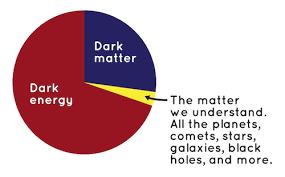
More is unknown than is known. We know how much dark energy there is because we know how it affects the universe’s expansion. Other than that, it is a complete mystery. But it is an important mystery. It turns out that roughly 68%of the universe is dark energy. Dark matter makes up about 27%. The rest – everything on Earth, everything ever observed with all of our instruments, all normal matter – adds up to less than 5% of the universe. Come to think of it, maybe it shouldn’t be called “normal” matter at all, since it is such a small fraction of the universe.

What is dark matter?

We are much more certain what dark matter is not than we are what it is. First, it is dark, meaning that it is not in the form of stars and planets that we see. Observations show that there is far too little visible matter in the universe to make up the 27% required by the observations. Second, it is not in the form of dark clouds of normal matter, matter made up of particles called baryons. We know this because we would be able to detect baryonic clouds by their absorption of radiation passing through them. Third, dark matter is not antimatter, because we do not see the unique gamma rays that are produced when antimatter annihilates with matter. Finally, we can rule out large galaxy-sized black holes on the basis of how many gravitational lenses we see. High concentrations of matter bend light passing near them from objects further away, but we do not see enough lensing events to suggest that such objects make up the required 25% dark matter contribution. So, in other words, no one knows what Dark Matter is.

NASA SCIENCE

NASA Science

Preface and Introduction -The Apophatic Assertion

20 Jul

My Newly Published Revised Book

11 Jun

This revised book published on Amazon on June 11, 2022, explores what the Buddha and other apophatic teachers have consistently taught, and what is now clear through scientific investigation, that living beings, the environment, and even the universe are deeply enmeshed and are All. This is one existence and actions by all living and non-living forces interact with and alters the previous reality- some more than others. Therefore, once we become awakened to, inspired, and apply the truths that the Buddha and others have discovered, there is a real possibility for a Heaven on Earth without the distraction of seeking supernatural intervention. Heaven on Earth can briefly be described in a biocentric way as a world of humans acting through wisdom and empathy and compassion, This book is an exciting exploration of the Reality of Apophatic teachings, helping to point to the Truths they teach.

The Biological Origin of “Self”

14 Feb

“Everything should be as simple as it can be but not simpler!” ~ Albert Einstein

The Biological Origin of “Self”

 In my book, The Buddha’s Teachings: Seeing Without Illusion, I explore the Buddha’s concept of Anatta, or no-self. I show that the Buddha described the concept of self as a relative, linguistic, social construct dependent on culture and time. Experiencing this insight of ‘no-self’ helps us to comprehend and dissolve away the attachment and clinging to self-identification that causes suffering until ultimately all traces of self-identification are gone and all that’s left is freedom.  However, the nature of self is one of the most enduring assumptions of humankind, and if asked how one knows they have a self, often the reply is, “I can make decisions, I can choose; therefore, I know there is an ‘I’ who is the chooser behind my choices.” This blog explores the question, “How real is the conscious self as the cognitive executive in charge?”

 The newest research in neuroscience and biology indicates that besides some significant cognitive embellishments on the original phenomena, selectivity and choice is a function based on an organism’s biological and evolutionary need to minimize and sort out all possible “blooming, buzzing confusion” (William James) that would occur without the body’s filtering system. In his book, Quantum Reality, Physicist Wolfram Schommers quotes physician Hoimar von Ditfurth, who stated: “No doubt, the rule ‘As little outside world as possible, only as much as is absolutely necessary is apparent in evolution. It is valid for all descendants of the primeval cell and therefore for ourselves. Without a doubt, the horizon of the properties of the tangible environment has been extended more and more in the course of time. But in principle, only those qualities of the outside world are accessible to our perception apparatus which, in the meantime, we need as living organisms in our stage of development. Also, our brain has evolved not as an organ to understand the world but an organ to survive.”

 In fact, every second, we are inundated with information from the many stimuli around and in us. In order to keep the brain from becoming overwhelmed by the steady stream of data competing for attention, brain cells work together to sort and prioritize information. Our sense organs and our brain operate as an intricate kind of filter which limits and directs the mind’s focus, so that under normal conditions, attention is concentrated on just those objects or situations or sensations that are of importance to the organism. This ability to pay attention to relevant information while ignoring distractions is a core brain function.

 Without the ability to focus and filter out “noise” we could not effectively function. As reported in Science Digest, in a study appearing in the journal Nature, researchers from Dartmouth’s Geisel School of Medicine and the University of California Davis studied communications between synaptically connected neurons under conditions where subjects shifted their attention toward or away from visual stimuli that activated the recorded neurons. The results point to a novel mechanism by which attention shapes perception by selectively altering presynaptic weights to highlight sensory features among all the noisy sensory input. “While our findings are consistent with other reported changes in neuronal firing rates with attention, they go far beyond such descriptions, revealing never-before tested mechanisms at the synaptic level,” said study co-author Farran Briggs Ph.D., assistant professor of Physiology and Neurobiology at the Geisel School of Medicine. “Many processes in the brain occur automatically and without involvement of our consciousness. This prevents our mind from being overloaded by simple routine tasks. But when it comes to decisions, we tend to assume they are made by our conscious mind. This is questioned by our current findings.” The researchers found that it was possible to predict from brain signals which options participants would take up to seven seconds before they consciously made their decision. The fact that decisions could be predicted so long before they were made goes against our usual intuitive sense that we always make our decisions with conscious deliberation, and that this deliberation process is a foundation of our self.

 How does our brain achieve this ability to choose and focus attention? The answer is believed to be connected with what is called “efficient selection”, which is likened to a filter; routing important sensory information to higher-order perceptual areas of the brain while suppressing disruptions from irrelevant information. Reporting their research in Neuron, Justin Gardner and colleagues at the RIKEN BSI, found that sensory signals were efficiently selected. They said that stimuli that are particularly disruptive to our ability to focus and that evoke high neural activity, are preferentially passed on to perceptual areas of the brain because stimuli with high contrast that evoke large sensory responses, such as flashing lights or loud noises, can easily disrupt our ability to focus. 

  Expanding on the description of the neurobiological- cognitive system in his paper, The self: social construct or neurobiological system?, Philipp Rau wrote:

 ‘We can rightfully reject the social theory of selfhood with its claim that the self is only a social post-lingual emergent. Rather, the self is at root a neurobiological-cognitive system that, long before socialization, allows the individual to be conscious of itself in the world. But having rejected a social account of how the self emerges does not compel us to deny that the self, once emerged, can be shaped by sociocultural factors. The processes contributing to the self are distributed across a number of neuroanatomical structures. It is only their synchronous neural activity that generates a self.  The core self of the neuro-cognitive theory only arises when the organism becomes conscious of itself interacting with the world. Thus, the self emerges precisely when the internal–external boundary is straddled. The phenomenal content of the neuro-cognitive self, however, corresponds to what Cartesian intuition would have us conceive of as an ontologically independent self. There is no such self-independent of the brain and body, of course, but the self-representational processes described by the neuro-cognitive theory, in creating a conscious self-model, produce in us the illusion that there might be (cf. Metzinger, 2003, chs. 1, 6, 8).

 What Descartes in his Meditations believed to have isolated as “a res cogitans” (a thinking thing), is the content of the core self, the product of a neurobiologically driven cognitive system.’

Biochemist Mae-Wan Ho goes one step further by saying that this system is a function not only of the brain, but of how the organism functions as a coherent whole; what she calls “the quantum coherence of the organism”. In an article on the ISIS website titled, Quantum Coherence and Conscious Experience, she wrote, “I propose that quantum coherence is the basis of living organization and can also account for key features of conscious experience – the ‘unity of intentionality, our inner identity of the singular ‘I’, the simultaneous binding and segmentation of features in the perceptive act, the distributed, holographic nature of memory, and the distinctive quality of each experienced occasion.”

In her book, The Rainbow and the Worm, she explains that:

“The liquid crystalline water matrix pervades the entire organism from the extracellular connective tissues to the interior of every single cell and is the carrier of electric and electromagnetic signals. Special membrane proteins have water-filled channels that cross the cell membrane, acting as ‘proton wires’ to transport protons in and out of the cell. This is a special instance of the proton jump conduction that’s much faster than ordinary electric currents through wires, and it could be happening all over the body. The same liquid crystalline matrix transmits the heart’s large pulsating electromagnetic field throughout the body, including the brain, which paces and intercommunicates with the myriad local rhythms. Within the cell, it transmits the much higher frequency electromagnetic waves emitted by molecules that depend on specific frequencies to recognize one another and coordinate their actions even at a distance. So we see that the body is a quantum coherent organism which creates and recreate herself from moment to moment.”

 Mae -Wan Ho likes to call this process “Quantum jazz”, which is the music of the organism dancing life into being. She goes on to write that:

 “Quantum jazz is played out by the whole organism, in every nerve and sinew, every muscle, every single cell, molecule, atom, and elementary particle, a light and sound display that spans seventy octaves in all the colors of the rainbow. There is no conductor or choreographer. Quantum jazz is written while it is being performed; each gesture, each phrase is new, shaped by what has gone before, though not quite. The organism never ceases to experience her environment, taking it in (entangling it) for future reference, modifying her liquid crystalline matrix and neural circuits, recoding and rewriting her genes. Quantum coherence is the ‘I’ in everyone that gives unity to conscious experience.”

 As we can see from these examples of a new understanding about the significance of biological regulation and coherence of the organism, the previously intuitive construct of the “Cartesian Theater” in the brain, wherein the self sits as a spectator on the world and self acts as the CEO executive of all decision making, is exposed as an illusion. Clearly, the biologically based core functions of organization, selectivity, and coherence are necessary for organism survival. The abstracted cognitive embellishments serve as relative, convenient designations or identifications, which constructs a virtual presence of the ‘self’ illusion, and is based in ignorance, and through steadfast identification creates craving and suffering. Only now are we able to empirically support the Buddha’s insights of ‘anatta or no-self’ which he gained through the introspective practice of bhavana, or meditation.

Copyright Rodger R Ricketts, Psy.D. 2021

The Veil Of Unknowing

7 Jan

“The most beautiful thing we can experience is the mysterious. It is the source of all true art and science. He to whom the emotion is a stranger, who can no longer pause to wonder and stand wrapped in awe, is as good as dead —his eyes are closed. The insight into the mystery of life, coupled though it be with fear, has also given rise to religion. To know what is impenetrable to us really exists, manifesting itself as the highest wisdom and the most radiant beauty, which our dull faculties can comprehend only in their most primitive forms—this knowledge, this feeling is at the center of true religiousness.” Albert Einstein

This short essay takes seriously the advice of Albert Einstein and will satisfactorily clarify the title in a couple of paragraphs. One of the topics that I discussed in my books, The Teachings of the Buddha: Seeing Without Illusion and The Buddha’s Radical Psychology: An Exploration is that we and all living beings are confronted with the fact that because of our evolutionary biological constitution we are like the men of the well-known ‘Blind Men and Elephant’ parable. The story goes that a long time ago a raja gather together all the men of a town who were congenitally blind. He presented to each man different parts of the elephant: to one the head of the elephant, to another its ears, to another a tusk, to another the trunk, the foot, back, tail, and tuft of the tail, saying to each one that that was the elephant. Then he asked each to describe the elephant. The men who were presented with the head answered, ‘Sire, an elephant is like a pot.’ And the men who had inspected the ear replied, ‘An elephant is like a winnowing basket.’ Those who had been presented with a tusk said it was a plowshare. Those who knew only the trunk said it was a plough; others said the body was a granary; the foot, a pillar; the back, a mortar; the tail, a pestle, etc. Then they began to quarrel, shouting, ‘Yes it is!’ ‘No, it is not!’ ‘An elephant is not that!’ ‘Yes, it’s like that!’ and so on, till they came to blows over the matter.

Now this parable has two lessons: one is that of the nature of dogmatic points of view and more for this essay the nature of knowledge. For if the elephant represents existence in the sense of the external environment, human beings are like the blind men of the story when it comes to comprehending the nature of existence. We can’t understand yet we keep thinking we can. Also for some this has the consequence of dogmatic thinking.

The reason we can’t know the veiled nature of existence is really quite obvious and depends on only two factors. The first and primary factor is that we are physical beings and as physical beings, we interact and input the sense data from the external environment through a highly selective physical apparatus – our body. We, and by the nature of it, all physical beings, have by necessity certain senses which have adapted over our evolutionary history to be sensitive to only a very restricted range of available sense data. It is through this highly limited input of the overall possible data that we then construct with our cognitive apparatus our ‘world’ or our personal idiosyncratic significance and meaning of the external world. In fact, this construction is an illusion of the veiled reality of existence and is dependent on our particular species’ nervous system and brain structure.

Therefore, we see that existence which is our ‘grounding’ is inscrutable and unknowable. Just to give a few examples of our very limited range of the known frequencies in the universe – we might not be aware of many other existent manifestations – what we call visible light is just one ten-billionth of the electromagnetic radiation spectrum. So, we’re only seeing a very tiny sliver of that, because we have biological receptors that are tuned into that little part of the spectrum. Radio signals, mobile phone signals, television signals, and many other signals are going right through our body without our awareness because we do not have biological receptors for that part of the spectrum. Also, while the human ear is capable of hearing many sounds produced in nature, certainly not all. The normal range of hearing for a healthy young person is 20 to 20,000 Hz so a heartbeat of 1 or 2 Hz cannot be heard and neither can we detect frequencies as high as 100,000 Hz as most bats can.

Then after receiving the various available sense inputs, our brain processes these inputs and then constructs an interpretation of that information so we can make sense out of the raw data we receive. This construction becomes our ‘world’ or our sphere or scene of our inner life. While in an evolutionary way this process has been successful to allow survival and adaption; in the larger sense living creatures are embedded and encapsulated in their own worlds unable to fully comprehend the larger universe because it is impossible to input all that information and then create a model about it. In fact, even the type or form of thoughts we can think are constrained by our biology and even more surprising Space and Time is also manufactured by our brain. So we live in a veiled universe and us mere mortals will never totally be able to see beyond the veil.

Familiarity with nature never breeds contempt. The more one learns, the more one expects surprises, and the more one becomes aware of the inscrutable. Archibald Rutledge