Tag Archives: Knowledge

We cannot be separate from anything, everything is everything, the one is the all, a great oneness.

25 Jan
  • By Paul Moses
  • By Paul O’Hara Copyright © UniMed Living Pty Ltd

We gaze outwardly to the stars and inwardly to the atom, still seeking to measure it all in three-dimensions, which is in direct contrast to what we know the nature of the multi-dimensional Universe to be. This desire to measure and see everything in terms of our three-dimensional world allows a sleight of hand that reduces or collapses, or squashes, what is unified vibration or waves into what it is not – i.e., a particle that behaves as an individual solid, separate from the vast interconnectedness of vibration. And these particles are the building blocks of what we call matter, which we have observed to be separate from each other.

This is not true of course, but simply an illusion, as we know atoms are 99.99…% space, and space is filled with vibration. Even if it has become densified it is still just vibration and still very much connected to all other vibration, whether we like it or not.

We have this perception or need to unify, to come together, however in truth we are already all unified as one, and in this oneness we cannot help but be connected to everything else – such are the mechanics of vibration in space, our universe. Connecting to our oneness comes from a surrender to our multi-dimensional state, as it has been there all along. Whenever we try to unify ourselves, or anything in life, we are actually coming from a point of separateness, and we only ever achieve separateness from this.

In our desire to make sense of the world we seek to create and recreate everything to fit into the image of the material world that we uphold to be. We create the illusion that the world is made up of particles, and we use this to reinforce the notion of the individual. Therefore, it can be said quite clearly that there is no such thing as the individual, and therefore there is no such thing as the ‘I think’. By identifying purely as physical beings, have we disconnected from that which we truly are?

If we are only open to the physical reality with our separate identities, our gaze comes from that individuality and seeks separateness.

Quantum Mechanics simply describes the truth of our Universe.

If we say that it is only describing the atomic-world, are we denying the fact that all our chemistry is bound by the laws of quantum mechanics? This includes all biology, our bodies, the planet and all the stars. QM is not merely a theory, it is the basis of every aspect of life right down to the most practical, it is in fact a very practical science. Without these laws of quantum-physics we would not have mobile phones, GPS, laser, LED screens, MRI scanners, all our computer technology and communication media.

How did our modern-day science become separated into a myriad of very separate parts, often ignoring each other and the truths presented by one another? Quantum Mechanics naturally is central to all of science for it offers absolute truth to how all matter and energy in all sciences relate and interact. Yet the vast majority within the so-called ‘science’ field know very little of Quantum Mechanics. The very foundation of modern ‘evidence-based-science’ is flawed when a basic understanding of Quantum Mechanics is applied, for the ‘evidence’ is always affected by the observer.

We are actually living as a reduced or collapsed version of what we are, gazing with eyes that are blinkered from the truth: we are not individuals as such but rather inextricably connected to everyone and everything – just as every particle in the universe is connected to every other particle.

If we choose to see and recognise individuality we are creating and recreating that illusion, a corruption of the truth, simply a lie. The truth is that our Universe, as the name implies, is one song, or one unified vibration where nothing happens by itself. There is no such thing as individualisation – we cannot be separate from anything, everything is everything, the one is the all, a great oneness.

Our responsibility as scientists, as we all are, is to open our being to our world of space, a space filled with vibration constantly communicating with itself. And to know: I am that I am.

 Irreducible: Consciousness, Life, Computers, and Human Nature. Federico Faggin: 2024 John Hunt Publishing

23 Jan

COMPUTERS AND HUMAN NATURE

On Human Nature vs. Machines: “Man is not a machine; he is a spiritual being, expressing a depth of consciousness and emotion that transcends mere mechanical function.”

On the Danger of Misconception: “The idea that classical computers can become smarter than human beings is a dangerous fantasy. It is dangerous because if we accept this notion, we will inherently limit ourselves to expressing only a very small fraction of who we are, reducing the rich tapestry of human experience to mere computations.”

On Consciousness and Quantum Systems: “We are not even close to computers in terms of understanding the complexities of consciousness. While comparisons are often drawn, the reality is that the brain functions on an entirely different level. We are quantum systems, embodying a depth and intricacy that far surpasses that of artificial constructs.

On Free Will: “Humanity stands at a significant crossroads. Either it chooses to return to the belief that it holds a fundamentally different nature than machines, or it risks being reduced to a mere machine among machines, losing the essence of what it means to be human.”

On Meaning and Understanding: “A computer ‘knows without knowing that it knows,’ highlighting a crucial distinction. It processes symbols without genuine understanding; there is no witness, no pause for reflection, and no self that engages in true comprehension of its actions or outputs.”

On the Limitations of AI: “AI cannot truly be empathic. The notion of ’empathic robots’ being developed to care for the elderly is overly simplistic and naive. Such claims fail to recognize the profound human capacity for empathy, which cannot be replicated through programmed responses or algorithms.”


The Awakening – Federico Faggin

20 Jan

IRREDUCIBLE- 2024 John Hunt Publishing

Top physicist and inventor of the microprocessor & touch screen, Federico Faggin, for an intriguing conversation into the nature of reality. Federico once had a materialistic scientific perspective on consciousness and reality until one day a spontaneous spiritual awakening changed his perspective forever. In this episode he shares that very experience and how it has shaped his current view on reality. With this deeper knowing, he spent decades researching reality, today he shares his findings. He reveals why computers can never be conscious, who we are our essence, what carries on after death, and our unbreakable connection to something larger than ourselves. He also discusses the very real force of love that underlies all things, the secret to spiritual growth, and why humans can never be replaced by artificial intelligence.

Love is the feeling out of which all other feelings emerge.

It’s the force that motivates you to find out who you are.

– Federico Faggin

The Hard Problem of Consciousness

David Chalmers formulated the “hard problem” of consciousness as the question of how and why neural activity in the brain gives rise to subjective experiences (qualia). Traditional science considers consciousness an emergent property of brain complexity, but Faggin offers a radically different perspective:

  1. Consciousness is fundamental and primary: it is not a byproduct of the brain but exists independently of matter.
  2. The material world is an expression of consciousness: rather than consciousness emerging from matter, matter itself is shaped by consciousness.
  3. The Self is irreducible and unified: each individual is a unique manifestation of a universal consciousness.
  4. Information alone cannot explain consciousness: unlike computers and AI, which process information but lack subjectivity and intentionality, consciousness involves direct experience.

Faggin proposes a reinterpretation of quantum mechanics based on the primacy of consciousness. He builds upon key quantum phenomena that challenge materialist views and integrates them into his metaphysical framework.

Federico Faggin’s Quantum Metaphysics

One of the most enigmatic and debated aspects of quantum mechanics is the collapse of the wavefunction. In the standard interpretation of quantum mechanics, physical systems exist in a superposition of multiple states until they are observed. This raises the profound question: what causes the collapse of possibilities into a single reality? 

Federico Faggin’s metaphysical interpretation suggests that consciousness itself plays an active role in this process. Rather than being a passive observer of an already-determined reality, consciousness participates in shaping what is actualized. In this view, observation is not merely an act of measurement but an act of creation, where consciousness determines the outcome of quantum potentialities. 

This perspective aligns with interpretations of quantum mechanics that emphasize the role of the observer, such as the von Neumann–Wigner interpretation, but extends further by positing consciousness as the foundational element of reality rather than an emergent property of the brain.

This framework naturally leads to the idea that the universe is fundamentally interconnected, a notion strongly supported by the phenomenon of quantum entanglement. When two particles become entangled, their states remain correlated regardless of the distance between them, even across vast cosmic scales. The speed at which this correlation manifests exceeds the limits of classical physics, defying the constraints of locality. 

If consciousness is indeed fundamental, then this interconnectedness might not be merely a physical anomaly but a reflection of a deeper unity within reality itself. The separation between objects, beings, and events could perhaps appears from our limited perception, while at the most fundamental level, all things are interwoven within a single, complex and conscious reality. This evokes the concept of Wholeness which is central to our research in the Science & Philosophy Institute.

However, contrasting with our approach, Faggin suggest that matter itself is not independent of consciousness but rather a manifestation of it. Classical physics treats matter as the fundamental substrate of reality, governed by deterministic laws. However, quantum mechanics reveals a world in which particles do not have fixed properties until they are measured, existing instead as a field of probabilities. 

Faggin argues that these probabilities are not mere abstract mathematical constructs but expressions of consciousness interacting with the physical world. In this sense, what we perceive as “matter” is not an independent entity but rather the structured unfolding of consciousness into form. As such, the laws of physics do not emerge from an abstract mathematical framework but from an intrinsic intelligence embedded within reality itself.

This leads to a redefinition of information at the quantum level. In classical computation and physics, information is treated as a purely quantitative measure, devoid of intrinsic meaning. However, if consciousness is primary, then quantum information is not just numerical data—it is qualitative and experiential. 

What Faggin proposes is not merely an extension of quantum theory but a profound rethinking of reality itself, where consciousness and matter are inseparably intertwined, and the universe is understood as a living, conscious whole.

A new Model of Reality: Internal and External Reality

Faggin introduces a dual model of reality, which he calls “Internal Reality” and “External Reality”:

  • External Reality (Material World): the world described by classical and quantum physics, governed by objective laws but devoid of subjectivity.
  • Internal Reality (Consciousness): the domain of subjective experience, intuition, and creativity.

According to Faggin, consciousness is not a byproduct of the brain but the fundamental essence from which the material universe emerges. Internal Reality shapes and informs External Reality.

If consciousness is fundamental and the universe is its manifestation, several profound implications arise:

  • Science must integrate subjectivity: the purely objective study of reality is insufficient and a new paradigm is needed that acknowledges the active role of consciousness.
  • Computers will never achieve consciousness: while AI can simulate intelligence, it will never possess true awareness, or a subjective experience deeply interconnected to its larger context.
  • Quantum mechanics must be reinterpreted: the observer’s role is not just epistemological (as in the Copenhagen interpretation) but ontological.
  • Life has an inherent purpose: if consciousness is primary, then the universe is not random or mechanical but follows an evolution guided by conscious purpose.

Federico Faggin’s theory offers a revolutionary perspective on consciousness and reality, proposing that consciousness is the fundamental essence of existence, while matter is merely one of its expressions. His theory provides a possible answer to the hard problem of consciousness and suggests a new interpretative framework for quantum mechanics, moving beyond reductionist materialism toward a metaphysical vision where each individual is a unique manifestation of the universal primeval consciousness.

Universal Consciousness Field

19 Jan

Proposed Framework

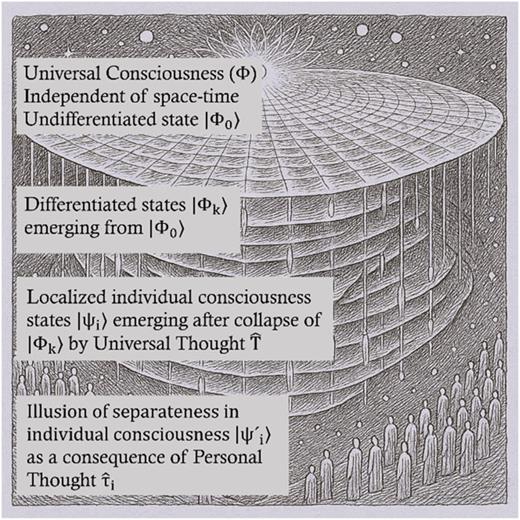
The Universal consciousness field exists beyond space-time in an undifferentiated state. Through differentiation, it gives rise to localized excitations, which manifest as physical structures or individual consciousness. Following the Big Bang, the universal consciousness field evolves, generating complex systems capable of awareness – sentient beings with individual consciousness localized in space-time. Once differentiated, personal thought shapes individual awareness and perception, producing evolving subjective interpretations of reality over time. This process creates the illusion of separateness, even though all individual consciousness remains intrinsically connected within the universal consciousness field.

Personal thought reinforces the sense of individuality while simultaneously concealing the underlying unity with universal consciousness. An important implication of modeling as a localized excitation of interconnected nature of the field is that dissolution of individuality (e.g., through death) does not imply annihilation but rather reintegration into the universal field. This aligns with perspectives that treat consciousness as a temporary manifestation of a universal substrate.

Maria Stromme, Professor Uppsala University: Consciousness as the foundation – new theory

Everything belongs to an infinite Whole

18 Jan

I became aware that we’re all connected. This was not only every person and living creature, but the interwoven unification felt as though it were expanding outward to include everything in the universe- every human, animal, plant, insect, mountain, sea, inanimate object, and the cosmos. I realized that the entire universe is alive and infused with consciousness, encompassing all of life and nature. Everything belongs to an infinite Whole. I was intricately, inseparably immersed with all of life. We’re all facets of that unity- we’re all One, and each of us has an effect on the collective Whole.  

Anita Moorjani

Dying to Become Me, 2012 Hay House, LLC

The Fabric of Life

18 Jan

Until we go beyond the superficiality of basic sense perception and investigate and see the complex tapestry of existence, we stay in the IT realm as Martin Buber explained in his book, I and Thou. Once we see the strands of our life within the unique fabric of existence with the magnificent, interconnected unity and complexity of life and living things, we are finally able to empathize with the essence of All and enter a Thou relationship. Then our relationship with the world, with all living beings, changes fundamentally to seeing the empathetic symbiosis of ourselves with all other living life forms. It is at that point that existential care, affinity, compassion and friendliness appear and are expressed in our interactions and relationships with all the others. Rodger R Ricketts

Irreducible

8 Jan

Union Is in the Heart

Follow the advice of your heart, because no one will be more faithful to you than him. —Book of Sirach, 37.13

 I think that the positive forces that will create our future will not be the forces and the laws of matter, but those of conscious cooperation, comprehension, and love for others that all beings in existence must sooner or later manifest because these values are the essence of our deepest nature.

I also think that the most effective way to achieve union is through a process of collective and cooperative creation of a just, empathic, and loving society through right and courageous actions informed by the heart and by the intuitive and rational mind. Then our experience and knowing will grow in our hearts and they will guide our individual actions through an ever-higher level of consciousness.

Unfortunately, today there is the real danger of letting ourselves be seduced by the spreading culture of digital ontology and digital consumerism that replaces true and profound relationships with virtual and superficial ones, thus halting, if not reversing, our spiritual development.

Social networks designed to bombard people with suggestive messages, often personalized to reinforce personal biases or based on false information or on presumed conspiratorial theories, generate groups that can become alienated from reality in self-isolating worlds. Nikola Tesla said that “progress must serve to improve the human race; if not, it is only a perversion.”

Technology must be used to help us discover our true nature, not to further imprison us in meaningless virtual worlds designed to enrich the richest. We have come to the point where we can truly unite as humans no matter where we were born, or stay divided in warring factions with ever increasing destructive technology on our side. Only when we truly comprehend that we are responsible for our experiences and that the choice is ours alone, can we begin to truly know ourselves and the world.

To know ourselves more and more, we need a new empathic science that can convert scientific knowledge into deep lived knowing and from it generate new scientific knowledge. Similarly, we need a new rational spirituality that can convert lived knowing into new scientific knowledge and from it generate new lived knowing. These two disciplines can then intertwine in endless and mutual crescendo.

This is the essence of the Creative Principle of One. Within this vision, empathic science and rational spirituality, integrating and interweaving, will evermore increase our loving, joyful, and fulfilling union with the Whole.

Federico Faggin

The cosmic roots of human nature and our culturally conditioned self‑image

8 Jan

Conclusions: regaining our healthy, complete and harmonious self
Part of human nature is given by Nature; another part comes from society. The
ground of our personality is given by Nature, the construction built upon it is given
by culture. The basic directivity of human nature is towards uplifting life in the
comprehensive and profound context of the Living Universe. Our genuine human
abilities can develop and flourish only in a society establishing their favourable conditions. Our full human potential can be nurtured only in a culture which is in harmony to the cosmic roots of our ontological Self.
In order to live fully with the cosmic roots of our Selves and live the life we are
born into, we need to mobilize all our energies and abilities at all times. Recognising
the cosmic roots of our Self, and appreciating the comprehensive, ontologically
complete and healthy worldview it is possible to win over alienation and regain our
healthy, complete and harmonious Self. We can regain our genuine human nature
implanted into us by the Living Universe.

Attila Grandpierre

Image

Medium of the Divine

7 Jan

Perceptual Relativity and the Observer Dependent Universe

6 Jan

Reality appears to consist of a vast number, possibly an infinite number, of sensory worlds.
Each person has their own individual world. This is the world they perceive which is always different
from the world perceived by others. Variations exist from person to person due to each person
occupying different points in time and space and due to the quality of the individual person’s sense
organs. Each species has its own world due to the tendency for members of each species to have the
same sense organs which will tend to function in a similar way within each member of the species.
There seems to be no good reason for favoring any one of these sensory worlds over any other of
them. It seems impossible to claim that the human view of the world has any special claim to validity
when an alteration of our senses will give us different sense perceptions. How can you say what you
perceive is, when the same thing can be perceived with different sense organs and it can be something
quite different? If the human view was to be preferred it would be no more than a case of a human
centric view of the world that is not capable of any real justification.

Rochelle Forrester